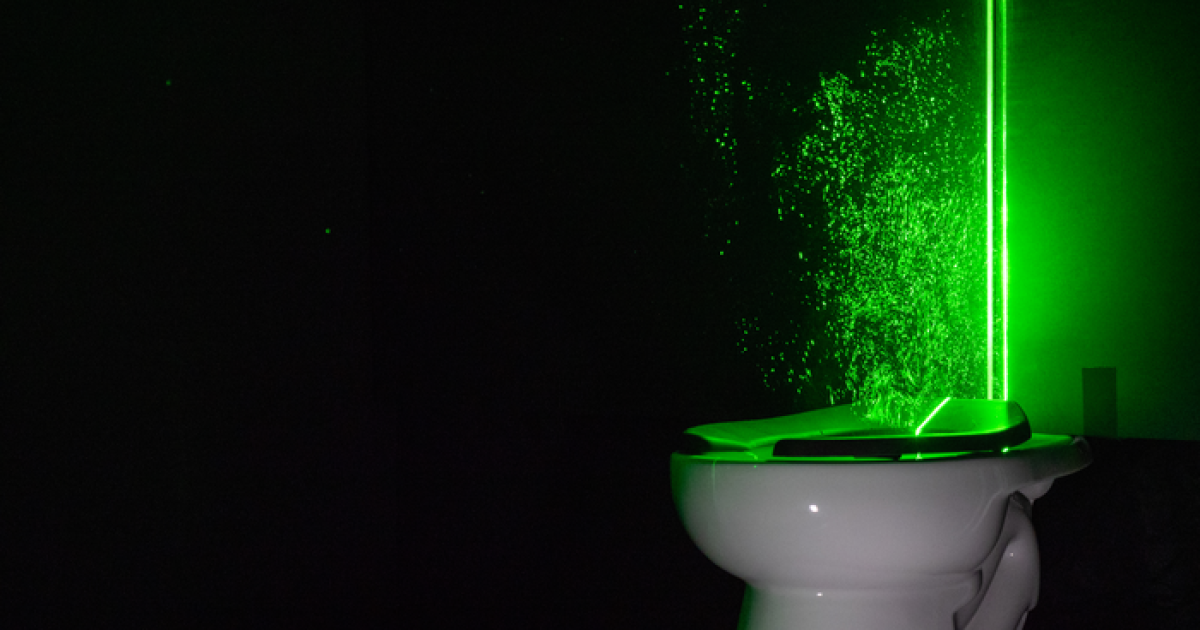
Engineers at the University of Colorado Boulder have confirmed what the germ-phobic among us have long suspected: The flush of a commercial toilet releases a Vesuvius-like cloud of tiny droplets and aerosol particles that reaches more than 5 feet above the seat.
Though invisible to the naked eye, when illuminated by green lasers, the plume appears like a burst of microscopic confetti thrown at the world’s grossest party, one composed of tiny drops of water and whatever else might be in the bowl.
The research, published this month in the journal Scientific Reports, was strictly an exploration in fluid mechanics. The team flushed toilets containing only clean water, and did not investigate the infectiousness of any particles that might be in the plume.
But their tools confirmed that each flush reaches much farther beyond the bowl than most of us would like to believe.
“We all were astonished,” said John Crimaldi, the study’s lead author. “I said, ‘Oh, my God — that’s what happens?”
Crimaldi is a professor of hydrology who specializes in fluid mechanics — specifically, how air and water transport other materials flowing along with it. He has looked at the ways ocean currents distribute sperm and eggs to fertilize corals, and how odor particles travel through the air to communicate information to animals.
He turned his attention to toilets at the urging of his Boulder colleague and co-author Karl Linden, an environmental engineer who studies the disinfectant properties of ultraviolet light.
While brainstorming the ideal test case for a UV-based surface disinfectant, Linden’s mind first had to go to some dirty places.
“Where do we get exposed to viruses, and where do we get exposed to pathogens?” Linden said. “And one of the thoughts I had was, ‘Well, what’s happening in toilets?’”
Linden was specifically picturing commercial toilets: the tankless, lidless workhorses found in public restroom stalls. Most public toilets in North America are outfitted with what’s known as a flushometer-style valve, which relies on pressure rather than gravity to force water through the bowl.
The result is a high-powered flush that leaves a fine cloud of water vapor in its wake — a smaller, less-cheerful version of the mist that rises above each log as it makes its final plunge down Disneyland’s Splash Mountain.
Previous studies have confirmed that the surfaces around public toilets are often hotbeds of fecal bacteria. UV light could be an effective disinfectant, Linden thought — but first, he needed a better understanding of how microscopic pathogens move around the space.
He turned to Crimaldi, whose lab uses lasers to visualize fluid movements that would otherwise be imperceptible to the human eye. Crimaldi’s fluid mechanics lab has an annual summer tradition of taking a week to tackle a bite-sized scientific challenge, without funding or any pressure to publish. The toilet question was a perfect fit.
“We said, ‘Maybe nothing will come of it, or maybe we’ll get something really cool,’” Crimaldi said.
Researchers Aaron True, left, and John Crimaldi stand in the lab where they studied the aerosols emanating from a flushed toilet.
(Patrick Campbell / University of Colorado Boulder)
Rather than cart their equipment to the closest bathroom, the team installed a working toilet in the lab on top of a metal frame that could be aligned with their lasers. Then they calibrated the plumbing’s water pressure to match that of a typical commercial restroom.
They knew their laser would make some aerosols visible. They were not prepared for the minor explosion that greeted them on first flush.
“It’s like a volcano erupting,” Crimaldi said. “Some of us were stunned into silence. Some of us were just laughing out of disbelief, and also kind of like, ‘Oh, my God, we’re really on to something here.’”
The team then trained a pulsed laser and a pair of scientific cameras on the spray to measure the speed of its individual water particles. A toilet flush doesn’t have the velocity of a sneeze, which can send droplets spurting up to 100 miles per hour, or even a cough, whose droplets can travel up to 50 miles per hour.
Aerosols in the “surprisingly energetic and chaotic” plume reached a maximum velocity of 2 meters per second, or just under 4.5 miles per hour, the study authors reported. Yet once airborne, they took a while to settle back down. Nearly eight seconds after the flush, particles still hovered more than 5 feet above the rim of the bowl — well past nose level for most people. Many remained airborne for more than a minute.
“I certainly am much more inclined after seeing these videos to wear a mask in a public restroom than I might have been before,” Crimaldi said.
Though the experiments were conducted with toilets empty of all but clean water, Crimaldi strongly suspects that adding toilet paper and human waste to the mix only injects more chaos and energy into a flush.
“I have an intuitive sense that the presence of solids might exacerbate the problem because there’s just additional things for the water to impinge on and to create more opportunities for this energetic mixing of fluids,” he said.
Linden hopes to use this experiment as a starting point for future research that tracks the distance bacteria and other pathogens travel in these aerosol clouds, and how long they remain infectious. Depending on those findings, “we can start thinking about, well, what interventions can we use?” he said. “What are some redesigns of a toilet that we might want to consider?”
Advocates of alternatives to flush toilets said the study strengthens the argument for seeking better methods of human waste disposal.
“This new study adds some dramatic visual evidence for yet another disadvantage of traditional Western toilets and our strong desire to flush and forget,” said Bryn Nelson, a microbiologist and author of the book “Flush: The Remarkable Science of an Unlikely Treasure.” “Many composting toilets use a vacuum flush and little to no water, so this could be another reason to consider the merits of these environmentally-friendly models.”