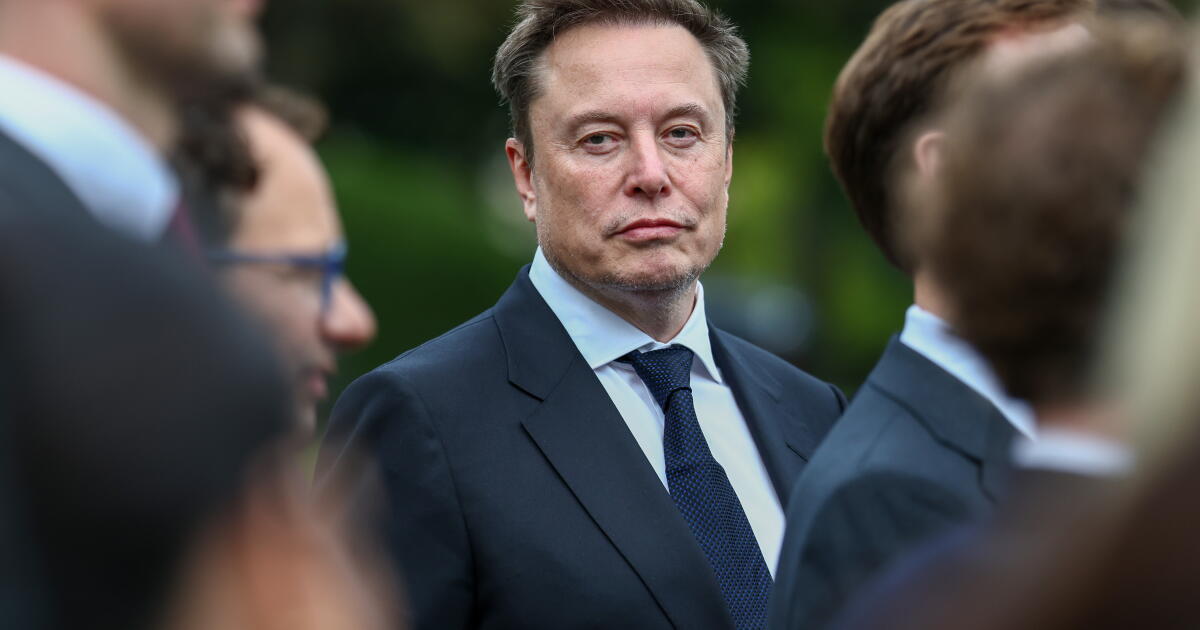
The historic landslide victory for Democrats in the midterm elections deeply bruised the Republican Party and President Trump, but there’s one man who may have been hurt equally as bad: Elon Musk, the world’s richest person and the party’s biggest donor.
The near trillionaire reportedly spent close to $450 million backing GOP candidates across the country and in Texas specifically — where his SpaceX and Tesla are headquartered and have large operations — but his massive donations failed spectacularly and may have backfired.
Now Musk and his businesses could face a challenging time ahead as Democrats are expected to rein in the unfettered growth of AI businesses and likely expose him and his companies in particular to more congressional and regulatory scrutiny.
“Top of the Democratic agenda on day 1 needs to be a pause on advanced AI development, regulation of this out of control industry, and a ban on artificial superintelligence,” Rep. Yassamin Ansari (D-Ariz.), wrote on X.
With Democrats taking control of House and Senate committees, Musk also faces the possibility of being called before Congress to answer questions about his controversial role leading DOGE, or the so-called Department of Government Efficiency.
Even Musk quipped on X about the results: “Guess my election-interfering space lasers didn’t work this time.”
A representative for Musk could not be reached for comment.
Joe Sandri, a technology executive and general counsel at the Environmental Health Trust, said that the party should be taken at its word.
“If the Democrats are to be believed, which I think they are, they’ve got years of questions unanswered on a whole bunch of things — and Musk is clearly one of the primary people they have questions about,” Sandri said.
Shares of SpaceX closed down 3.8% on Wednesday to $135.92, while Tesla fell 3.3% to $385.19. Both companies have market caps well above $1 trillion.
Musk has established a vast business empire that includes an industry-leading rocket business, the country’s largest electric vehicle maker, a commercial broadband satellite network, government contracts for space exploration and military communications, as well as smaller ventures.
SpaceX, which was founded in 2002 in El Segundo and moved its headquarters from Hawthorne to Texas in 2024, is a rocketry pioneer that has become the world’s dominant launch provider.
Tesla, which still operates its original factory in Fremont, Calif., assembled 1.65 million cars, as well as some trucks, in the U.S., China and Germany last year, employing more than 100,000 workers.
However, in recent years Musk has focused on massive investments in artificial intelligence, which he views as key driver of all his businesses. Early this year, in a $1.25-trillion deal, SpaceX acquired his artificial-intelligence company xAI, which had built two advanced data centers in Tennessee and Mississippi that Musk wants to expand.
The data center business, which includes renting out computing capacity to competitors that include Anthropic and Google, was the biggest revenue and profit driver for SpaceX in the third quarter, reaching $7.6 billion.
Musk wants to expand the data centers, and build a giant AI chip plant outside College Station, Texas, called Terafab, in a joint venture with Tesla. He has pinned the future of the electric car maker on autonomous driving and ride-hailing, which would be heavily dependent on AI.
“For the coming months and into 2027, he will be heavily impacted for sure,” said Mehdi Paryavi, the chairman of the Washington, D.C.-based think tank International Data Center Authority.
The mushrooming data center business in Texas prompted Republican Gov. Greg Abbott to pause construction, but even tougher regulations could be on the way after his loss to Democrat Gina Hinojosa. In her election victory speech Tuesday, she lambasted “powerful people who have gotten very comfortable running this state.”
Terafab is unlikely to face slowdown, given the geopolitical necessity to manufacture chips domestically, but the site’s planned adjacent data centers could face uncertainty because of permitting, said data center analyst Jeremie Eliahou Ontiveros at SemiAnalysis.
“Everyone loves big industrial projects in the U.S., and I think it’s hugely bipartisan that we need to have advanced semiconductor manufacturing on U.S. soils,” he said. “But … he’s gonna also build data centers on site and it’s unclear exactly how these will be treated.”
The second-largest business of SpaceX is communications, which includes its highly profitable Starlink broadband satellite network. The division also makes military-grade Starshield satellites, which were at issue last month when Ukrainian President Volodymyr Zelensky complained his country’s access to them had been slowed down.
There were mixed reports on whether the White House or Trump had conducted the slowdown, which was later restored, with some Democrats calling for an investigation into the matter. Sandri expects that Musk will be questioned as well on a series of government civilian and military communications contracts SpaceX has received.
“There’s no question that’ll be much more heavily scrutinized,” Sandri said.
SpaceX’s launch business, which brought in $1.8 billion in third-quarter revenue, dominates the industry. It accounts for the vast majority of satellites and other craft put into orbit largely by its Falcon 9 rocket, which is launched from Florida and Vandenberg Space Force Base in Santa Barbara County.
Musk plans to retire the rocket and replace it with Starship, currently under development in South Texas. It is the largest rocket ever constructed, and Musk sees it as key to launching hundreds of thousands of data centers into orbit. NASA also has contracted with the company to use the rocket on its missions ferrying astronauts to and landing them on the Moon.
Musk’s other big business, Tesla, even prior to the midterm election results, has been hit by slower sales, competition from China overseas and the loss of federal EV tax credits because of the Trump administration’s policy position that climate change is a hoax.
With gas prices rising due to the Iran war, Tesla’s vehicle deliveries increased slightly in the third quarter, but at a little over 486,000 was still down from 497,000 a year earlier.
Musk has downplayed the sales slump at Tesla, focusing on the company’s future as a maker of autonomous vehicles and taxis. But with Democrats in charge of both houses of Congress, there could be greater regulatory pushback because of safety concerns.
“We think the market fears Democrats will look to target Tesla,” said Morningstar analyst Seth Goldstein in a note Wednesday.
Musk disclosed last month that the boards of both Tesla and SpaceX were evaluating whether to pursue a merger of the two companies, which Musk said could make sense because of the companies’ shared AI ambitions.
However, such a tie-up would be the largest in history and would almost certainly raise antitrust concerns that Democrats would seize upon. Analysts said it would make sense to have any merger completed before Trump’s term is over.
“Certainly, right now the Justice Department wouldn’t do anything about it,” said Charles Anthony Smith, a political science and law professor at UC Irvine. “A future Justice Department with a different attorney general might very well say there are problems with this.”