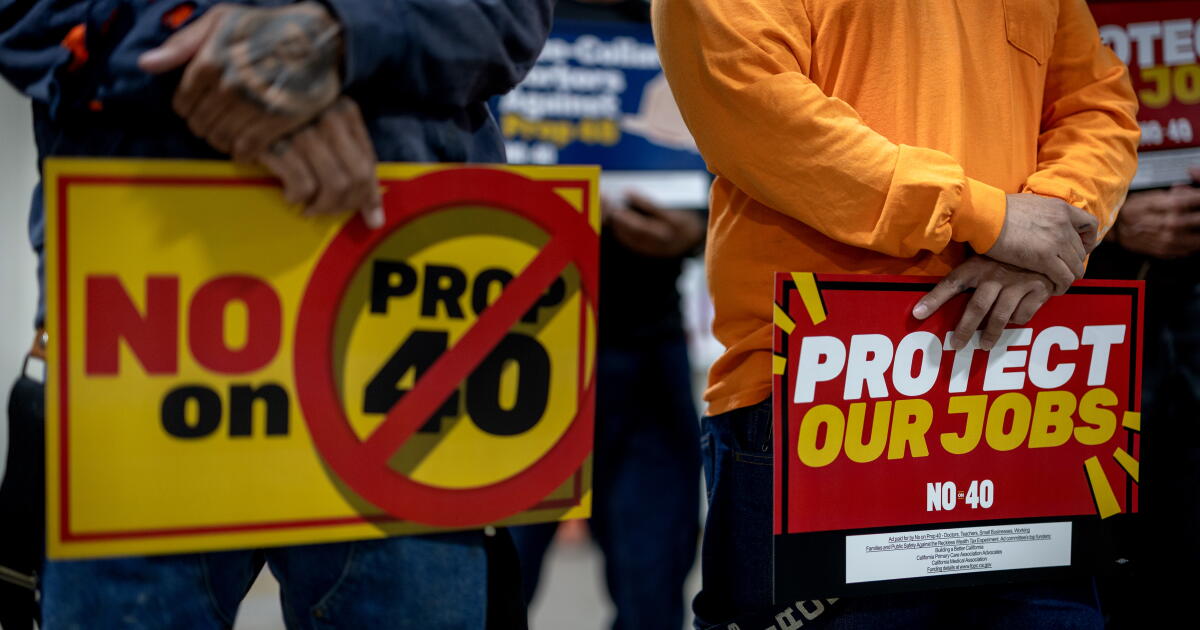
California voters have officially rejected the controversial billionaire tax.
Proposition 40 sought to impose a one-time 5% tax on California billionaires’ assets to try to offset federal healthcare funding cuts.
Despite the blue wave in the midterm elections, the novel tax on the ultra-wealthy had trailed from the first day of vote counting and was officially rejected on Monday. Roughly 53% of California voters voted against the measure while 47% voted for it, the Associated Press said as it declared that California voters had rejected the measure.
Although the tax was rejected in the vast majority of counties, the final tally showed major pockets of support in Los Angeles and San Francisco — home to the lion’s share of the state’s 200 billionaires. Orange County, however, voted no by a wide margin.
The political battle over the ballot measure and two competing proposals divided the state and was among the most expensive in California history. More than $400 million had been spent on the three intertwined ballot measures, with more than 90% spent opposing the billionaire tax, according to fundraising disclosures filed with the secretary of state’s office.
Billionaires, notably Google co-founder Sergey Brin, poured hundreds of millions of dollars into groups that funded ads to kill the billionaire tax. California Gov. Gavin Newsom, the California Teachers Assn. and Planned Parenthood Affiliates of California are among the powerful Democrats and other Democrat-aligned groups that expressed fears that billionaires would flee the state. Some, including Brin and fellow Google co-founder Larry Page, moved out of California because of the proposal.
An onslaught of advertisements against the billionaire tax argued it could impact all Californians, not just the ultra-wealthy. Teachers, firefighters and other middle-class Californians became the face of their campaigns, fueling growing opposition ahead of election day.
Opponents of Proposition 40 said Californians made the “right decision,” calling Proposition 40 a “reckless experiment” that would hurt the state’s economy. The group included the California Medical Assn., California Primary Care Assn. and the California School Boards Assn.
“Proposition 40 risked California’s economic competitiveness and fiscal stability, as well as the revenue we rely on to fund our top priorities — from education and healthcare to public safety and infrastructure,” the group said.
Leaders of the Service Employees International Union-United Healthcare Workers West, which sponsored the proposition, vowed to put a billionaire tax proposal on the 2028 ballot if Sacramento leaders don’t find a way to better support the public health sector. Given California’s volatile budget, which is expected to be particularly problematic next year, it appears unlikely that state lawmakers will find a way to backfill an estimated $100 billion of federal healthcare funding cuts.
Supporters said the proposed tax on more than 200 California billionaires aimed to raise that amount, with 90% funding healthcare, and the remainder going to schools and food assistance.
“Billionaire-funded propaganda may have influenced the outcome of this election, but as hospitals reduce services, emergency rooms close and families lose access to care, the truth will become increasingly difficult to hide,” said Suzanne Jimenez, chief of staff for the SEIU-UHW. “Californians will see for themselves what was at stake.”
This will not be the end of the debate about taxing the rich. U.S. Sen. Bernie Sanders (I-Vt.) and Rep. Ro Khanna (D-Fremont), who both backed Proposition 40, are pushing for the passage of a federal 5% tax on American billionaires.
Earlier this year, they introduced the “Make Billionaires Pay Their Fair Share Act.” Despite Democrats winning control of the House and Senate last week, the legislation will probably face constitutional challenges if it passes.