Architect John Lautner’s Sheats-Goldstein Residence in Beverly Crest is one of the most recognizable Midcentury Modern homes in Los Angeles. It appeared in “The Big Lebowski” and countless photo shoots and design magazines. GQ just hosted a party there. With a living room that opens up onto a sweeping view of the city, and a distinctive, angular roof, the house is so architecturally significant that it is part of the Los Angeles County Museum of Art.
Just a couple of miles away in Westwood, another building Lautner designed for the same original owners is an unofficial fraternity house that is not quite as glitzy. Steps from UCLA, it sits on fraternity row, and students, some from fraternities, have rented rooms there for decades.
During a recent visit, balconies contained a beer pong table, a surfboard and a Nu Alpha Kappa sign. There was a gaping hole in the driveway, covered haphazardly by planks of plywood. Photos in one online rental listing show a Red Bull-branded cocktail table and a Corona 12-pack.
“It’s been allowed to really deteriorate badly,” said Eleanor Schrader, an architectural historian who is on the board of directors of the John Lautner Foundation, which celebrated its 30th anniversary with events this month, and is an instructor at UCLA Extension. “I just wish there was more respect for it, but it’s a bunch of kids who are living on fraternity row, and they have no idea who John Lautner is.”
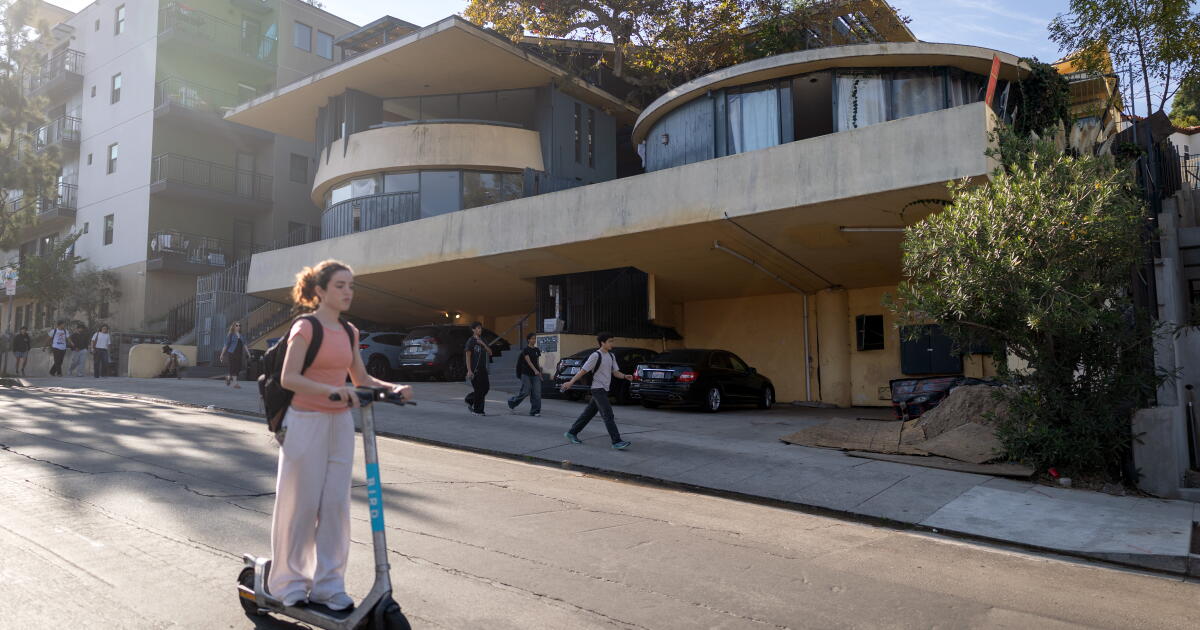
Colloquially known as the Treehouse, the unusual building stands apart on fraternity row.
(Eric Thayer/Los Angeles Times)
Fariba Ghaffari, who manages the property and whose family has owned it since around 1991, doesn’t dispute the condition of the building, known at various times as the Sheats Apartments, L’Horizon, the Treehouse or just Treehouse. “It is not in the best shape,” Ghaffari said. “Twice we’ve refurbished it. … I always say I wish I could pick up the building and move it somewhere else. Fraternity boys do not take care of the building.” Apartments there rent monthly for $3,500 for a two-bedroom to $6,900 for a six-bedroom, according to the online listing.
Lautner, a Frank Lloyd Wright protégé, designed the eight-unit building for Helen Taylor Sheats, an artist, and Paul Henry Sheats, a UCLA professor. Construction finished in 1949. (The more famous Sheats-Goldstein Residence was completed in 1963.) In a 1950 article, the Los Angeles Times described it as “one of the most unusual and beautiful luxury apartments in the country.” The city of L.A. designated it a historic-cultural monument in 1988. Paul died in 1984 and Helen died in 1999.
A 2002 article in the Daily Bruin, UCLA’s student newspaper, said, “In a word association test with the building, students would doubtfully say ‘architectural marvel,’ and would more likely come up with ‘party’ or ‘kegger.’” It even appeared as a stand-in for a sorority house in the 1990 Andrew Dice Clay raunchy comedy “The Adventures of Ford Fairlane.”
From the street, the building appears to have two cylindrical forms with windows wrapping around, sitting on top of a flat base, with a carport underneath. Additional units are farther back into the hillside, and there is a central courtyard with trees and a small waterfall. The Los Angeles Conservancy describes the building as forming a “strangely harmonious, abstractly futuristic and truly organic-feeling whole.”
“It’s just an unusual form,” said real estate agent Brian Linder of the Value of Architecture, who in December 2025 sold Lautner’s Salkin House in Echo Park to eyewear designer Jérôme Mage. “It’s got these mushroom columns and every apartment is unique,” Linder said. “You see Lautner’s creativity.”

Some students are offering photography and video services to those who throw events at the apartments, like this one, under the moniker La Horizon, a nod to one of the building’s many names.
(Jan Masler)
Leaning into its party reputation
Nicolas Distasi, who graduated from UCLA this spring and lived at the Sheats Apartments his senior year, recalled that people would knock on his door and ask to throw parties there. Distasi, a graphic designer who said he and his roommates were rare non-fraternity residents, chose the property and its “duality” as the topic of his senior thesis. On one hand it is the Sheats Apartments, a monument with architectural significance. On the other hand, it is the Treehouse, a prime party location. “It’s such a uniquely constructed place, and you can feel how much potential it has, but it’s just been sent into this state of disarray and just disrepair,” he said.
Looking into the building’s history and interviewing past residents, Distasi said he realized how special of an experience living there was. “Lautner’s other homes and the Case Study homes in Los Angeles in general, they’re not accessible to normal people, in a sense,” he said. “What I think is special about this one is that it was just dropped into the hands of the students.”
Current residents who are living among the fraternity students have found a new way to embrace the party culture. Under the banner La Horizon, inspired by one of the names for the property, creatives living in Distasi’s former top-floor unit this semester have started offering photography, videography and other media services for people who throw events there. UCLA clubs “come to us and they want to host all kinds of different events,” resident Jack Young said. “We just figure out all the logistics, and we might have our friend DJ for the event.” That DJ is often Ryan Coronado, a UCLA senior who also lives in that unit.
So far, they haven’t heard many complaints from management. “For the most part, we respect the crib, we clean up, we hire a cleaning service and make sure that everything is completely taken care of,” said Jan Masler, another UCLA senior in the top-floor unit. “We do have a lot of love for our apartment.” Young added, “We try to give it the glory that it deserves.”
Blythe Mayne, whose husband is Pritzker Prize-winning architect Thom Mayne, lived there as a UCLA freshman in 1973. She described it as a perfect place to live but said even back then there may have been fraternity antics.
She recalled hearing from the property manager at the time, Tuck Taylor, the son of Helen Sheats, that his mother once leased the building to a fraternity and discovered the tenants were hacking out pieces of wood from the basement to burn in their fireplaces.
She lucked out on getting her apartment after another tenant was evicted. “I walked by the building and I looked at it and it had this waterfall coming down and trees, and it was gorgeous,” she said. She knocked on Taylor’s door and said, “I need to live here.”
Her unit was circular, with a fireplace in the middle. Half of the circle consisted of a wedge-shaped kitchen, two wedge-shaped bedrooms and a bathroom. The other half was the combined living room and dining room, with a balcony, and there were windows everywhere. “Immediately, I was like, this guy was a genius, whoever this guy was,” Mayne said about Lautner.

A drone view of the Sheats Apartments.
(Eric Thayer/Los Angeles Times)
Who would buy it?
Not all past Sheats Apartments tenants have appreciated the architectural significance of the building, but Ghaffari, the property manager whose family owns it, does. She said she knew of the building as a master’s student in architecture at UCLA, and that when it came up for sale, she told her family to buy it. When the sale went through, they held a big party with lots of architects in attendance, though not Lautner, who died a few years later, she said.
Not only do fraternity brothers not make great tenants, but also maintaining an old building is expensive, Ghaffari said. Since 2015, the city of L.A. has required retrofitting certain older wood-frame buildings for earthquake protection, and Ghaffari said doing this cost her family nearly $300,000.
After the retrofit, the building’s exterior walls and floors cracked due to construction of a new building next door, Ghaffari’s family has alleged in court. “There are millions of dollars, from what I understand our experts have said, that it would take to refurbish it, to fix what has happened,” Ghaffari said. A February 2025 complaint against the property was filed with the city for “buildings in need of general repair,” but the city found no violation, according to a public database.
Other Lautner properties show rehabilitation is possible. The Salkin House, which is a year older than the Sheats Apartments, went through a restoration a couple of years ago that the New York Times described as “a major undertaking” that lasted more than two years. After the former Desert Hot Springs Motel in Coachella Valley, built around the same time as the Sheats Apartments, fell into disrepair, two designers bought it in 2008 and transformed it into the boutique Hotel Lautner, with four chic units starting at $450 per night.
Those who love the Sheats Apartments wonder if a collector would take on the building. But Mayne, the former tenant, said the location might deter a high-brow collector. “It couldn’t be a worse environment for living in, if you’re anything other than a student,” she said.
Ghaffari has an idea. Perhaps her family can work with UCLA to rent it exclusively to architecture students. “Non-students wouldn’t rent that close … to fraternity row,” she said. “But if the entire building after it’s fixed is occupied by architecture students? … It’s something that I should have thought of before.” A spokesperson for UCLA’s architecture department declined to comment on the idea.
A version of this story originally appeared on Max Kutner’s Zephyr Letter Substack.