As Russian bombs and cruise missiles rocked cities across Ukraine early Thursday morning, another front in the long-simmering conflict was erupting. The internet quickly became a battlefield in its own right, with propaganda and disinformation threatening to muddy the water for Americans following the crisis from afar.
Digital disinformation has long been a favorite tactic of the Kremlin’s — as Americans learned via the proliferation of “fake news” during the 2016 presidential election — and the Ukraine crisis is proving to be no exception. Over the last few days, researchers have warned that President Vladimir Putin’s regime is pushing, and will continue to push, false narratives aimed at justifying its aggression.
At least some of those narratives are finding purchase among an American public divided by previous waves of disinformation, said Graham Brookie, senior director of the Atlantic Council’s Digital Forensic Research Lab. “What we see … is not an insignificant amount of organic audience engagement from U.S. citizens that are predisposed to have their previously held beliefs reinforced by Russian disinformation.”
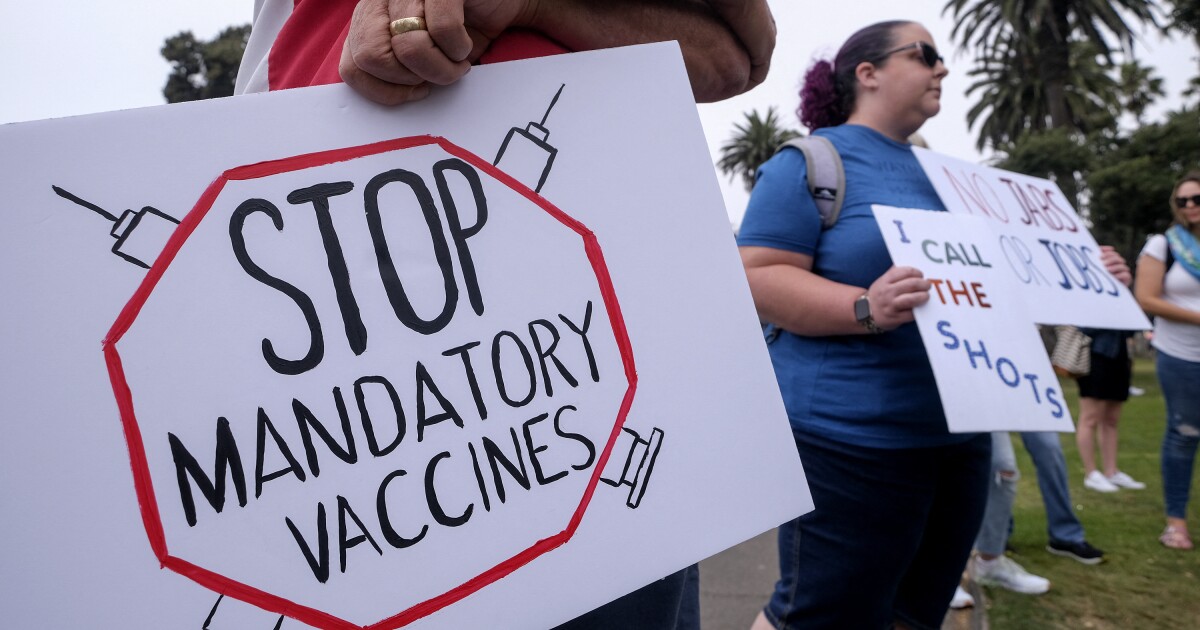
For instance, he said, anti-vaccine groups that are already skeptical of the U.S. government are now primed to disbelieve the official U.S. government narrative around Ukraine.
Russian “influence operations” relying on disinformation “exist at a steady state,” and have for years, added Brookie, but the ramp-up to war in Ukraine has brought “a massive surge.”
Jennifer Granston, head of insights at the social media analytics firm Zignal Labs, said the conspiracy theory that the Ukraine conflict is a government-manufactured distraction from supposed harms of COVID-19 vaccines is one of the disinformation narratives her company has monitored in recent days, along with the claim, embraced by a Russian state media outlet, that the invasion is a mere “peacekeeping mission.”
Reaction to Russia-backed propaganda has been mixed. Even among far-right groups that have in the past been sympathetic toward Putin — a strongman leader whom former U.S. President Trump often praised — the complexities of the present moment have left some split in their loyalties.
“The online far-right space is rather confusing right now,” said Heidi Beirich, co-founder of the Global Project Against Hate and Extremism. “Some commenters on fringe sites are securely pro-Putin, and are attacking NATO and the idea that any intervention should happen in Ukraine. I’ve even seen posts asking that Putin invade the U.S. and spare us from Biden.”
“But the conversation is pretty complex and wide ranging,” she added via email. “There are also posts on Telegram supported by American white supremacists trying to recruit for the Azov Battalion” — a neo-Nazi unit in the Ukrainian military.
Daniel J. Jones, president of the nonprofit research group Advance Democracy, noted a similar dynamic. Historically, he said, American fringe groups have helped spread Russian misinformation, and Russia has amplified “homegrown” American misinformation in turn.
But that interplay has been upended by the current Ukraine crisis. “Most of the U.S. right-wing groups and platforms we monitor are claiming that the invasion would never have happened under former President Trump,” Jones said over text message; some such groups even claim the crisis was manufactured by Biden “to distract from his ‘corruption’ and poll numbers.”
Regardless of how the conflict is received by Americans, Putin’s first priority is controlling information within his own country, said Brookie, the director of the digital forensics lab. He called Putin’s recent speech about Ukraine a “tour de force of historical revisionism … focused on shoring up support, or at least making a show of shoring up support, to the Russian people.”
To disseminate his preferred narratives across the social internet, Putin relies heavily on content produced by state-affiliated media outlets RT and Sputnik. In 2017 testimony before the Senate Intelligence Committee, Clint Watts, a senior fellow at the Foreign Policy Research Institute, said false news stories and conspiracy theories originally reported by RT and Sputnik were frequently amplified by sites such as Breitbart and InfoWars, filtering from there into the broader conservative media ecosystem.
RT was all-in on Ukraine coverage Thursday. “War in Ukraine started 8 years ago, Russia is now ending it, Moscow claims,” read one headline. On Facebook, where it has more than 7 million followers, the outlet posted a 26-second video with the caption, “Putin on military operation: ‘What is happening is a necessary measure, we were left no other option.’”
On Friday, Nick Clegg — vice president for global affairs at Meta, the company formerly known as Facebook — reported that Russian authorities had ordered the company to stop fact-checking posts made by four state-owned Russian media organizations, but that the company had refused to comply.
“As a result, they have announced they will be restricting the use of our services,” Clegg wrote in a tweeted statement. Meta owns the Facebook platform as well as Instagram, WhatsApp and the Facebook Messenger app, among other subsidiaries. The company did not immediately respond to a request for comment as to which four Russian media outlets were involved in the decision.
While RT may look like a slick broadcast channel, it’s closer in spirit to the Soviet-era newspaper Pravda, some observers said. Facebook, Twitter and YouTube all label it as state-controlled media.
“It is definitely the mouthpiece of the Russian government,” said Kathryn Stoner, a Stanford University political science professor and author of “Russia Resurrected: Its Power and Purpose in a New Global Order.”
This week the National Broadcasting Council in Poland adopted a resolution to remove Russian channels, including RT, from its register. A United Kingdom official also expressed concern that RT would spread “harmful disinformation” about the Ukraine crisis, according to Reuters.
The outlet did not respond to a request for comment from The Times.
“We’re in a moment of new media disruption, where the world is getting used to social media channels and this has been very much exploited by Kremlin media working to confuse the situation,” said Nicholas Cull, a professor of public diplomacy at USC, during a Thursday panel discussion on the information war in Ukraine. “I am struck by how unready the U.S. government is for an information war with the Russians.”