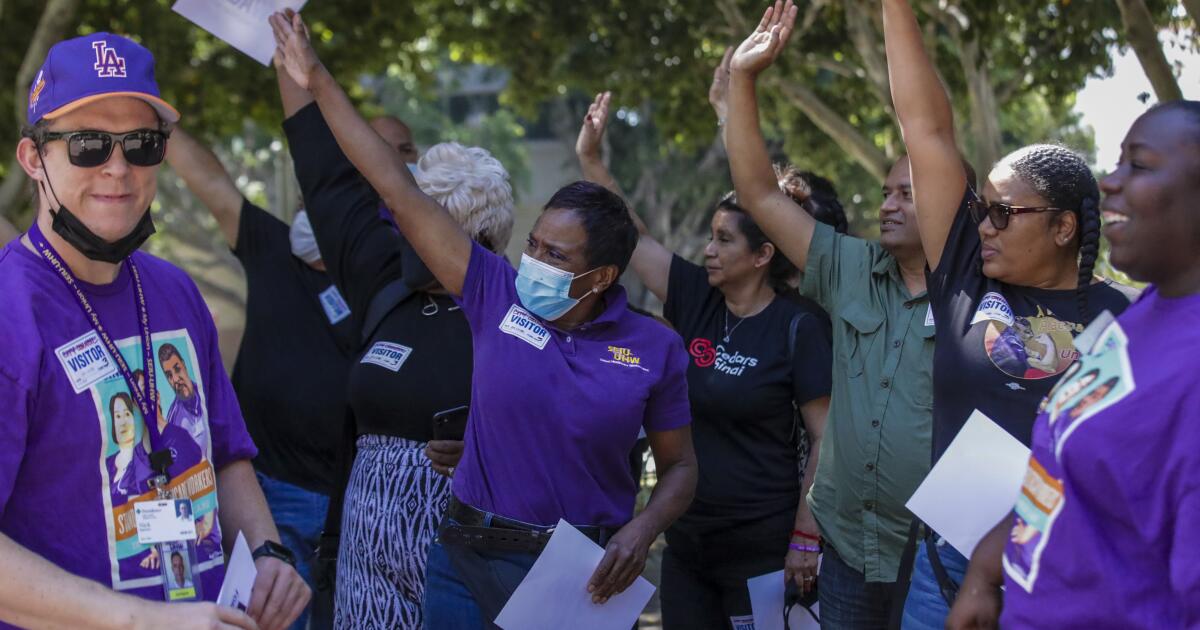
Many California healthcare workers — from nursing assistants and medical coders to cleaners and security guards — will see at least $25 an hour starting in 2026 after Gov. Gavin Newsom signed a bill on Friday that mandates an industry minimum wage statewide.
The first-in-the-nation legislation was backed by unions who said more pay is necessary to stem the state’s healthcare worker shortage and improve patient care, pointing to burnout exacerbated by the COVID-19 pandemic.
“Today California is putting a stop to the hemorrhaging of our care workforce by ensuring healthcare workers can do the work they love and pay their bills — a huge win for workers and patients seeking care,” Tia Orr, executive director of SEIU California, said in a written statement, commending “the courage and commitment” of healthcare workers during the pandemic.
Under the new law, workers at large healthcare facilities will earn $23 an hour starting next year, $24 an hour in 2025 and $25 in 2026. That applies to all staff, including launderers and hospital gift shop workers.
Employees at independent rural hospitals and facilities that serve high rates of Medicare and Medi-Cal patients, however, will see $18 an hour next year and won’t reach $25 an hour until 2033.
Other smaller workplaces, including urgent care clinics and skilled nursing facilities, are required to pay employees $21 an hour next year, reaching $25 an hour in 2028.
Newsom, whose decisions on labor laws are under scrutiny amid statewide worker strikes, contemplated signing the bill for weeks, adding his signature just one day before the deadline to approve legislation sent to him by lawmakers last month.
The law was signed after thousands of Kaiser Permanente workers walked off the job last week in one of the biggest strikes by healthcare workers in U.S. history. They reached a tentative contract agreement on Friday.
Newsom also recently approved a wage hike for fast-food workers at large chains to $20 an hour. California’s standard minimum wage is $15.50 an hour.
But the liberal governor — who also approved more paid sick time off for all workers — has been criticized by other recent vetoes of labor rights legislation, including a bill that would have given striking workers unemployment benefits and a bill to grant domestic workers OSHA protections.
The healthcare minimum wage legislation by longtime labor advocate state Sen. Maria Elena Durazo (D-Los Angeles) was the result of a hard-fought deal between lawmakers, unions, and lobbyists representing hospital administrators, nurses and dialysis clinics.
The bill struggled during the legislative session as even union-friendly Democrats worried that rural community hospitals already facing bankruptcy would collapse under mass wage increases or pass costs on to patients.
Negotiations made to quell those concerns and garner more support for the bill significantly staggered the rollout of the minimum wage. Last-minute amendments to the bill block cities and counties from raising wages locally for the next decade, prohibit attempts to cap hospital executive pay, and pause costly recurring ballot measures regarding the operation of kidney dialysis clinics.
Groups such as the California Chamber of Commerce and the California Hospital Assn. removed their opposition to the bill after amendments made during the last week of the legislative session.
Early estimates of the costs of the legislation projected billions for healthcare companies and at least $973 million annually for the state. But that was before the legislation was narrowed down to include a years-long phase-in plan.
The total fiscal impact on the state — which is facing a billion-dollar budget deficit — is yet to be confirmed but expected to be significantly less because of the amendments to the bill.
:quality(70)/cloudfront-us-east-1.images.arcpublishing.com/tronc/JPHRV27GABDSFKXQTOKVYNGKFM.jpg)