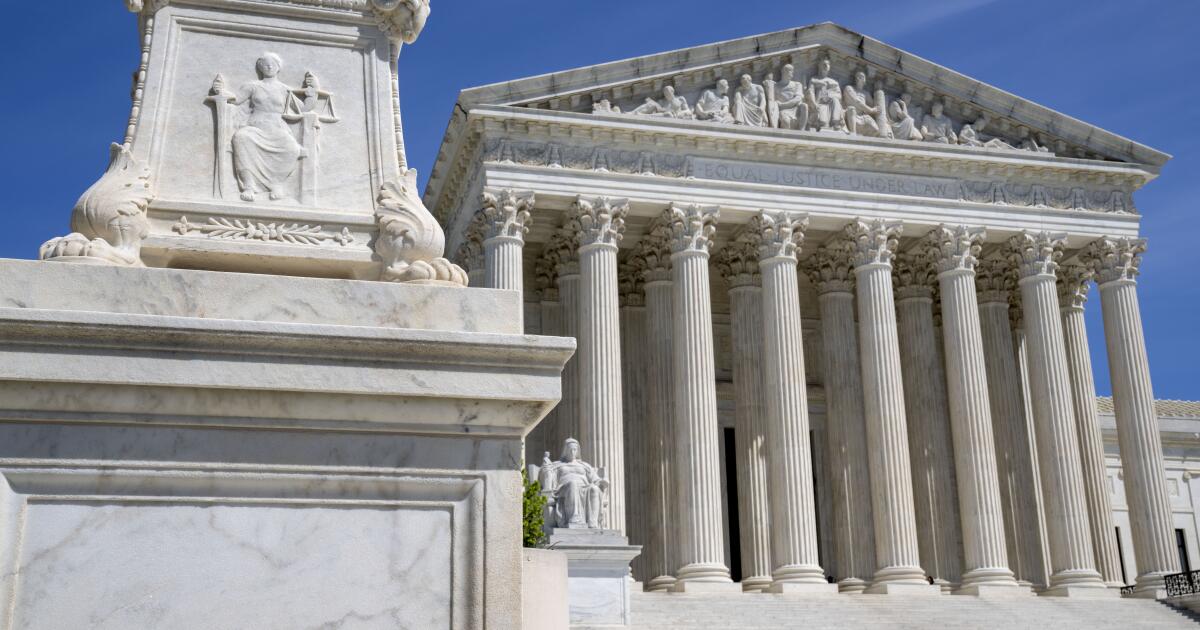
The Supreme Court will consider Monday whether Florida and Texas can regulate social media to protect “conservative speech,” or instead whether Facebook, You Tube, TikTok and others have a free-speech right to decide what appears on their sites.
This 1st Amendment clash also features a dispute over how to characterize these popular and profitable sites. Are they private companies like a newspaper or a book store with full free-speech rights to decide what material to include or exclude?
Or as Justice Clarence Thomas has insisted, are these online platforms more properly described as “common carriers” like a telephone company with a legal duty to carry all speech and discriminate against none based on the message?
The outcome will be closely watched in the blue states as well as the red ones.
Last year, the California Legislature adopted a measure to prohibit online companies from collecting and selling data on children and teenagers, but it was blocked on 1st Amendment grounds by a federal judge in San Jose. The state’s appeal is now before the 9th Circuit Court.
The Biden administration is also facing suits from several Republican states for allegedly pressuring social media sites to remove “disinformation” on the dangers of COVID-19 vaccines. The Supreme Court will hear that case next month.
The Florida and Texas laws under review at the Supreme Court arose from the complaints that former President Trump was being discriminated against or blocked by social media sites, including Twitter.
In 2021, Florida Gov. Ron DeSantis signed into law his state’s first-in-the-nation law and said it targeted the “Big Tech censors” who “discriminate in favor of the dominant Silicon Valley ideology.”
The measure, adopted before billionaire Elon Musk purchased Twitter and changed its name to X, applies to social media sites with more than $100 million in annual revenue or more than 100 million users.
It authorizes suits for damages for “unfair censorship” and large fines if a social media site “deplatforms” a candidate for office, as happened for a time to Trump after he continued to spread false claims about the 2020 election.
Texas Gov. Greg Abbott said “conservative speech” was threatened when he signed a somewhat broader bill a few months later. It says a social media platform with more than 50 million users in the United States “may not censor … or otherwise discriminate against expression” of users based on their viewpoint.
NetChoice and the Computer & Communications Industry Assn. sued to challenge both laws on free-speech grounds, and both were put on hold, including by a 5-4 order from the Supreme Court.
The two federal appeals courts in the South, speaking through Trump appointees, took opposite stands on the free-speech issue.
Judge Kevin Newsom, speaking for the 11th Circuit Court in Atlanta, blocked most of Florida’s law from taking effect on the grounds it was unconstitutional.
The 1st Amendment “constrains government actors and protects private actors,” he said. Social media sites are private companies, and “put simply, with minor exceptions, the government can’t tell a private person or entity what to say or how to say it.”
Judge Andrew Oldham, speaking for the 5th Circuit Court in New Orleans, upheld the Texas law on the grounds the state sought to protect the free speech rights of Texans.
A former counsel to Abbott and a law clerk to Justice Samuel A. Alito Jr., Oldham said it is a “rather odd inversion of the 1st Amendment” to say the social media platforms have a “right to muzzle speech. … We reject the idea that corporations have a freewheeling 1st Amendment right to censor what people say.”
Both state measures also require social media sites to disclose how they decide on removing information or users. That part of the Florida law was not blocked by the lower courts.