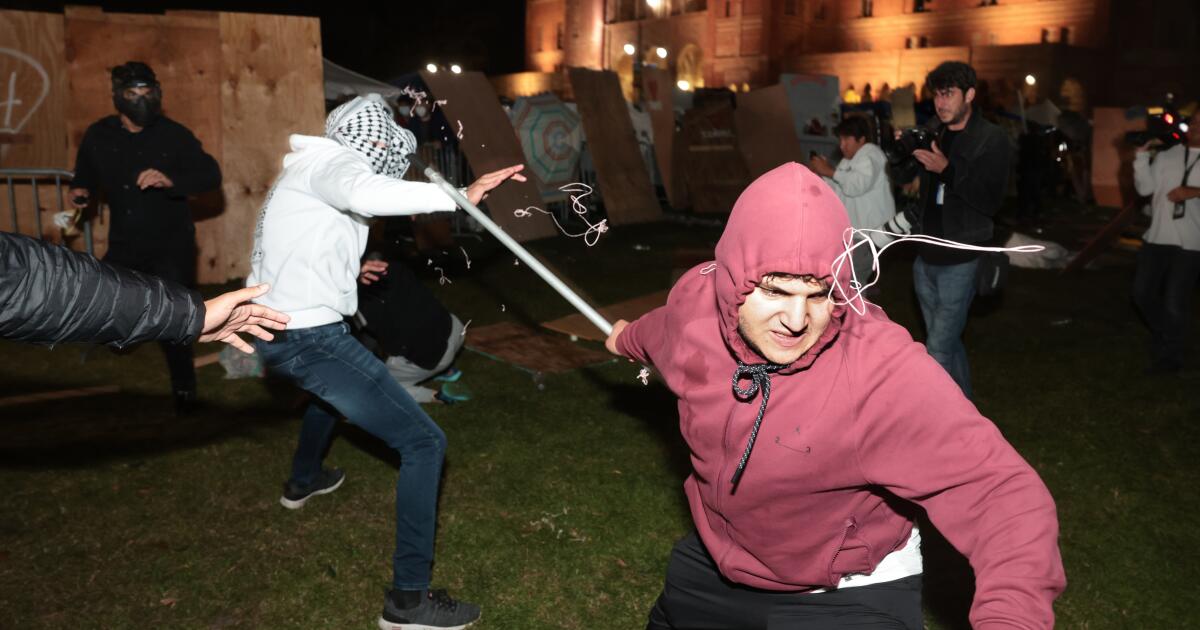
It is shaping up to be perhaps the biggest case in the history of the UCLA Police Department: how to identify dozens of people who attacked a pro-Palestinian camp at the center of campus last week.
The mob violence was captured on live television, but it took three hours for police to bring it to an end. Those involved left, and no arrests were made.
But the trail is not cold.
UCLA detectives are now scanning hundreds of images in an attempt to identify the attackers. They intend to use technology that captures facial images and compares them to other photos on the internet and social media to put names to faces, according to law enforcement sources.
The same technology has allowed police to identify suspects in smash-and-grab retail burglaries. It also was the heart of the Jan. 6 investigation, in which videos of those storming the U.S. Capitol helped the FBI identify many of the assailants and led federal prosecutors to charge more than 1,300 people. In those cases, investigators often were able to find social media images of the assailant wearing the same clothing as during the attack.
“Technology has made the entire community into the eyes of law enforcement,” said retired Los Angeles police Capt. Paul Vernon, who led an effort after a mini-riot following the Lakers’ NBA championship victory in 2010 that resulted in dozens of arrests based on videos, social media posts and security footage. “Photo recognition has gotten a lot easier.”
Vernon said an investigator also could gather cellphone data from the immediate area to prove an individual was there at the time of the incident. In some cases, assailants may have posted to their social media accounts, essentially bragging about their actions. Officers wearing body cameras may have also captured some of the behavior, he said.
The attackers likely came in vehicles, so UCLA police will be examining data from license plate readers for movements near campus on May 1. Security cameras on streets neighboring the campus where they likely parked could yield more clues.
Along with continuing protests, finding those who attacked the camp will be a major challenge for newly installed UCLA Associate Vice Chancellor Rick Braziel, a former Sacramento police chief. Braziel will be tasked with bringing to justice those responsible for what Chancellor Gene Block called a “dark chapter in our campus history.”
On Monday night, Block outlined actions the school is taking in the aftermath of last week’s violence. University police will work with the Los Angeles Police Department and the Los Angeles County district attorney’s office to identify and prosecute the assailants “to the fullest extent of the law,” he said. The university “also connected with the FBI about possible assistance,” Block said in a statement.
Despite the technology, the probe faces hurdles. Some of the attackers wore masks, making it harder to identify them. In those instances, detectives will look for a moment before or after the attack when the perpetrators’ faces were revealed, an official who was not authorized to discuss the investigation told The Times.
There is also deep anger among some protesters in the camp because it took so long for police to stop the attack. That distrust could take a toll. Many of the students who were injured, some of whom were hospitalized with their wounds, have gone to groups such as the Council on American-Islamic Relations for Southern California but haven’t spoken with campus police.
UCLA is a small police department, so it is reaching out to other agencies and private entities to access the technology needed in the investigation, law enforcement sources said. But so far, UCLA hasn’t made a public appeal seeking information on specific suspects.
In the wake of the Jan. 6 attack, the FBI made arrests based on information from relatives, work colleagues, teammates, former friends and ex-significant others after the FBI released photos of suspects. An army of web sleuths and politically knowledgeable social media watchers known as “sedition hunters” also dedicated themselves to identifying the mob and turning their names over to the FBI.
Images from the UCLA attack are springing up on Instagram. In one case, a man can be seen using a plank to hit a pro-Palestinian protester and then punching and kicking others. Dressed in a black sweatshirt, white sweatpants and a black cap, his bearded face is not hidden. Police can use that image to track him down or ask for help identifying him.
“Holding the instigators of this attack accountable and enhancing our campus safety operations are both critical,” Block said. “Our community members can only learn, work and thrive in an environment where they feel secure.”