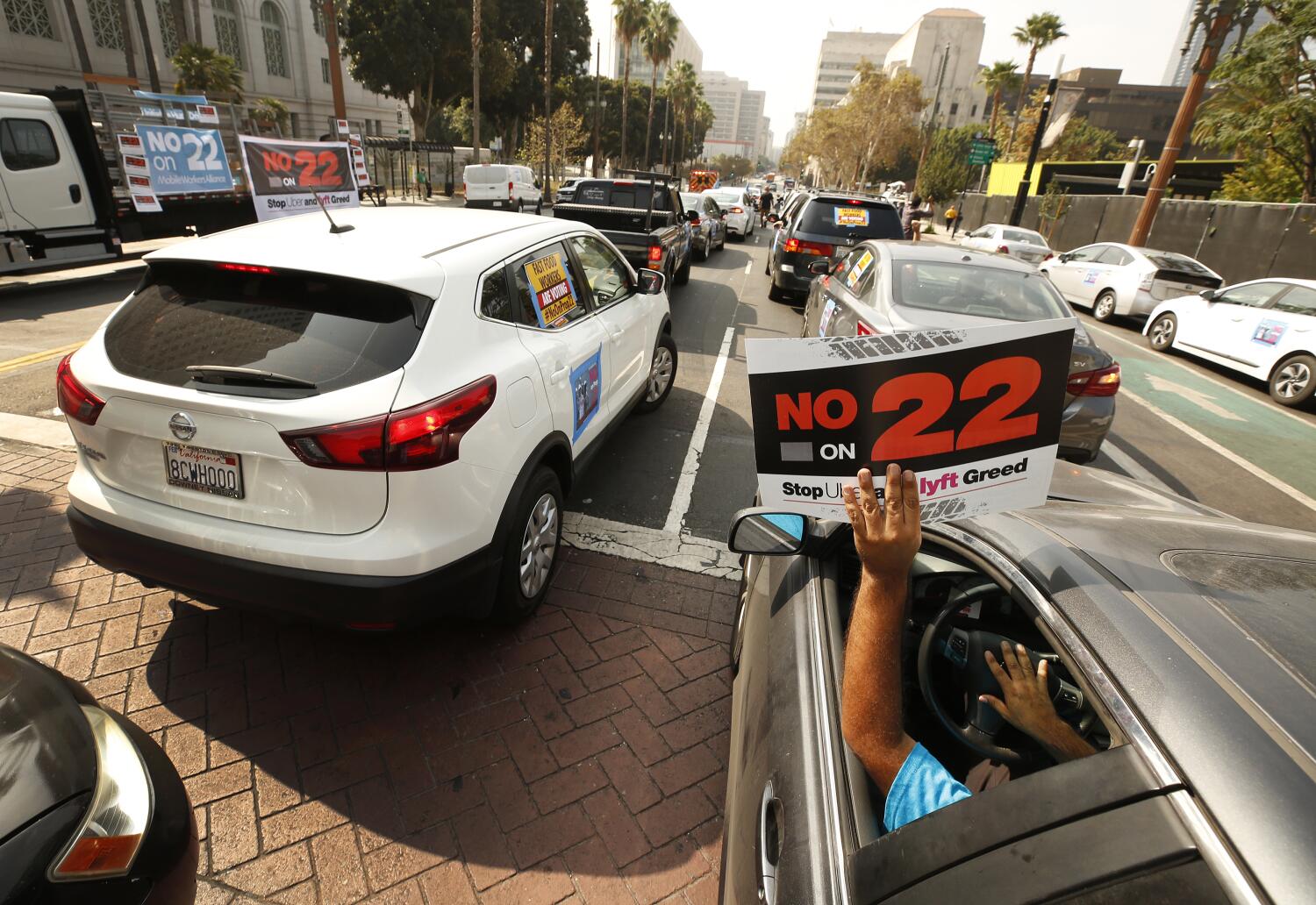
California’s Supreme Court will hear arguments Tuesday on the constitutionality of Proposition 22, the voter-approved law that classified drivers working in the gig economy as independent contractors rather than full-fledged employees.
The court must decide whether the law, which Uber, Lyft, Doordash and other app-based delivery companies pushed with a $200-million campaign in 2020, unlawfully interferes with the state Legislature’s authority to provide workers’ compensation protections to those who are injured on the job.
How the justices ultimately rule will have enormous implications for the delivery and ride-hail companies that have argued their ability to operate in California depends on the law’s survival, as well as the million-plus people in California who drive for them. A victory for the group of drivers and unions that brought the lawsuit challenging Proposition 22 would leave Uber, Lyft and companies like them to decide whether to continue operating in California, one of their largest markets.
Under the law, drivers are considered to be their own employers, a designation that frees the companies they drive for from having to provide benefits that traditional employees in the state are entitled to, such as overtime, sick leave and a minimum wage.
The Service Employees International Union and a group of drivers first brought the lawsuit challenging Proposition 22 in January 2021, just after the law went into effect. They unsuccessfully sought to take the case directly to the California Supreme Court and were left to pursue the case in a lower court.
In a sweeping decision, Alameda County Superior Court Judge Frank Roesch ruled in August 2021 that Proposition 22 was unconstitutional and unenforceable.
The law failed to pass constitutional muster, Roesch wrote, because it infringed on the power of the Legislature explicitly granted by the state Constitution to regulate compensation for workers’ injuries.
“If the people wish to use their initiative power to restrict or qualify a ‘plenary’ and ‘unlimited’ power granted to the Legislature, they must first do so by initiative constitutional amendment, not by initiative statute,” the judge wrote.
In March 2023, a split three-judge panel from a state appeals court largely reversed that ruling, finding the law did not impede the Legislature’s authority and upholding the legality of the law’s provision classifying drivers as contractors.
Supporters of the law celebrated the ruling as a “historic victory for the nearly 1.4 million drivers who rely on the independence and flexibility of app-based work to earn income, and for the integrity of California’s initiative system.”
Proposition 22 has remained in effect throughout the appeals process.
When they make their case Tuesday, attorneys for the drivers and the union are expected to press ahead with their assertion that the law improperly leaves gig economy drivers who suffer injuries while working without access to compensation enjoyed by traditional employees in the state.
The state Constitution “grants the Legislature unlimited power to protect workers with a complete workers’ compensation system,” said Scott A. Kronland, an attorney representing SEIU and the drivers.
A coalition backed by Uber, Lyft and DoorDash, called the Protect App-Based Drivers & Services coalition, meanwhile counters that courts should respect the will of voters, who voted by a 58% margin to approve the law.
“The court for 100 years has not found a restriction on voters’ initiative power,” said Kurt Oneto, an attorney representing the coalition.
On Monday around 9 a.m., scores of drivers gathered outside the office of SEIU Local 721 in Westlake, preparing to travel as a car caravan up to San Francisco to rally outside the courthouse during oral arguments. They loaded into dozens of honking cars lined up along a nearby intersection, plastered with signs denouncing Proposition 22 as “bad for workers, bad for the economy, bad for California.”