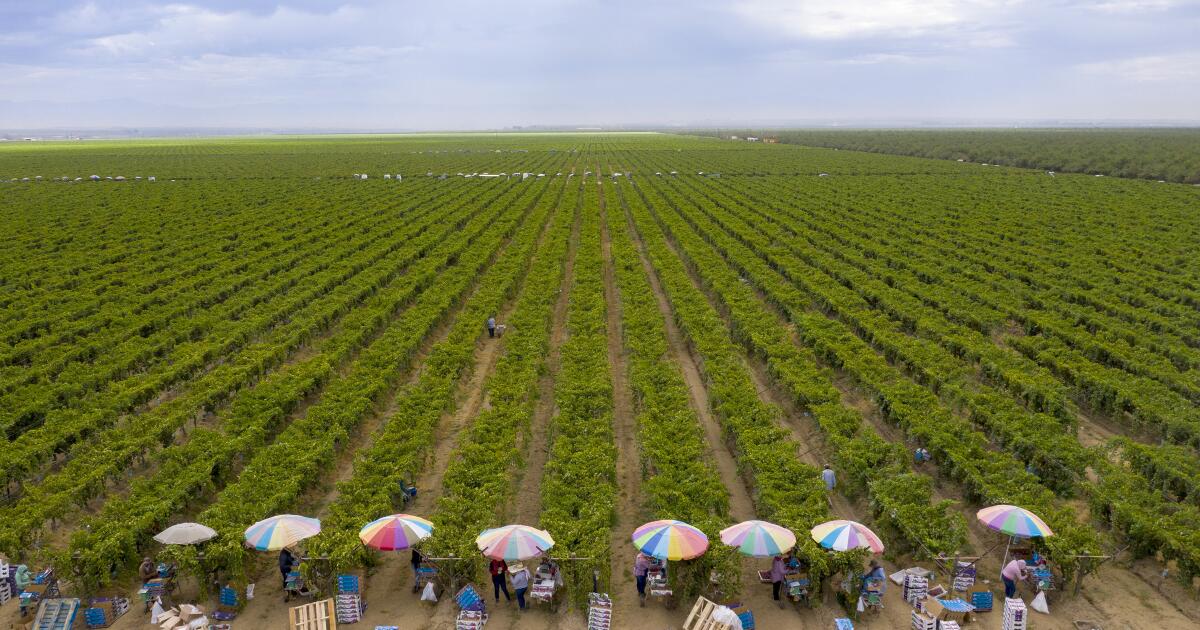
California has sharply cut its enforcement of heat-protection laws for outdoor laborers while extreme heat has intensified in recent years — endangering farmworkers, construction workers and others who toil in scorching temperatures — an investigation by the Los Angeles Times and Capital & Main has found.
From 2017 to 2023, the number of field inspections conducted by the California Division of Occupational Safety and Health, known as Cal/OSHA, dropped by nearly 30%, according to agency data. The number of violations issued to employers in that period fell by more than 40%.
Worker advocates say the numbers show a failure to adequately enforce California’s landmark outdoor heat-illness law, which was enacted nearly two decades ago after several farmworkers died in San Joaquin Valley fields. The law requires protections such as providing break areas with shade and “pure, suitably cool” water as “close as practicable” to workers when temperatures exceed 80 degrees.
“We just need Cal/OSHA to be out there more often and do more inspections that hopefully will save farmworker lives,” said Ephraim Camacho, a community worker for California Rural Legal Assistance who visits fields in the San Joaquin Valley and helps workers file complaints. “We are constantly getting calls from workers complaining, specifically, about the lack of shade and drinking water.”
In a statement, Cal/OSHA said that its 2023 inspection numbers were an increase over 2021. But the number of inspections in 2023 also dropped by 15% from the year before, according to the data. The agency said it is improving training and investing in automation.
“The department will continue to ramp up these efforts as we aggressively work to increase hiring,” Cal/OSHA said. The agency said it’s creating a new agricultural unit that will operate in cities including Lodi, Salinas, El Centro and Fresno and “significantly expand enforcement.”
With peak temperatures increasingly topping 105 degrees in July and August through much of California’s agricultural heartland, the state has experienced its six warmest years on record since 2014, climate assessments by the National Oceanic and Atmospheric Administration show. At least 17 workers have died in heat-related incidents since 2014, according to Cal/OSHA.
With the temperature well over 100 degrees, a farmworker cools off in a spot of shade in a peach orchard in August 2023.
(Gina Ferazzi / Los Angeles Times)
The Legislature is considering a bill by Sen. Dave Cortese (D-San Jose), a former farmworker, that would promote compliance with the state’s outdoor heat regulations and ensure that workers are compensated and receive medical treatment if they suffer heat-related injuries while working for an employer who had failed to comply with the law. In cases where the farmworkers died, their families would be compensated.
For years, Cal/OSHA has struggled with staffing shortages that critics say have compromised worker safety. As of June 30, the most recent figures available, the agency had a vacancy rate of 37%, or 141 unfilled positions, in its enforcement bureau, which oversees workplace inspections. Earlier this year, lawmakers criticized Cal/OSHA for multiple oversight breakdowns during an Assembly hearing in which farmworkers and their supporters accused the agency of failing repeatedly to enforce workplace protection laws.
Capital & Main — an investigative journalism organization — interviewed more than 40 farmworkers across California in recent months. Workers said they often toil without shade and sometimes without water provided by employers. On other occasions, according to workers, there is not enough shade for all employees, and break areas and water may be hundreds of yards away in sprawling fields, making them impractical to reach during afternoon breaks that often last just 10 minutes.
“All that matters is production,” agricultural worker Nazario Sarmiento, 37, said in Spanish. He added that for years he has picked lemons, oranges and grapefruit in San Joaquin Valley orchards without shade and at times with no water provided by employers.
A reporter surveyed agricultural fields in seven California counties this spring and summer and saw workers laboring without shade, including in a grape field on a 108-degree day in Kern County, in citrus orchards on a 99-degree day in Tulare County, in a pepper field on a 91-degree day in San Benito County and in tomato fields on an 89-degree day in Contra Costa County.
In interviews, worker advocates said they have also visited fields that lacked shade, or where water and shade were located hundreds of yards away.
“I won’t say it’s every farm. … But I will say that there is negligence when it comes to protecting the workers, whether they’re hired directly by the farm or they’re hired through a contractor that the farm hires,” said Marivel Mendoza, executive director of Hijas del Campo, which hands out food, water and protective equipment to workers in the fields of Contra Costa and San Joaquin counties.
Workers said they do not complain or file complaints for fear of being targeted by supervisors. “They will say you’re not doing your work and fire you,” a 36-year-old strawberry picker in the Santa Maria Valley said in Spanish.
Since May, the California Department of Industrial Relations, which oversees Cal/OSHA, has refused multiple requests from Capital & Main for detailed breakdowns on outdoor heat-safety inspections, including enforcement actions by industry and region, claiming the records cannot be disclosed due to “privilege.”

A farmworker holds a water bottle containing a chunk of ice while working in a peach orchard in August 2023.
(Gina Ferazzi / Los Angeles Times)
Still, the data in the agency’s 2023 annual report show a steady decline in the overall number of enforcement actions during the six-year period.
In 2017, Cal/OSHA inspectors conducted 4,150 outdoor heat-safety inspections and cited employers for 1,996 violations. In 2023, the agency recorded 2,929 inspections and 1,130 violations.
The report noted the importance of outreach efforts to increase awareness about heat-illness prevention regulations and safety measures. Outreach includes educational materials for employers and workers and communications to vulnerable communities. Yet between 2017 and 2023, the number of outreach efforts dropped by 83%, from 1,805 to 308, the report shows.
In 2005, California became the first state in the nation to enact outdoor heat safety regulations.
The outdoor heat law applies to the agricultural, construction, landscaping and oil and gas extraction industries, as well as to certain transportation activities. Employers are required to provide heat illness training and have a written safety plan in English and the language understood by a majority of their workers.
For farmworkers, employers are required to take additional “high-heat” measures when temperatures reach 95 degrees. These include 10-minute “cool down” breaks every two hours and additional breaks while working overtime.
A recent study by the UC Merced Community and Labor Center estimated that 59% of agricultural workers in California were not citizens, the highest percentage of any industry in the state. Many of those farmworkers face language, technological or other barriers to filing complaints, while others are hesitant to speak out because of their immigration status, according to worker advocates. These barriers, advocates say, make it especially critical that Cal/OSHA ramp up enforcement operations.
“These are long-standing issues that have been ignored for far too long,” said Irene De Barraicua, director of policy and communications for Líderes Campesinas, a statewide organization that advocates for women who work in the fields and their families. She said Cal/OSHA needs to leverage its limited resources by partnering with community-based organizations that have the trust of workers and can help conduct outreach.
“If you don’t have these inspectors, or it’s not happening quick enough,” she said, “then there should be more of an official collaboration with community-based organizations that are out there on the ground.”
This story was produced in partnership with Capital & Main, the McGraw Center for Business Journalism at the Craig Newmark Graduate School of Journalism at the City University of New York and was supported by the Fund for Investigative Journalism.
Newsletter
Toward a more sustainable California
Get Boiling Point, our newsletter exploring climate change, energy and the environment, and become part of the conversation — and the solution.
You may occasionally receive promotional content from the Los Angeles Times.

:quality(70)/cloudfront-us-east-1.images.arcpublishing.com/tronc/FD7UYJ7BFZFIFIBXN3TVVMX2ZU.JPG)