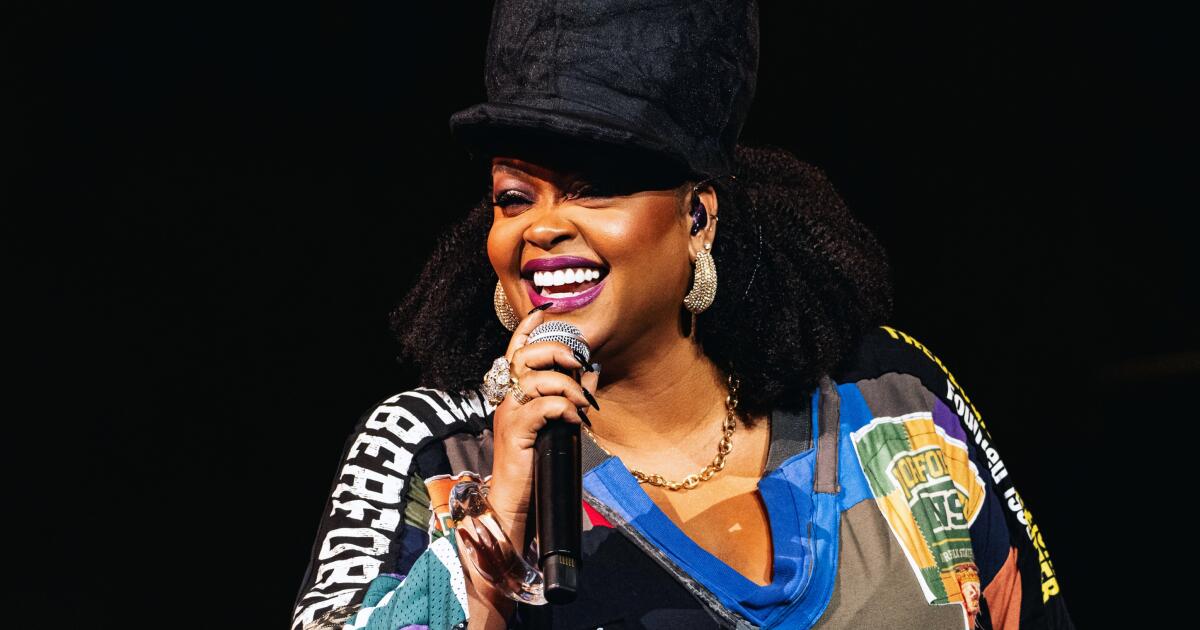
Grammy-winning singer Jill Scott brought her “To Whom This May Concern” album — her first in more than a decade — to life at Inglewood’s YouTube Theater last week. Backed by a razor-sharp 11-piece all-male band (including background singers fittingly dubbed “Freeman”), Scott moved effortlessly through a two-hour set filled with songs from the genre-expansive album along with several fan favorites like “He Loves Me (Lyzel in E Flat)” and “Gettin’ in the Way.”
Enforcing a phone-free policy at her personal request, the North Philadelphia native kept the audience intensely locked in — hanging onto her every word and every seemingly impossible note she struck with ease. Before long, it was easy to forget that we didn’t have our devices. Smiles filled the intimate room. Couples danced together. Strangers sang to each other in joyful unison, while others closed their eyes or held their hands on their chest in complete awe of witnessing a veteran artist in her element.
Jill Scott is on tour for “To Whom This May Concern,” her first album in over a decade.
(Jada Imani M)
In her only interview during the tour thus far, we caught up with Scott backstage to talk why she never performs a song the same way twice, how removing devices makes concerts better and why she thinks “To Whom This May Concern” deserves several accolades.
I’m still coming down from all of the energy from the show. How are you feeling post-show?
I am hot from the inside, and it’s gonna take me hours to calm down. [Laughs]
You’ve always described music as an intimate, two-way conversation between you and the audience. For this tour, you created a strictly phone-free space. Why did you decide to do that and how did this shift the experience for you as a performer?
In a couple of ways. One part is that it’s terrifying because there’s no buffer between me and them, so that’s actually scary, but I embrace it. The other part of it is that it’s wonderful because people initially come in kind of nervous about not having a buffer between myself and the space or themselves and space. Then I watch them gradually release, and I get a kick out of that every night. That’s my favorite part.
I’m surprised to hear that it’s scary for someone like you who’s been performing at such a high level for so many years.
Because I care. It matters to me. I really want them to have a good time. I really want them to release some things, allow themselves to be. If you want to make out, if you want to dance, if you want to cry, if you want to shout, or put up your hands in the air, or sit still, I want them to be able to do that. I think it’s important. That’s the relationship. That’s the real relationship between artist and fans of the music. It’s the connection between the music. I’m here to [be of] service. I’m here to push the ship along, but it’s really their relationship with the music and I’m a conduit. That part is probably one of my other favorites. You have to relinquish your id and allow the thing to be the thing. I think sometimes you can practice the joy and the life out of a thing. We practice a lot, but then we forget everything we practice so that it’s alive. My musicians’ freedom is mandatory. It’s a part of the job. So if they show up and play the exact same thing in the exact same way every night, they’re probably not going to be around very long. I need them to be wide open and to rediscover the music every night from their perspective. It’s their 11 perspectives on stage, and then of course there’s the lighting designer. I need him to be free. Don’t give me the same light at the same time every night. Even front-of-the-house sound engineer as well as our in-ear monitors, everybody is playing a part. “What does she need? Let’s read her. Let’s, you know, pay attention. What does she want?” It’s a lot of fun.

You could see really feel that from you and your entire band.
Tonight was a different audience. They were very attentive. Last night they danced all night long from the very beginning. I couldn’t even see the floor. Tonight they were listening. I know it’s a Wednesday night. Everybody’s got to go to work [the next morning], but they were beautiful. The listening audience is probably my favorite. They get quiet and I’m like “Oh, it’s so scary. Am I doing the right thing?” [Laughs] But that means they’re listening. Who doesn’t want to be heard?
Your son came out with you tonight. How was that experience for you?
It’s beautiful to see. He told me Tierra Whack is not traveling with us because she has a new album out, “Whack’s Museum,” so she’s a little busy. He was like, “Mom, how do you feel about me doing the second verse?” and I was like “Be at sound check tomorrow with a mic in your hand.”

He looked so comfortable on stage.
He does. It’s kind of scary. Super exciting. I don’t know what he’ll want to do, but he’s working our set, so he’s a part of the crew. So after he does his performance, he puts back on his blacks and he does his job, and I love that for him, to have that sense of responsibility. He’s exceeding anybody’s and everybody’s expectations. He’s so good at this. All the clothes you see, he steamed up.
He’s really working his way up.
Yes, you must earn your way.
Your album “To Whom This May Concern” released in February, and it feels like a love letter from your favorite auntie. There’s lessons about learning from your mistakes, honoring your ancestors and loving yourself. Now that your fans have been living with these songs for several months, I’m curious if performing them live has shifted your relationship with them at all?
No. On a great night, I like telling the stories that I’ve read. I like embodying them in front of other people. I like watching them experience them in a new way. I’m a fan of that. It just makes it more and more true. Then I see how many people are singing along and how many people are looking at me, and I’m like “Yesss.” It’s reaching the people and I know it’s going to be different because there’s a different audience every night. So I’m thrilled about the project and how it’s touching people. You hope you don’t work this hard at a thing for it to fall on deaf ears, and I know how microwavable music has been, but I believe the cream rises to the top. It’s been a beautiful 26 years. I look forward to 26 more — in my way.
Your album has been receiving a lot of praise from fans and critics. There’s still a few months before the Grammy nominations are announced, but at this point in your career, how important is that recognition to you? Is it as important as it was when you first started your career?
I think I deserve it. That’s all. [Flashes a smile]
I mean everything about this project from beginning to end is blood, sweat and tears. I stayed up many nights just to write, a hunger in my belly and a savage appetite. And I mean it. Everything is true and I love that for me. That’s the kind of thing that takes time and I think musically, it’s incredible. I think the stories are awesome and intentional, and everything about it, from the planning of it to the marketing, has been from my soul, and I think it deserves several.