Identifying the source of a food-borne illness such as cyclosporiasis — a diarrhea-causing parasite that has sickened thousands of people in the United States — is almost as difficult as finding a needle in a haystack.
It’s not impossible to narrow down the culprit but it is a challenge because public health investigators are analyzing multiple pieces of evidence from available public health data, following a potential food source through the supply chain and testing samples of potentially contaminated food.
On Wednesday the U.S. Food and Drug Administration announced it was initiating a traceback investigation into a second cyclosporiasis outbreak. The agency has yet to link the latest outbreak to a specific product or location.
The announcement follows a larger outbreak with cases that date back to May and that has affected more than 10,000 people across five states — Indiana, Kentucky, Michigan, Ohio and West Virginia — who reported feeling ill after eating Taco Bell meals with shredded iceberg lettuce.
On Friday, the Centers for Disease Control and Prevention expanded the first outbreak to include four more states — Illinois, Kansas, Oklahoma and Pennsylvania.
Based on epidemiological information collected by the CDC, a total of 1,947 people infected with cyclosporiasis across those states said they became ill after eating Taco Bell between June 22 and July 20.
“We also expect to continue to see the number of confirmed cases rise, despite the recall, due to the fact that it can take as long as six weeks for CDC and state officials to determine if a sick person is part of this outbreak,” the agency said in a statement.
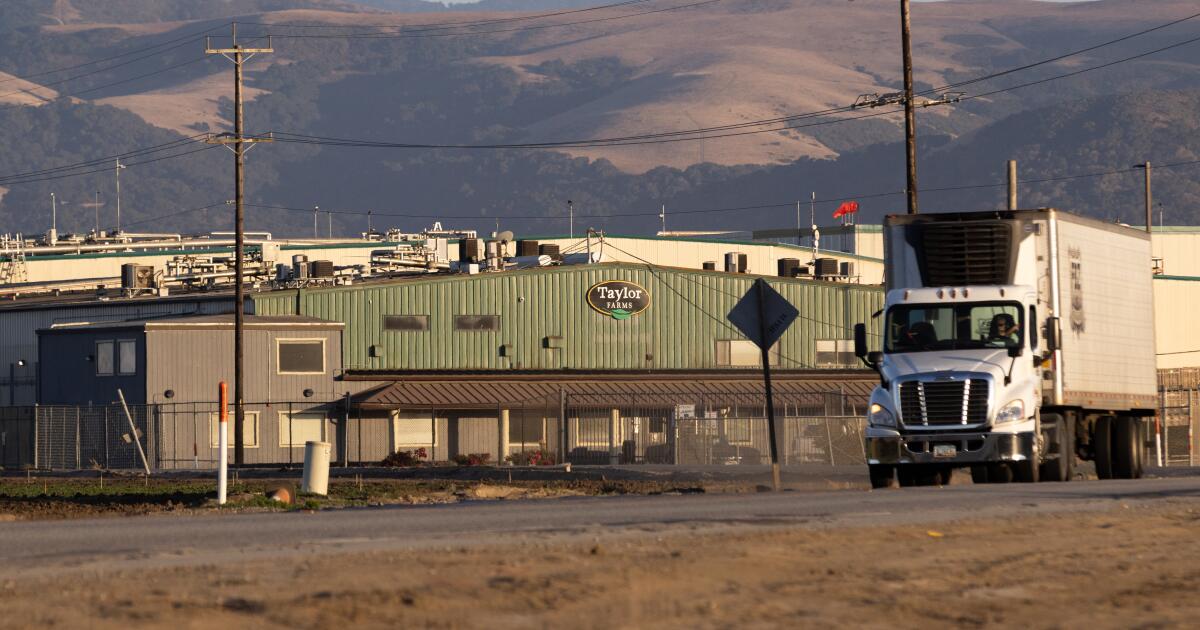
Officials say traceback and outbreak data have linked the largest outbreak to lettuce supplied to the affected Taco Bell eateries to a Taylor Farms’ facility, Taylor Farms de Mexico, located in central Mexico.
But a recent false positive detection of cyclosporiasis in a sample of the California-based company’s lettuce and statements made by Mexico’s public health officials have raised questions about how federal health officials investigate these types of outbreaks.
What does the false positive test result mean?
A recent sample of lettuce from Taylor Farms de Mexico gave a false positive test result for the cyclosporiasis parasite.
On X, the FDA stated, “To clarify, this false positive lab sample does not change the basis for FDA’s ongoing outbreak investigation or the overwhelming epidemiological data supporting the current voluntary recall by Taylor Farms.”
The regulatory agency continues to work with Taylor Farms to ensure “product implicated in this outbreak has been removed from the market,” the regulatory agency stated.
The false positive test was brought up during a Tuesday morning news conference in Mexico, where Health Secretary David Kershenobich said Mexican officials have traveled to Guanajuato — where Taylor Farms de Mexico is located — to conduct their own investigation in conjunction with the U.S.
“So far, no evidence has been found to indicate that it originated here, yet we are taking every precaution in case that turns out to be the case,” Kershenobich said.
The FDA reiterated on Friday that its traceback investigation and outbreak data continue to point to shredded iceberg lettuce from Taylor Farms in central Mexico, despite no samples from the facility yet testing positive for the cyclosporiasis parasite.
“We encourage the public to continue to avoid all products listed in Taylor Farms’ voluntary recall,” the regulatory agency said in a statement.
A complete list of the recalled items can be found here.
How public health investigates a food-borne illness
Food- and water-borne outbreak investigations start with sick people, said Gregory Stevens, professor and chair of the Department of Public Health with Cal State Los Angeles.
A person has to feel sick enough to seek medical care and their healthcare provider must test for a food-borne illness by obtaining a a stool sample.
The results of that sample are then reported to local health departments who alert state and federal health agencies if they identify a cluster of people diagnosed with the same food-borne illness. In this case, it’s the cyclosporiasis parasite.
“When a cluster is big enough everybody’s ears perk up, communication starts,” and multiple avenues of investigation begin, Stevens said.
State and federal officials conduct interviews with the people who tested positive for the particular illness to understand when they first felt sick, their symptoms, the level of care they needed, whether they traveled, what they’ve eaten and where they’ve dined or shopped for food.
When a specific restaurant, retailer or food product has been identified as a potential source for the cluster of sick people, public health officials then conduct traceback investigations, a process where they trace the food that the ill people reported eating all the way back to the farm or the production facility.
The agency then tests a sample of the crop or a batch of a product looking for whatever is causing people to get sick.
What are the challenges of investigating cyclosporiasis?
There are many natural flaws that come with this investigative process.
To start, if a person gets sickened from a food-borne illness, they might not seek medical care, Stevens said.
And if they do, “that provider may not test for food-borne illnesses,” he said.
As a result, a diagnosis is never made and that information never makes it to the local health department. Instead, the medical provider may just tell their patient to keep an eye on their symptoms, wait and hydrate.
In the case where an investigation is initiated by public health agencies, “there is often a significant delay between when someone ate the contaminated food, when they became sick, when they were diagnosed and when public health officials were able to interview them,” said Anne Rimoin, professor in the department of epidemiology with the UCLA Fielding School of Public Health.
The delay could make it more difficult for ill people to remember all the foods they ate, “down to a single ingredient in a salad,” before they were stricken, Rimoin said.
“And if you’re like me, I don’t even remember what I ate two days ago,” Stevens quipped.
Because this type of multipoint investigation is reactive, the product that’s suspected of causing the illness may have already moved through the supply chain into stores or restaurants and has already been consumed.
“Even when food is available for testing, contamination can be uneven, so a negative test does not necessarily rule a product out,” Rimoin said.
Do public health’s investigation always pinpoint the cause?
Experts say that when a food-borne outbreak occurs, the public understandably wants to know which product is causing the illness, where it came from and how to protect themselves.
“It’s completely reasonable to want certainty, especially with something as common and essential as food safety,” Stevens said. “But public health, I think, is more about reaching the strongest evidence-supported conclusions possible, and it’s not always perfect.”
An investigation might not come up with a singular answer.
“Investigators may be able to identify a likely source for one cluster of cases while other cases remain unexplained or may be linked to a different source,” Rimoin said. “Finding a likely source does not necessarily mean finding the source of every single case.”
One of the largest cyclosporiasis outbreaks in North America was linked, through data collection from clinicians and laboratories, to imported raspberries from an estimated five Guatemalan farms in 1996. At the time, more than 1,400 cases of the disease were reported in 20 states, the District of Columbia and Canada.
“These investigations are rarely about one single piece of proof,” Rimoin said. “They are about putting together epidemiology, traceback, supply chain information and laboratory evidence to determine the most likely source.”