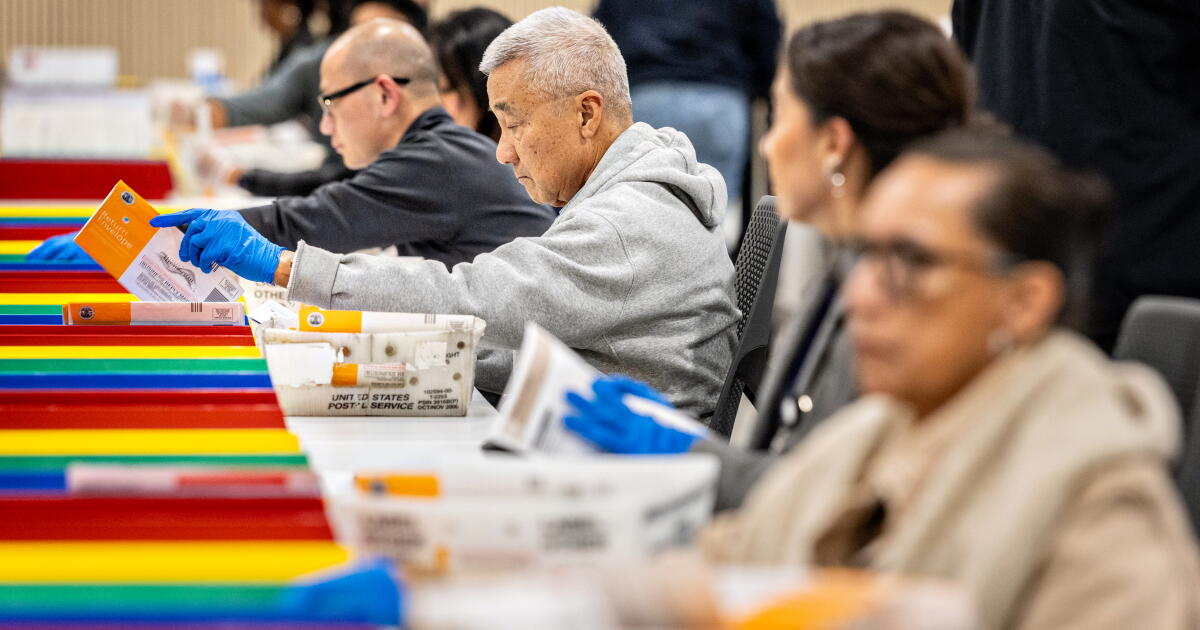
Nearly two-thirds of California voters are worried that the Trump administration may try to halt the vote count early, stoking disquieting levels of election anxiety on the eve of the midterms, a new poll shows.
Those fears arise as the Justice Department continues its aggressive efforts to challenge or wrest control over state voting processes, including threatening to prosecute uncooperative elections officials in California, after years of baseless claims of widespread election fraud by the Republican president.
Among California voters, 63% worry that the federal government may attempt to stop the counting of votes in California and other states in the days following Tuesday’s election, according to the poll from the UC Berkeley Institute of Governmental Studies, co-sponsored by The Times. Around half of voters — 49% — are not confident that the state’s election will be free of federal interference, the survey found.
“Both of the items, together, I think should raise alarms for threats against democracy in California,” said Matt Barreto, director of the UCLA Voting Rights Project.
California voters also have grievances with the state’s ballot propositions, a slate of 14 measures that include new taxes on billionaires and funding for cancer research. More than 8 in 10 of the state’s likely voters said that this year’s propositions were worded in a way that made them hard to understand and that special interests groups have too much influence over which propositions appear on the ballot.
Those concerns were shared across partisan lines, unlike how Californians felt about the threats posed to integrity of elections by the Trump administration. The high level of fear in the state reflects the fact that registered Democrats outnumber registered Republicans by nearly 2 to 1 in California.
While 58% of Democrats are not confident the election will be free of federal interference, 27% of Republicans feel the same way, according to the poll. Similarly, 85% of Democrats are worried about the vote count being halted, compared with 22% of Republicans. A majority of California voters not affiliated with either party also expressed fears of interference by the Trump administration.

“I think voters are reflecting the reality,” Barreto said. “For the past month, the president and the Department of Justice have been attempting to directly interfere and take over California elections and voters are aware of that.”
The Department of Justice has sued California requesting the state set aside some 20,000 ballots the federal government has flagged as being potentially from noncitizens. Federal prosecutors have threatened criminal actions against election officials who refuse to comply. On Monday, the Trump administration escalated its effort to discount the flagged California ballots to the Supreme Court, which rejected its request to set aside the ballots.
Over the weekend, Newsom sent a letter to U.S. District Court judges across California sharing his “grave concerns federal agents will seek search warrants to seize ballots and ballot materials before the election results are certified” and urging judges not to comply.
Newsom wrote that President Trump’s history of weaponizing the Department of Justice to carry out his partisan agenda supports “legitimate concerns about further attempts to disenfranchise voters and undermine election integrity.” Newsom said this could include an attempt to prevent the certification of California’s election.
Concerns have also been raised about the presence of immigration agents around voting centers and performing door knocks and street stops to try to identify voter fraud.
Court rulings have recently dealt a series of blows to the Trump administrations efforts to intervene in the state’s voting process. Nonetheless, distress over election integrity remains extremely high, according to the poll.
Fears of federal meddling in the election are slightly higher among voters of color; 64% of Black voters and 54% of Latino voters said they are not confident the election will be free of interference, compared with 44% of white non-Hispanic voters, according to the poll.

Voters of color tend to lean more liberal, but the historic and ongoing efforts to disenfranchise minorities probably also contribute to this disparity, Barreto said.
Black voters have been a target of voter suppression efforts from the post-Civil War Reconstruction era through the passage of the Voting Rights Act of 1965, he said. More recently, the Trump administration has singled out Latino Californians, accusing them of being noncitizens and voting illegally.
Professor Eric Schickler, co-director of the UC Berkeley Institute of Governmental Studies, described the level of alarm over election integrity in California and across the nation as without precedent.
He noted that both parties are distrustful about different things, with Republicans focused on allegations of fraudulent voting and Democrats fearful that the federal government may attempt to overturn results.
The last time America saw extreme political polarization paired with widespread claims of illegitimacy over election outcomes was during the Reconstruction era in the late 19th century, when there were widespread accusations of voter suppression in the South and of people voting illegally in the North, he said.
“That hasn’t happened really in the United States for well over a century now,” Schickler said, “so what we’re seeing now is really unusual, especially for a modern and long-lived democracy.”
Schickler said his highest level of concern with possible federal efforts to halt California’s vote count would be with congressional races. A handful of California races could play a pivotal role in deciding which party takes control of the U.S. House of Representatives. However, he said current polling data do not indicate that a Democratic path to victory in the lower house will rely on Golden State voters.
Trump in the past has criticized California for being one of the slowest states in the nation to finish tabulating its election results due to its large population and high number of voters who mail in their ballots. He’s also complained about late arriving ballots. Votes processed after election day in California typically contain a higher proportion of Democratic ballots than those processed on election night.
In addition, to highlight the unprecedented anxiety many California voters are feeling, the poll also shines a light on frustrations voters have with the state’s ballot propositions. Among likely voters, 82% agree that the wording of this year’s propositions made them hard to understand and 82% also agree that special interest groups have largely taken over which initiatives qualify.
In addition, 62% of likely voters feel that there are too many propositions on this year’s ballot. There are 14 statewide propositions, with many voters also seeing additional initiatives at a county and city level.
“The initiative is meant to be an outlet for voters when special interest groups lead legislators to fail to respond to their concerns,” Schickler said. “But now most voters believe the initiative process is itself too beholden to special interests.”
In the last 20 years, California’s ballot initiative campaigns have become increasingly controlled by large corporations or union groups. Part of this is due to the fact that it takes at least $50 million to run an effective campaign capable of reaching the state’s 23 million registered voters, making it challenging, but not impossible, to run a grassroots campaign, Barreto said.
The poll surveyed 2,787 registered voters in California from Oct. 19 to 25 in English and Spanish and has an overall estimated margin of error of plus or minus 2.5 percentage points. Among likely voters, the estimated margin of error is about 3 percentage points in either direction.
Times staff writer Kevin Rector contributed to this report.