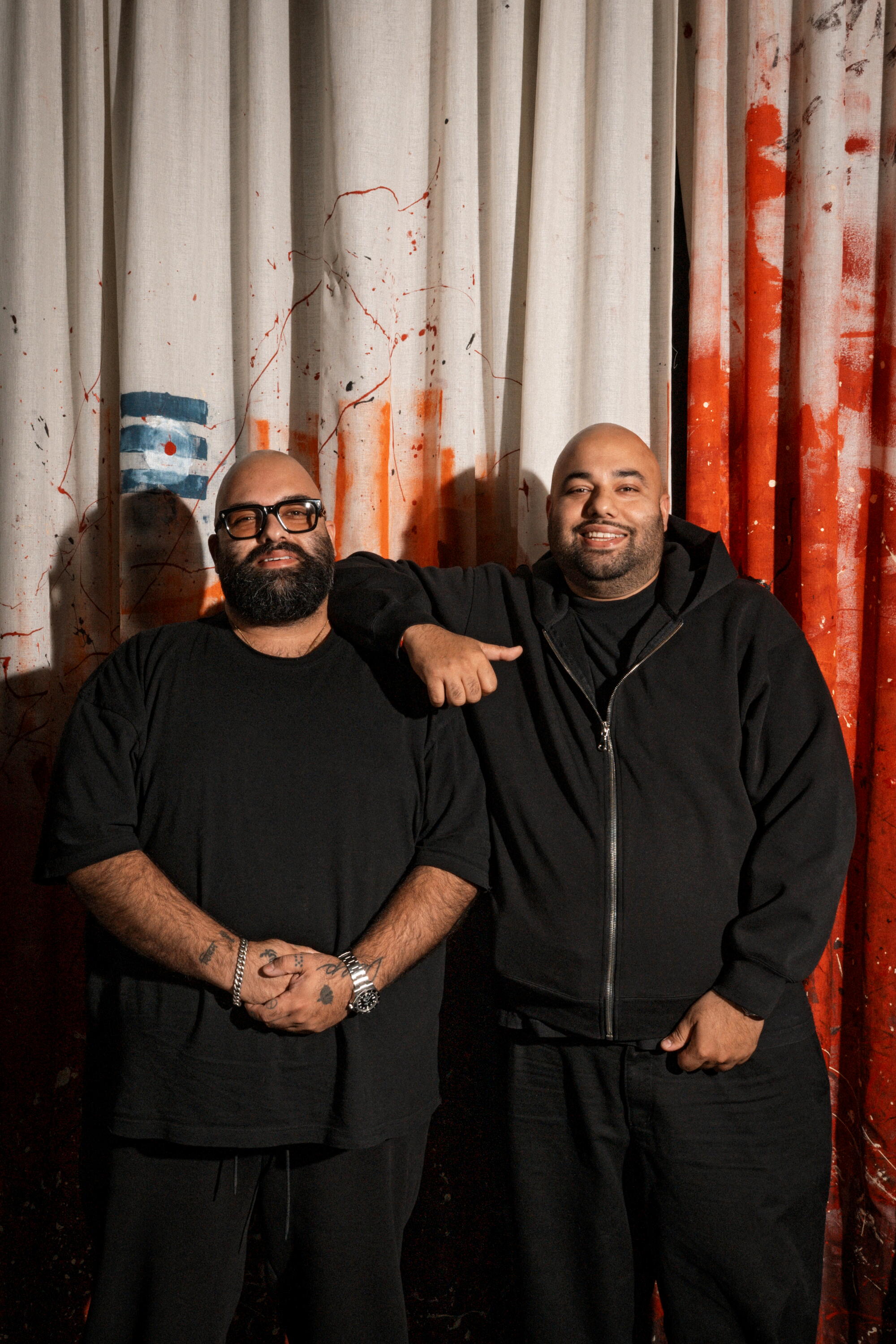
Abbot Kinney Boulevard is the Los Angeles of postcards and daydreams: sun-washed, stylish and just slightly out of reach. This year, Badmaash Venice, the third location of the groundbreaking Indian restaurant, has become the street’s new center of gravity.
From left, the co-owners and brothers behind Badmaash, Nakul and Arjun Mahendro.
High-end Italian, Japanese and well-known chain restaurants dominate the boulevard, a hotbed of trendy bars, coffee shops, matcha cafes and pricey boutiques. And here’s one of L.A.’s premier boundary-stretching Indian restaurants, interrupting the block’s monotony with fiery ghost chile lamb vindaloo, butter chicken samosas and my current favorite, steak frites.
The word “badmaash” is slang in Hindi for troublemaker or rascal. And in 2013, when chef Pawan Mahendro, his wife Anu and their sons Nakul and Arjun opened the first Badmaash restaurant in downtown Los Angeles, it was designed to be just that. The goal was to challenge expectations of Indian dining in America. The dining room playlist was hip-hop. There was Lambrusco on the wine list. Wall art featured a collection of Andy Warhol-esque pictures of Gandhi wearing brightly colored Ray Ban Wayfarers. And under a section of the menu labeled #foodporn, there was chicken tikka poutine, with masala-dusted fries smothered in brown gravy, melted mozzarella cheese and nuggets of chicken tikka.
Like the vast majority of mainstream Indian restaurants in America, the menu still emphasized North Indian and Punjabi-style cooking, with naan, tandoori chicken and seekh kebabs. But Pawan and his sons blurred cultural and generational boundaries, mining classical Indian techniques, street-food swagger and Southern California farmers market ingredients. The results altered the way many Angelenos think about modern Indian cuisine, with a style of cooking that draws from Pawan’s rise through kitchens in India and Canada, his sons’ upbringing in Toronto and their home in Southern California, distilling each stage of their lives into something that tastes like Los Angeles Indian food.

The exterior of Badmaash in Venice.
Badmaash Venice opened on the southern end of Abbot Kinney Boulevard in March. It feels like a grown-up version of the downtown and Fairfax Avenue restaurants, with a cavernous, brick-lined dining room, a brooding color scheme that explores various shades of black and gray, and a full bar lighted by candles slowly building elaborate wax stalagmites.
For all that’s new, the menu still holds the dishes that built Badmaash’s following. Begin with the dahi poori, semolina spheres filled with spiced chickpeas, whipped yogurt and both tamarind and mint chutneys made using Anu’s grandmother’s recipes. The wonderfully layered textures and temperatures are irresistible, with the crisp shells collapsing, then exploding, flooding your mouth with the sensations of the cool yogurt and sweet chuntneys. Then order a pair of golden, flaky samosas filled with silky butter chicken laced with tandoor smoke.
Badmaash Venice
1616 Abbot Kinney Blvd., Venice, (310) 310-2580, badmaashla.com
Prices: Small plates, chaats and samosas $8-$24, seasonal salads and vegetables $20-$25, tikkas and kabaabs $18-$28, Badmaash favorites $14-$93, traditional Indian $22-$34, breads and rice $6-$12, desserts $12-$16.
Details: Open daily from 4:30 to 11 p.m.
Recommended dishes: dahi poori, Punjabi fish fry, grilled lamb chop, lamb sausage seekh kebab, Badmaash steak frites, Pacific blue crab konkani, lamb neck korma, marinated gai lan, Goan pork curry, ghost chile lamb vindaloo, creamy black lentils, naan, Parle-G ice cream sammiches.
To drink: Director of operations Steve LaFountain designed the beverage program with riffs on the martini, margarita and spritz. The wine list skews French, with plenty to pair with whatever is on the table. There are a couple of beers and a handful of nonalcoholic options, including mango and cardamom lassi, Thums Up Indian cola and chai.
The famed chicken tikka poutine made the trip west, though I will steer you in the direction of another heap of French fries, dusted with masala and accompanied by a 12-ounce prime Niman Ranch New York steak.
“Wouldn’t it be cool if an Indian restaurant had the best steak in the city?” says Nakul during a recent conversation.


Top, the Badmaash version of steak frites with “meat-masala” au poivre and masala fries. The dimly lit dining room is buzzing on a recent Thursday evening.
In the same way the Badmaash burger slid Indian flavors into a quintessential American food, the Badmaash steak frites marries a ginger, garlic and serrano chile-rubbed steak with the spiced fries. The meat absorbs just enough of the rub for a warm, subtle backbone. It’s served with a silver sauce boat filled with a luxurious au poivre. The pan drippings from the restaurant’s eight-hour short ribs act as a building block for the sauce, with a caramelized onion and red wine curry bolstered with pops of black, pink and pickled green peppercorns.
Though the setting feels right for a romantic rendezvous, the best meals at Badmaash involve the constant passing of plates across the table. A few orders of Punjabi fish fry, encased in a chickpea batter that shatters, and a plate of lamb sausage seekh kababs modeled after the ones Pawan enjoyed at the Bademiya food hall in Mumbai, packed loosely, impossibly juicy and swiped through a fenugreek cream sauce. A round of lamb chops, coated in a yogurt marinade fragrant with garam masala and nigella seeds. A bowl of Pawan’s signature Goan pork curry, tart and sweet in a dark sauce glossy with rendered pork belly. Crisp okra and potato sticks fried and tossed with dried mango dust. Mussels lounging in a golden coconut milk and white wine broth. Orders of naan bursting with melted white cheddar cheese and chopped serrano chiles you reach for between courses, and to sop up any remnants of sauce left in the various plates and bowls. Frosty glasses of olive oil washed vodka martinis, mango lassi and Taj Mahal Indian Lager. Your server should partake in a game of table Tetris throughout the evening.
Having spent more than a decade building a more curious audience for Indian food in Los Angeles, the Mahendros are also introducing diners to regional specialties that help define the new menu. The Pacific blue crab konkani taps into the coastal culinary traditions of the Konkan region in Western India, which borders the Arabian Sea. Pawan plucks the crab from its shell and seasons it with onion, garlic, mustard seeds and curry leaf. The crab is served in a pool of lush, brown butter coconut curry sauce that thrums with the dull, pleasant heat of dried chiles.
At some point during the meal, you will want to lick every bowl clean, and come to the grim realization that no amount of sauce will suffice. This will ring especially true with the arrival of the lamb korma, a dish with origins in the Mughal Royal kitchens of South Asia, that boasts tender lamb in an intensely aromatic gravy. Pawan replaces the more traditional lamb leg or shoulder with lamb neck, roasting the meat for hours until it slips from the bone. The drippings are combined with cashews and pistachios toasted in brown butter, yogurt and boiled onions that lend the sauce a satiny body. It has a slight but intoxicating floral aroma, perfumed with crushed green and black cardamom pods, and a few drops of kewra water, a sweet-and tropical-smelling distillate made from pandanus flowers.

A plate of the Parle-G ice cream sandwiches at Badmaash are the perfect end to every meal.
But for all of Badmaash’s innovation, it’s the appearance of a dessert I first spied on its menu 13 years ago that still encapsulates the spirit of the Mahendro family so perfectly. The Parle-G ice cream “sammich” strikes just the right balance of nostalgia and novelty. The biscuit, which tastes like a cross between a graham cracker and tea biscuit, was created in the 1930s as an affordable, locally made alternative to more-expensive British imports. Over the years, the cookies became a symbol of national pride, enjoyed at every level of society.
Pawan forms perfect triangles of vanilla bean ice cream, then uses two Parle-G cookies to make a bite-size sandwich. It’s the future and the past. Childhood memories and grown-up aspirations, all wrapped up in an ice cream sandwich. I can’t think of a better way to end a meal at Badmaash. Or better fuel for the five-block trek to wherever you managed to park your car.