Aging infrastructure, short-term thinking, and ambitions that far outstrip its funding are just a few of the problems threatening the future of America’s vaunted civil space agency, according to the National Academies of Sciences, Engineering, and Medicine.
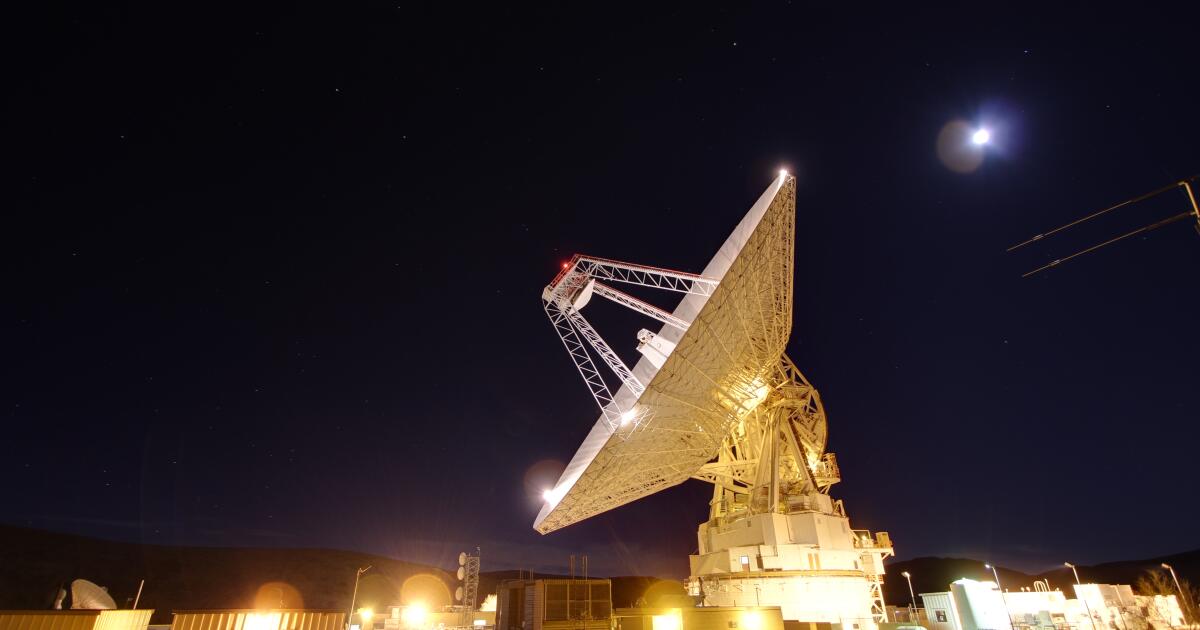
In a report commissioned by Congress and released this week, experts said that a number of the agency’s technological resources are suffering, including the Deep Space Network — an international collection of giant radio antennas that is overseen by NASA’s Jet Propulsion Laboratory in La Cañada Flintridge.
Report authors warned that NASA has, for too long, prioritized near-term missions at the cost of long-term investments in its infrastructure, workforce and technology.
“The inevitable consequence of such a strategy is to erode those essential capabilities that led to the organization’s greatness in the first place and that underpin its future potential,” the report said.
The choice facing the agency is stark, lead author Norman Augustine said Tuesday: Either the U.S. must increase funding for NASA, or the agency must cut some missions.
“For NASA, this is not a time for business as usual,” said Augustine, a former executive at Lockheed Martin. “The concerns it faces are ones that have built up over decades.”
Even as society at large has become exponentially more reliant on technology in the 60 years since NASA’s founding, federal investment in research and development has declined significantly over the decades, the study said.
This has been felt acutely at NASA, whose funding from Congress, adjusted for inflation, has plummeted from its Apollo-era high and remained essentially flat for decades.
NASA’s budget for years has hovered around 0.1% of total U.S. gross domestic product — less than one-eighth of its allowance during the mid-1960s.
Within the space agency, the report noted, science and technology funding has remained at a constant percentage within the budget even as missions have become far more costly and complicated.
As a result, NASA centers have only “low- to moderate-level efforts” underway to study emerging technologies that in a previous era might have been pioneered at the agency.
“NASA is a strong organization today, but it has underfunded the future NASA,” Augustine said.
The centers include JPL, where the report committee interviewed staffers at all levels of the organization.
JPL referred requests for comment to NASA.
“This report aligns with our current efforts to ensure we have the infrastructure, workforce, and technology that NASA needs for the decades ahead,” NASA Administrator Bill Nelson said in a statement provided by the agency. “We will continue to work diligently to address the committee’s recommendations — and drive our cutting-edge work on Earth, in the skies, and in the stars.”
Another key problem the report identified is neglect of NASA’s facilities, 83% of which have exceeded their designed life span. Attempts to repair and improve the agency’s infrastructure are stifled by a rule requiring a lengthy and labor-intensive review process for all requests over $1 million, a figure that has not changed since the rule’s inception despite a 30% increase in costs from inflation.
Employees at JPL in particular voiced concerns about this restriction, the report noted.
As a key example of a facility whose funding has failed to keep up with its increasing demands, the report highlighted the Deep Space Network, which makes up the world’s largest scientific telecommunications system.
JPL manages the network’s three terrestrial sites in Goldstone, Calif.; Canberra, Australia; and Madrid. The network’s budget has declined from $250 million in 2010 to roughly $200 million today, even as demands on it have increased.
As a result, the overburdened network has been forced to make costly compromises. During the Artemis I mission in late 2022, the lunar mission elbowed out all other scientific uses of the network, costing more than $21 million in data transmission from the James Webb Space Telescope alone.
The situation on the ground is not much better, the report noted. Basic infrastructure such as roads and pipes are failing at the sites, and their workforce is spread dangerously thin. Necessary maintenance and hiring would cost an estimated $45 million per year for the next 10 years, the authors wrote.
“This report is a wake-up call for NASA and political leaders,” said Casey Dreier, chief of space policy for the Planetary Society. “It identifies critical systemic issues that are already threatening NASA’s ability to pursue its ambitious program in exploration and science, issues that have been felt but not quantified until now. We have a 20th century infrastructure for a 21st century space program.”