Michele Hanisee has been doing everything in her power to expedite the arduous process of rebuilding her Altadena home.
But after navigating permitting delays, insurance stalemates and design flaws, there’s still one big unresolved issue that’s complicating her progress: sewage.
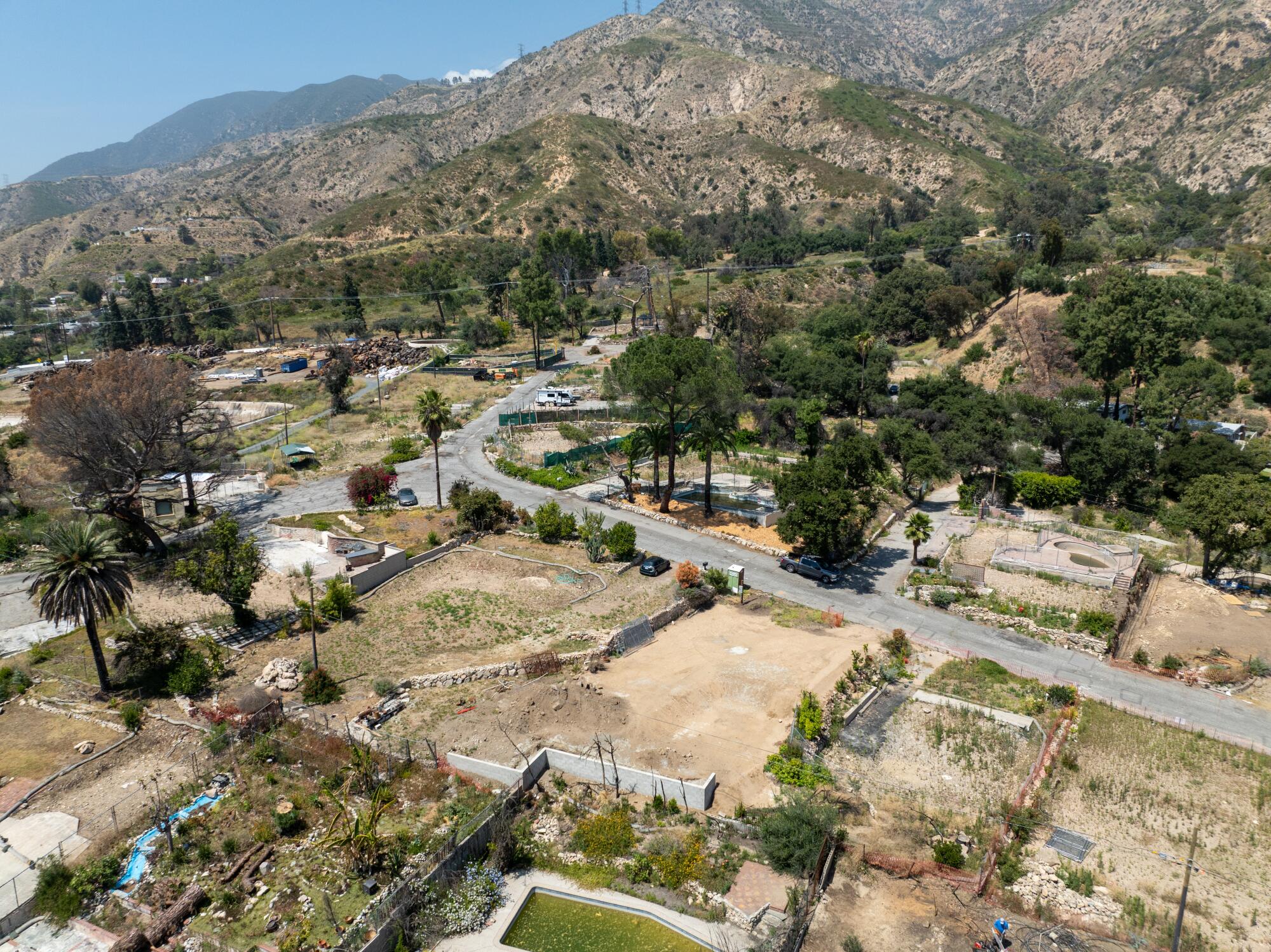
Hanisee owns one of nearly 700 properties in Altadena that’s never had sewer lines, instead operating for decades on now-outdated septic tanks or even more archaic and environmentally hazardous cesspools.
L.A. County officials — and many residents, included Hanisee — would like to connect these pockets of Altadena to the county sewage system.
But the cash-strapped county government said it simply cannot afford the estimated $70 million the new lines would cost. And although officials hope the county can eventually acquire state and federal funding for the project, the lack of certainty on the issue has left hundreds of fire survivors in a stalemate.
“Do I build [with] septic or wait for a sewer line?” said Hanisee, 59. She said this issue has been particularly frustrating as the county promised expedited rebuilding permits; “It doesn’t help much if they don’t expedite the infrastructure work,” she said.
It’s also a major financial concern. Several fire survivors in this situation told The Times that they feel torn between planning for an upgrade to county-run sewers, or just moving ahead with rebuilding and improving their onsite wastewater systems. Either option could bring hefty costs, particularly if the county doesn’t end up paying for the sewer line upgrade and it falls on residents. The worst-case scenario, many said, would be fixing up their septic system to meet current requirements, and subsequently having to pay for the sewer line installation and connection later on.
“How do you move forward when you don’t know how much money you have to spend on the build?” Hanisee said.
On Alpine Villa Drive, shown May 1, 2026, homes have mostly operated on now-outdated cesspool systems for sewage. The county is looking to install sewer lines here as the community rebuilds, but funding issues have left the project’s future in limbo.
County officials say they are aware of the quagmire facing these residents, yet they have no timeline for — or guarantee of — a resolution on the issue.
“Everything comes back to money,” said Anish Saraiya, the Altadena recovery director for L.A. County Supervisor Kathryn Barger. “We have more than $2.5 billion worth of public infrastructure we have to rebuild, including these sewers.”
He said the county remains hopeful that Congress will come through with $16 billion requested in federal aid for the region’s recovery from the Eaton and Palisades fires, which could be used on the sewer project — but that hasn’t yet been allocated or even promised. His team also is exploring potential state funding or other outside money, he said.
But even if the cash were available tomorrow, Saraiya noted that the engineering and construction could be lengthy, and the project could be completed after homes that need it are otherwise ready to be occupied.
“There are a lot of uncertainties,” Saraiya said. “We feel confident we can secure the funding necessary to make sure that it’s not an obligation on homeowners, but that is a bit of a timing challenge.”

Michele Hanisee, shown May 1, 2026, is trying to rebuild her home on Gaywood Drive as fast as possible. But she said it’s hard to move forward with looming uncertainty around her home’s sewage system, as she’s always operated on a standalone septic system. The county has said it would like to install and connect such homes to sewer lines, but don’t have the money to do so.
Timing, however, is of the essence for fire survivors. Many say they can’t afford to lose momentum on their rebuild, concerned about losing contractors, rising construction costs or how additional delays could further shrink their already-dwindling insurance payouts for temporary housing.
Others feel completely stymied by this latest headache, which only builds on other unexpected costs and hurdles in an already complicated process.
“Will we be forced to go onto the sewer?” said Patricia Anderson, Hanisee’s neighbor, who still hasn’t decided whether she can or will rebuild. “And will we have a big expense for that? Those kind of issues are a concern.”

Patricia Anderson, 83, shown May 1, 2026, would love to rebuild her Altadena lot on Gaywood Drive, but the lack of clarity around potential sewage upgrades for her street has exacerbated the already overwhelming process.
About half of the 682 lots with on-site sewage systems — most of which are septic tanks — experienced fire damage or total destruction, according to county records. These systems, scattered across Altadena, “pose significant risks of groundwater contamination, surface water pollution and potential public health hazards,” according to a statement from the L.A. County Department of Public Works. But the department noted that replacing all of them at once is a large-scale project that “requires a level of cross-departmental integration that has historically been difficult to achieve in disaster recovery settings.”
So far, the county has funded technical planning for the sewer expansion, but environmental reviews, feasibility studies and securing resident permissions — as many of the affected streets are private — have not been completed.
Even though county officials hope to find a way to pay for a widespread sewer upgrade, they’ve also presented residents with an option to form small community improvement districts, or property tax assessment groups, to finance small portions of municipal sewer lines. About a dozen neighborhood groups are considering that option, but many fire survivors worry it only adds to their already-squeezed budgets; estimates of up to $70,000 per lot have been circling neighborhood group chats, if not more. The county’s estimate of the cost by parcel is actually higher: between $85,000 and $134,000, depending on a property’s location and topography.
But the idea of a fragmented sewer installation and residents footing the bill misses the context of this moment, said Morgan Whirledge, a new representative on the Altadena Town Council, which can pass along concerns or recommendations to Los Angeles County leaders, but holds no real governing power or spending authority. He is a fire survivor whose home previously ran on a cesspool system.
“This work presents an opportunity to coordinate,” Whirledge said, noting ongoing undergrounding of power lines by Southern California Edison and other widescale construction. “You don’t want to come rip a street up twice.”
The county’s Department of Public Works has said that residents rebuilding like-for-like, without major changes to the size or setup of their home, can continue to use on-site septic systems, if they’re in good condition. But any other rebuild requires additional testing and potential upgrades or expansions.

Morgan Whirledge surveys the initial stages of rebuilding at his Altadena lot on May 1, 2026, including where his outdated cesspool system still sits underground.
If residents are willing to take a gamble on the unfunded sewer expansion project, rebuilds can be approved “with the intent to connect later, even if the sewer installation isn’t yet scheduled,” the Public Works Department statement said.
Barger, Altadena’s most direct governmental representative, said she understands this is an issue “that can slow recovery if we don’t get it right.”
“My focus is on finding a path forward that gives residents clarity, avoids unnecessary costs, and ensures we’re rebuilding Altadena in a way that is sustainable for decades to come — not just patching together short-term fixes,” Barger said in a statement.
Some worry that 16 months after the fire, it’s already too late for that.
Hanisee is still waiting on her permits, which if approved, include plans to connect to a new county-run sewer, which she hopes isn’t too optimistic.
“There’s this huge unknown liability for people whose streets didn’t have a sewer line,” Hanisee said. “We just want to go home and also not be forced to sell and leave because of all these issues that are creating obstacles to rebuilding.”
Because she’s not building like-for-like, if she ends up needing to rely on her old septic tank, it will require additional testing and possibly an expansion or update, both of which would add more costs to her rebuild. She also worries that she’ll end up having to pay for the new sewage lines.
What once felt like quirks of their Altadena neighborhood — helping upkeep the road, running on a cesspool — “all these things … have turned into nightmares,” Whirledge said. “It’s this cumulative effect of these incremental cost increases and complicating factors. That can be a huge blow at a time when you’re already really vulnerable.”
He and his family transitioned from the cesspool to septic for their rebuild, while also building for the possibility of a future sewer line connection — a plan he realizes is cost-prohibitive for many fire survivors, especially when there’s still a real chance that residents have to fund the new sewer line.
Decommissioning his old cesspool and buying the new septic tank already cost almost $10,000, he said, and installation and testing could easily triple that. His insurance policy does provide some reimbursement for code upgrades, but he said it won’t come close to the costs the family is facing.
“It’s a lot of money,” Whirledge said, “especially for something you want to never have to think about.”

A worker pumps sewage from a portable toilet on the property of Morgan Whirledge, who is in the initial stages of rebuilding at his Altadena lot, including where his outdated cesspool system still sits underground.

:quality(70):focal(1828x1236:1838x1246)/cloudfront-us-east-1.images.arcpublishing.com/tronc/4DJICVL2JJF6PNUDITA2ESGN6I.JPG)