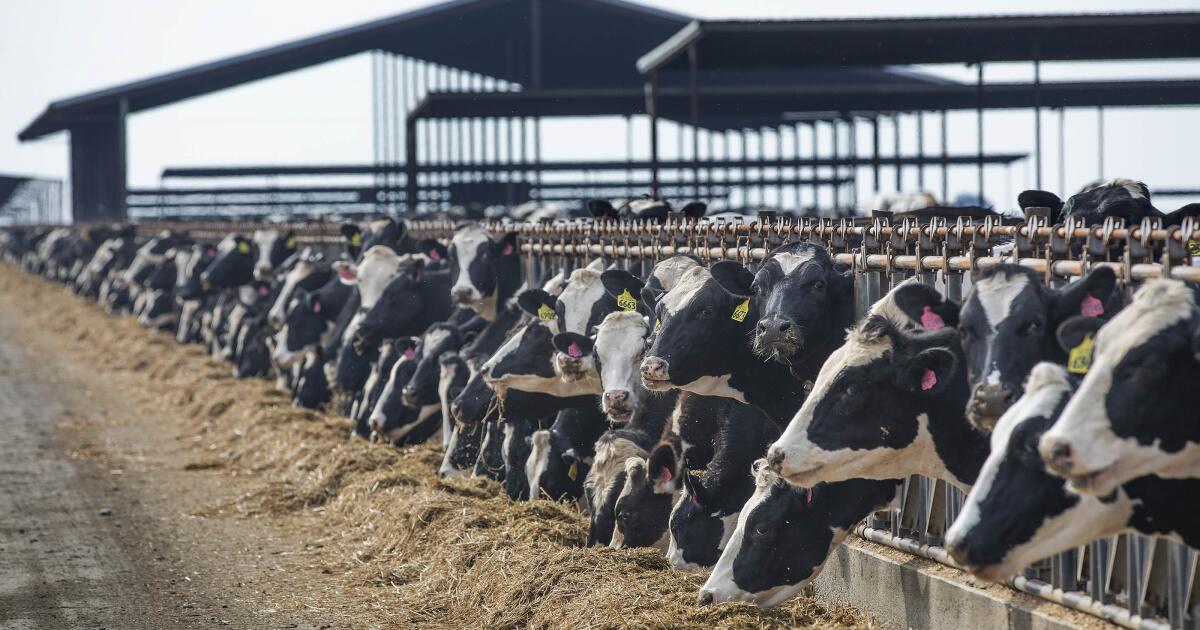
Scientists are sounding alarms about a genetic mutation that was recently identified in four dairy cow herds, nearly one year after H5N1 bird flu was first reported in Texas dairy cattle.
Although not confirmed, scientists believe the infected herds are located in San Bernardino County, where health officials announced a dairy outbreak last week.
The genetic mutation is one that researchers have dreaded finding because it is associated with increased mammal-to-mammal transmission and disease severity.
“That is the mutation found in the first human case, which was extremely pathogenic in ferrets,” said Yoshihiro Kawaoka, an infectious disease expert at the University of Wisconsin, Madison and the University of Tokyo. “Finding the same mutation in cows is significant.”
The mutation is called PB2 E627K, and it was seen in a Texas dairy worker last March. It was not seen again until these sequences were uploaded late Tuesday. The data was uploaded by the USDA’s National Veterinary Laboratory Services to a public access genetic repository known as GISAID.
Henry Niman, an evolutionary molecular biologist with Recombinomics Inc., a virus and vaccine research company in Pittsburgh, reviewed the sequence data and reported the results to The Times and on social media Wednesday.
Last summer, Kawaoka exposed ferrets in his laboratory to that viral strain. He found the ferrets were able to transmit the virus to one another via respiratory droplets, and it killed 100% of the infected animals.
The Texas dairy worker who was exposed to a viral strain with the mutation complained only of conjunctivitis; he didn’t have a fever or show signs of respiratory dysfunction.
Richard Webby, a virologist at St. Jude Children’s Research Hospital, in Memphis, Tenn., said that the mutation “on its own is not a game changing worry for me.”
However, he said, if there is evidence that viruses with this mutation are actually spreading in cows “or any other host for that matter…. it’s not a stretch to think it could help enable more human infections, maybe with more disease.”
The data provided to GISAID don’t include location information, so scientists often use other clues to identify the herds.
In this case, because the sequence data was added Tuesday, it is likely from herds that were only recently reported by the USDA. In the last week, herds from Idaho and California have been added to the USDA’s tally.
The herds in California have the more common B3.13 strain, which has been associated with dairy cows since last year. The strain circulating in Idaho is D1.1, which spilled over from wild birds earlier this year.
Therefore, the new sequence data added on Tuesday — which were of the B3.13 variety — are likely from infected California herds, said several scientists the Times spoke with. And they pointed to a recently reported outbreak in four dairy herds from San Bernardino County as the likely source.
Since the outbreak was first reported in dairy cows last March, 70 people have been infected and one person has died. According to the USDA, 985 dairy herds have been infected, with 754 of those located in California.
“The key now is for California public health officials and hospital systems to be watching for nasty upper respiratory infections,” said John Korslund, a veterinarian and former USDA researcher. “Especially in dairy workers and their families.”
The San Bernardino County Department of Public Health didn’t immediately respond to a request for comment.
:quality(70)/cloudfront-us-east-1.images.arcpublishing.com/tronc/QFW7KMNRHBFGXFA7YKLWCWGAAU.jpg)