
In F40: A Journey Discovering the Legend, Zanei Reveals How Composite Engineering Shaped Ferrari’s Masterpiece
The Ferrari F40 is often revered as one of the most iconic supercars ever made. As the last car personally approved by Enzo Ferrari, it represents a blend of pure performance, groundbreaking materials, and uncompromising design. To truly understand the F40’s enduring legacy, we spoke with Alessio Zanei, author of F40: A Journey Discovering the Legend, who has delved deeply into the engineering marvel that continues to captivate car enthusiasts and casual admirers alike.
Interviewer: Hi Alessio! The Ferrari F40 is legendary, even to people who aren’t car enthusiasts. Can you explain in simple terms what makes it so special?
Alessio Zanei: Absolutely. The F40 isn’t just a car—it’s an icon of engineering and design. When it launched in 1987, it was the fastest road car ever made, built to celebrate Ferrari’s 40th anniversary. What makes it stand out is that it was the last car personally approved by Enzo Ferrari himself, which adds to its mystique. Plus, the F40 was incredibly raw and focused entirely on performance. It had no luxury features—just pure speed and an aggressive design. It’s the kind of car that leaves a lasting impression, even on people who don’t know much about cars.
Interviewer: You talk a lot about Ferrari’s use of new materials in the F40. For someone who doesn’t know much about car construction, why were these materials so important?
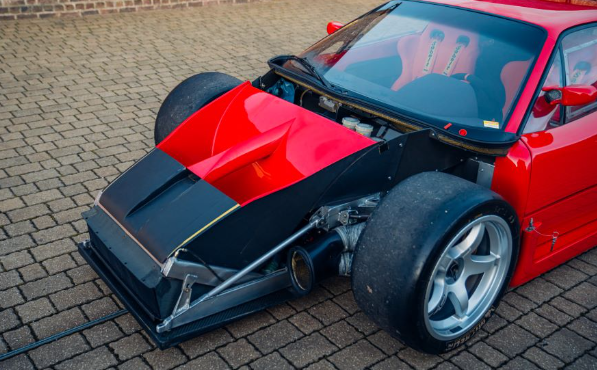
Alessio Zanei: Great question! Before the F40, most cars were built mainly from metal, like steel, which is strong but heavy. The F40 changed the game by using advanced composite materials, like carbon fiber and Kevlar, which are both lighter and stronger. This allowed Ferrari to make the car much faster and more agile. Imagine trying to run a marathon with a heavy backpack versus a lightweight one—the lighter load makes a huge difference in performance. By using these cutting-edge materials, Ferrari managed to reduce the car’s weight while keeping it incredibly durable and safe.
Interviewer: That’s fascinating! So, did Ferrari face any challenges in using these high-tech materials?
Alessio Zanei: Yes, definitely. At the time, using composites was a new frontier for road cars. Ferrari had to spend a lot of time researching and testing these materials. For example, they had previously made a fiberglass-bodied car in the ‘70s, but customers back then were skeptical about “plastic” cars. So, for the F40, they needed to ensure the materials were reliable and could handle the wear and tear of everyday driving, not just racing. They also had to balance advanced technology with practical production methods, which was a major challenge.
Interviewer: How did Ferrari’s choice to use composites influence the F40’s interior design?
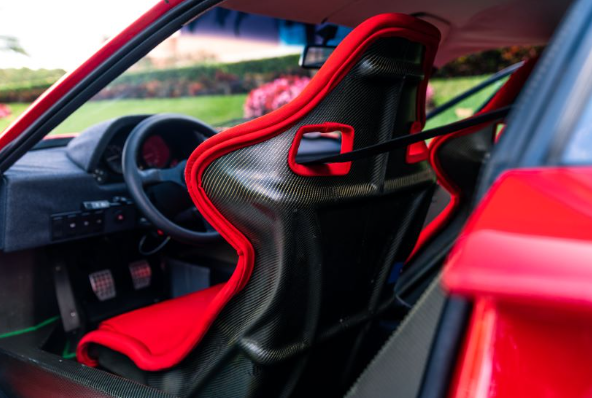
Alessio Zanei: Ferrari’s decision to use carbon fiber extensively wasn’t just about performance—it was also a design statement. The F40’s interior is famously raw and functional, with no padding or carpeting to cover up the exposed composite panels. This was intentional. As Pininfarina designer Ramaciotti explained, adding traditional interior finishes would have increased the car’s weight and diluted its technological impact. So, instead, the composites were left bare, giving the cabin a race-ready, minimalist feel that celebrates the car’s engineering roots. It’s a stark reminder that the F40 is all about speed and efficiency, not comfort or luxury. This approach makes sitting in the F40 a unique experience, like being strapped into a race car rather than a typical road vehicle.
Interviewer: But making the F40 a road car also required meeting various regulations. How did Ferrari balance these legal requirements with the car’s aerodynamic performance?
Alessio Zanei: This was one of the biggest challenges during the F40’s development. Initially, Ferrari intended to sell the F40 only in Italy, which simplified the regulatory requirements. But as global demand surged, they had to meet the homologation standards of other markets, including the United States. Each country had different rules, especially around emissions, lighting, and visibility. For example, to sell the car in the U.S., they had to add a catalytic converter to comply with stricter emissions regulations, which was a major adjustment.
Aerodynamics were another tricky area, particularly with the design of the door mirrors. The original prototypes had large mirrors mounted on the quarterlight windows, but wind tunnel testing showed that these disrupted airflow to the car’s critical side intakes. Ferrari had to redesign the mirrors to be smaller and more aerodynamic, mounting them directly onto the doors. This process involved a lot of trial and error, but the result was a design that maintained both functionality and the F40’s sleek, aggressive look.
Interviewer: It sounds like there was immense pressure to get everything right. How did the team at Pininfarina and Ferrari manage such a high-stakes project on a tight timeline?
Alessio Zanei: The entire project was a test of focus, collaboration, and instinct. According to Ramaciotti, one of Pininfarina’s key designers, the pressure was unlike anything they’d experienced before. The stakes were sky-high, and the timeline was tighter than usual, yet the team stayed committed and driven. They had about 50 stylists and technicians working non-stop alongside Fioravanti and Ramaciotti. Despite the intensity, there was a shared sense of purpose from the very beginning.
Interestingly, Ramaciotti mentioned that there was little internal debate about the car’s design direction. The team and Ferrari’s leadership seemed to have a natural, intuitive understanding of what the F40 needed to be. It was all about adhering to Ferrari’s core philosophy: simplicity, efficiency, and pure performance. As Fioravanti pointed out, the design process felt like a return to Ferrari’s roots, where the focus was on building a car without unnecessary complexity. In many ways, it was a simple yet powerful approach that resulted in a car that felt “right” from concept to production.
Interviewer: The F40’s development seems to be a story of balancing tradition with innovation. How do you think this approach reflects Ferrari’s broader legacy?
Alessio Zanei: The F40 is a perfect embodiment of Ferrari’s legacy. It’s a car that honors traditional engineering principles while pushing the envelope of what’s possible. By blending advanced composite materials with proven techniques like a reinforced steel chassis, Ferrari created a car that was both groundbreaking and practical for production. This hybrid approach allowed them to create something revolutionary without sacrificing the brand’s reputation for durability and quality. The F40 is more than a performance icon; it’s a testament to Ferrari’s ability to innovate under pressure while staying true to its core philosophy of making cars that stir the soul. It stands as a milestone in automotive history, showing what can be achieved when performance and design are perfectly aligned.
Interviewer: Speaking of composites, carbon fiber played a huge role in the F40. Can you break down why carbon fiber was such a game-changer for this car?
Alessio Zanei: Carbon fiber was a game-changer because it’s incredibly light yet extremely strong. Compared to steel, it allowed Ferrari to cut significant weight from the car, which translates directly into better acceleration, handling, and overall performance. The F40 was one of the first road cars to use carbon fiber on such a large scale. This material allowed engineers to shape and reinforce different parts of the car precisely where strength was needed most, while keeping everything else as light as possible. It’s like tailoring a suit to fit perfectly—every fiber was aligned to handle the stress and forces the car would encounter at high speeds.
Interviewer: You also mentioned that using carbon fiber affected the F40’s production process. Can you elaborate on that?
Alessio Zanei: Definitely. Using carbon fiber and other composites added a layer of complexity to the production process. For instance, the body panels were made by embedding these fibers in resin and curing them in molds under heat and pressure. This method required careful control, but it didn’t demand the expensive metal-stamping equipment used for traditional cars. It made the F40 ideal for a limited production run. However, Ferrari had to work closely with suppliers to ensure they could meet the production needs. Roberto Barbiero, the head of Project Development, explained that while they wanted to use all carbon fiber, limitations in supplier capabilities and production timelines forced them to balance carbon fiber with other materials like Kevlar and fiberglass. The result was a lightweight, strong chassis that was still manageable for production at scale.
Interviewer: Lastly, what do you think the legacy of the F40 teaches us about automotive design today?
Alessio Zanei: The F40’s legacy is a masterclass in prioritizing performance while being creative with materials and design. It teaches us that sometimes less is more—simplicity and focus can lead to something extraordinary. In today’s world of hypercars loaded with technology, the F40 stands as a reminder of the pure, unfiltered driving experience. It’s a car that puts the driver in full control, with no electronic aids to interfere. Modern engineers can still learn from the F40’s spirit of innovation, where every choice served a purpose. Even now, the F40 continues to inspire with its uncompromising dedication to speed and beauty. It’s a perfect blend of art and science, and that’s a legacy worth cherishing.