In a case that calls into question plant clearing techniques that have become fundamental to the California Department of Forestry and Fire Protection, or Cal Fire, the San Diego Superior Court has ordered the agency to amend a program to reduce wildfire risk across the state because it could make things worse.
The years-long legal action filed by the California Chaparral Institute and Endangered Habitats League against the Board of Forestry and Fire Protection within Cal Fire, highlights deep rifts between ecologists’ and firefighters’ approaches to solving California’s wildfire crisis.
Richard Halsey, director of the California Chaparral Institute, was elated. “Chaparral and sage scrub is more than 10% of the state,” he said.
“Despite all the rhetoric about how we love biodiversity, you’re going to wipe out where most of the biodiversity is in the state,” and in the process make the landscape more flammable, Halsey said of the Cal Fire plan.
Cal Fire’s Vegetation Management Program aims to use prescribed fire plus tree and brush cutting to reduce the risk of a wildfire igniting, exploding out of control and jeopardizing lives and property. In doing so, the agency also tries to nurture the biodiversity of native species and protect clean water and soil health.
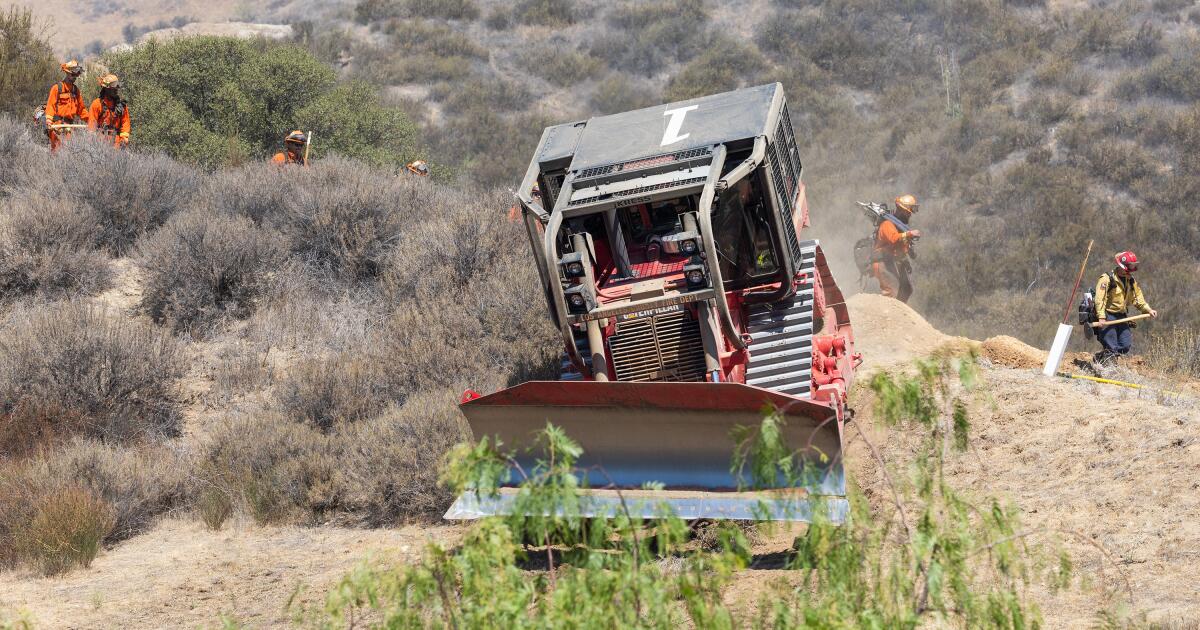
Crews clear a firebreak during the July 2023 Victor blaze in Santa Clarita.
(Jason Armond / Los Angeles Times)
In California’s conifer forests, this often looks like thinning an unnaturally high density of trees and brush that fuel exceptionally severe fire.
But in Southern California, much of the wildlands are home to chaparral ecosystems of shrubs, oak trees, native grasses and flowers, and the typical approach is to cut fuel breaks: long strips along ridgelines and roadways devoid of all vegetation that can stop creeping ground fires in their tracks and give firefighters safe access to battle wind-driven blazes that can easily jump.
Severe and frequent wildfires are already causing some areas with trees to become chaparral and some areas of chaparral to become just flammable grasses. The legal action claimed that Cal Fire’s chaparral firebreaks can cause this “type conversion.”
When native chaparral is cleared from a landscape, whether by a wildfire or through a vegetation management project, it’s often not native plants that grow back, but instead opportunistic fast-growing invasive grasses.
Cal Fire argued that its program addressed this in its environmental impact review. But the California Chaparral Institute and Endangered Habitats League said the department did not take into account that these invasive grasses are much more flammable than the native species it is cutting down — meaning it could increase fire risk.
The Vegetation Management Program guides real work on the ground. So far this year it has completed more than 5,400 acres of work on 26 projects. About 13% of the work was in shrublands, like chaparral.
The board did not immediately respond to a request for comment.
The ecology organizations filed the petition in 2020, and in 2023 the San Diego Superior Court ruled for Cal Fire. The organizations appealed, and, in May 2025, California’s 4th District Court of Appeal reversed the trial court and ordered it to determine how to remedy the problem.
On Nov. 14, the lower court ordered Cal Fire to address the potential for type conversion to worsen wildfire risk and until it does so, barred individual projects in the Vegetation Management Program from relying on the program’s blanket environmental review to comply with the California Environmental Quality Act.
The order does not apply to new fuel break projects that already have a plan to prevent flammable grasses from growing, nor to maintaining existing fuel breaks. Projects on land that has already lost its trees or chaparral to type conversion are also allowed to continue.
Ecologists and fire officials ultimately have the same goals: reduce devastating wildfires and protect native biodiversity. After all, fire can wipe out thousands of acres of native ecosystem — and the non-native ecosystems that plague the region can much more easily ignite.
But ecologists tend to favor solutions preserving native ecosystems (such as programs focused on reducing the chance of fire starting in the first place), whereas fire officials tend to gravitate toward solutions that view plants as “fuel” for a potential fire (such as cutting away vegetation to create fuel breaks).
Fire officials argue fuel breaks are one tool that gives crews a much needed strategic advantage when they’re working to protect communities. However, some ecologists question whether breaks even help in ember-driven fires and whether fire departments actually staff fuel breaks during an emergency.
These differences came into full focus as fire departments and land managers in the Santa Monica Mountains began a project to build a network of fuel breaks throughout the region in September, thanks to an expedited approval process created by Gov. Gavin Newsom and funding from the $10-billion climate bond that California voters approved last November.
“The governor and legislature were clear: We need to move faster to get more of these projects in … . Wildfire risks are getting worse,” Wade Crowfoot, California’s natural resources secretary, said at the time. “A well-designed fuel break that takes environmentally protective measures will not only protect these communities this winter but will allow for broader, more holistic landscape management.”
:quality(70)/cloudfront-us-east-1.images.arcpublishing.com/tronc/4FUYSZAQZVBMRPPRQDJJYEDXDM.jpg)

:quality(70):focal(1407x478:1417x488)/cloudfront-us-east-1.images.arcpublishing.com/tronc/ZQGCHTGIA4NQARQZ3JFBPVFNYA.jpg)