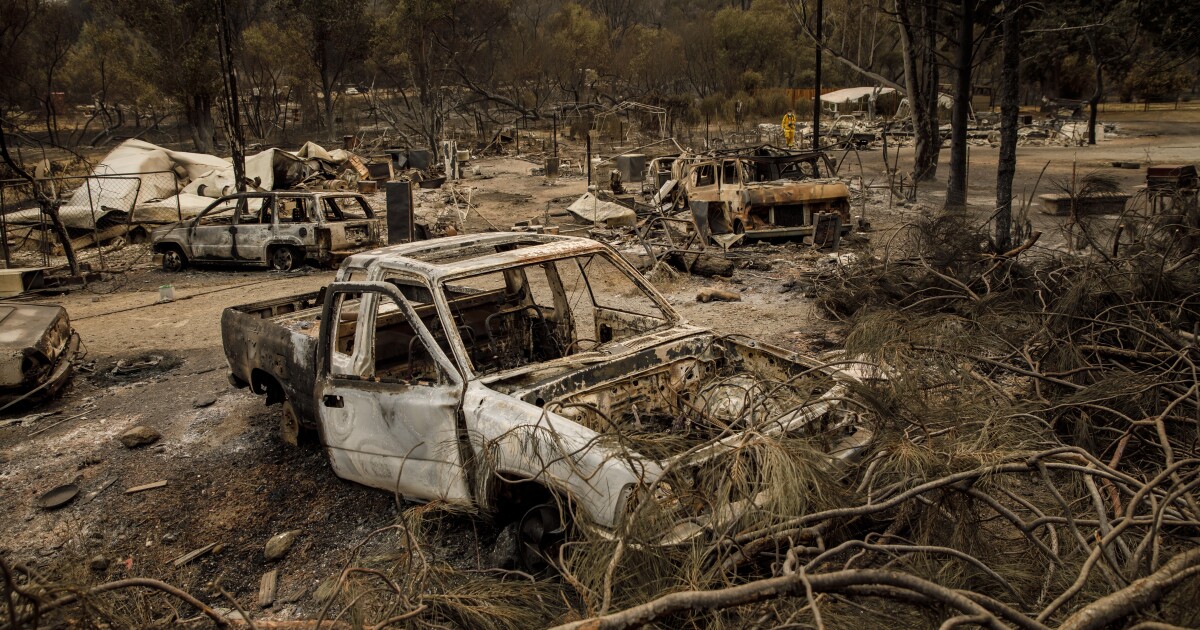
The sheer acreage consumed by fire in California in recent years is numbing: more than 2.5 million acres last year, and 4.3 million acres the year before that.
Already in 2022, before peak fire season has descended upon this drought-parched state, fire has burned nearly 17,000 acres.
Yet not all fires are equal. New research from UC Irvine shows that fires caused by human activity — be it arson, a neglected campfire, sparking electrical equipment or ill-conceived gender reveal parties — spread faster, burn hotter and destroy more trees than those caused by lightning strikes.
“The physics behind the fire is of course the same, but humans increase the risk of having these kinds of ignitions at really bad times during the year,” said Stijn Hantson, the study’s lead author. A project scientist in the lab of UCI Earth systems professor James Randerson at the time of the study, Hantson is now an Earth systems scientist at Universidad del Rosario in Bogotá, Colombia.
Wildfires are a natural part of a forest ecosystem and have been around longer than humans. But nature tends to start fires in less combustible conditions than humans do.
Longer droughts and higher temperatures have dried out vegetation and turned fire season into a year-round event. At the same time, humans have moved ever farther into previously unoccupied land that is more primed than ever to ignite.
Lightning typically happens in humid conditions, and is often accompanied by rainfall, both factors that dampen the growth of naturally occurring fires. But people light campfires, flick cigarettes and use machinery all year long, including when it’s dry and windy out.
“This is a nice and timely study that highlights more of the nuances of wildfire in the state,” said John Abatzoglou, a UC Merced climatologist who was not involved with the new research but has studied the effects of climate on wildfire.
“Most of the notorious fires the state has seen in the past several decades have been human-caused fires that are coincident with dry and very windy conditions,” Abatzoglou said. “These conditions often render fire suppression less effective or dangerous to fire-suppression operations.”
For the UCI study, researchers created a database of all 214 fires in California from 2012 to 2018 that could not be contained within the first 24 hours. Of these, 42.1% were caused by lightning strikes, 39.3% by humans and the rest by undetermined sources.
By the end of their first day, the human-caused fires were on average 6.5 times larger than those caused by lightning. These fast-moving fires also kill more than three times as many trees as slower ones, Hantson’s team found.
The results were published last month in the journal Nature Communications.
Randerson’s lab also developed a fire-tracking algorithm using signals from the National Oceanic and Atmospheric Administration’s Suomi satellite. By applying the algorithm retroactively to the last nine fire seasons in California, the team was able to see the relationship between a fire’s speed and the weather and vegetation where it burned.
Together, the two studies give scientists more tools to understand how a fire’s behavior affects ecosystems over time.
Human-ignited fires also tend to start in windier conditions than lightning-sparked fires, said Jennifer Balch, a fire scientist at the University of Colorado, Boulder.
In a 2017 study looking at wildfires fought by state or federal agencies from 1992 to 2012, Balch and a team that included Abatzoglou found that people caused 84% of the blazes, adding an average of 40,000 wildfires per year across the United States.
“People are starting fires 365 days a year,” Balch said, “and the chance of that happening increases as more and more people are moving into landscapes or recreating in landscapes that are flammable.”