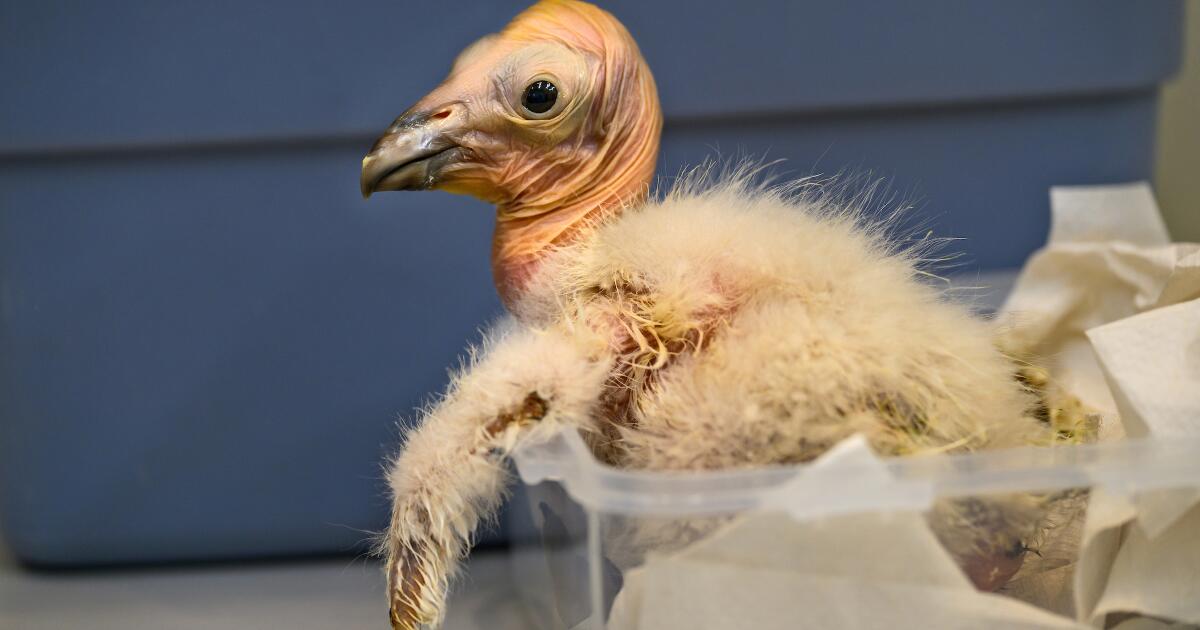
A new method of rearing California condors at the Los Angeles Zoo has resulted in a record-breaking 17 chicks hatched this year, the zoo announced Wednesday.
All of the newborn birds will eventually be considered for release into the wild under the U.S. Fish and Wildlife Service’s California Condor Recovery Program, a zoo spokesperson said.
“What we are seeing now are the benefits of new breeding and rearing techniques developed and implemented by our team,” zoo bird curator Rose Legato said in a statement. “The result is more condor chicks in the program and ultimately more condors in the wild.”
Breeding pairs of California condors live at the zoo in structures the staff “affectionately calls condor-miniums,” spokesperson Carl Myers said. When a female produces a fertilized egg, the egg is moved to an incubator. As its hatching approaches, the egg is placed with a surrogate parent capable of rearing the chick.
California condor eggs are cared for at L.A. Zoo. The animal is critically endangered.
(Jamie Pham / L.A. Zoo)
This bumper year of condor babies is the result of a modification to a rearing technique pioneered at the L.A. Zoo.
Previously, when the zoo found itself with more fertilized eggs than surrogate adults available, staff raised the young birds by hand. But condors raised by human caretakers have a lower chance of survival in the wild (hence the condor puppets that zookeepers used in the 1980s to prevent young birds from imprinting on human caregivers).
In 2017, the L.A. Zoo experimented with giving an adult bird named Anyapa two eggs instead of one. The gamble was a success. Both birds were successfully released into the wild.
Faced with a large number of eggs this year, “the keepers thought, ‘Let’s try three,’” Myers said. “And it worked.”
The zoo’s condor mentors this season ultimately were able to rear three single chicks, eight chicks in double broods and six chicks in triple broods. The previous record number of 15 chicks was set in 1997.
Condor experts applauded the new strategy.
“Condors are social animals and we are learning more every year about their social dynamics. So I’m not surprised that these chick-rearing techniques are paying off,” said Jonathan C. Hall, a wildlife ecologist at Eastern Michigan University. “I would expect chicks raised this way to do well in the wild.”
The largest land bird in North America with an impressive wingspan up to 9½ feet, the California condor could once be found across the continent. Its numbers began to decline in the 19th century as human settlers with modern weapons moved into the birds’ territory. The scavenger species was both hunted by humans and inadvertently poisoned by lead bullet fragments embedded in carcasses it ate. The federal government listed the birds as an endangered species in 1967.

A condor, one of a record-breaking 17 at the zoo, makes its way out of its shell.
(Jamie Pham / L.A. Zoo)
When the California Condor Recovery Program began four decades ago, there were only 22 California condors left on Earth. As of December, there were 561 living individuals, with 344 of those in the wild. Despite the program’s success in raising the population’s numbers, the species remains critically endangered.
In addition to the ongoing threat of lead poisoning, the large birds are also at risk from other toxins. One 2022 study found more than 40 DDT-related compounds in the blood of wild California condors — chemicals that had made their way from contaminated marine life to the top of the food chain.
“Despite our success in returning condors to the wild, free-flying condors continue to face many obstacles with lead poisoning being the No. 1 cause of mortality,” said Joanna Gilkeson, spokesperson for Fish and Wildlife’s Pacific Southwest Region. “Innovative strategies, like those the L.A. Zoo is implementing, help us to produce more healthy chicks and continue releasing condors into the wild.”
The chicks will remain in the zoo’s care for the next year and a half before they are evaluated for potential release to the wild. Thus far, the zoo has contributed 250 condor chicks to Fish and Wildlife’s program, some of which the agency has redeployed to other zoos as part of its conservation efforts.
In a paper published earlier this year, a team of researchers found that birds born in captivity have slightly lower survival rates for their first year or two but then have equally successful outcomes to wild-hatched birds.
“Because condors reproduce slowly, releases of captive-bred birds are essential to the recovery of the species, especially in light of ongoing losses due to lead-related mortality,” said Victoria Bakker, a quantitative ecologist at Montana State University and lead author of the paper. “The team at the L.A. Zoo should be recognized for their innovative and important contributions to condor recovery.”