When the long-awaited results of a necropsy of celebrity bald eagle Jackie revealed she died of bird flu, experts were surprised.
The contagious viral disease frequently kills raptors; that wasn’t odd. But her symptoms didn’t fit.
Jackie’s death from highly pathogenic avian influenza, as it’s formally known, sparked fears about the health of other eagles at Big Bear Lake, where she was born and spent her 14 years of life.
It also offers a window into a pandemic that has devastated wildlife around the world — and how much scientists still don’t know about what it’s doing to bald eagles.
A team with the San Dimas Raptor Rescue evaluated Jackie before transferring her to the Ojai Raptor Center.
(Los Angeles County Parks)
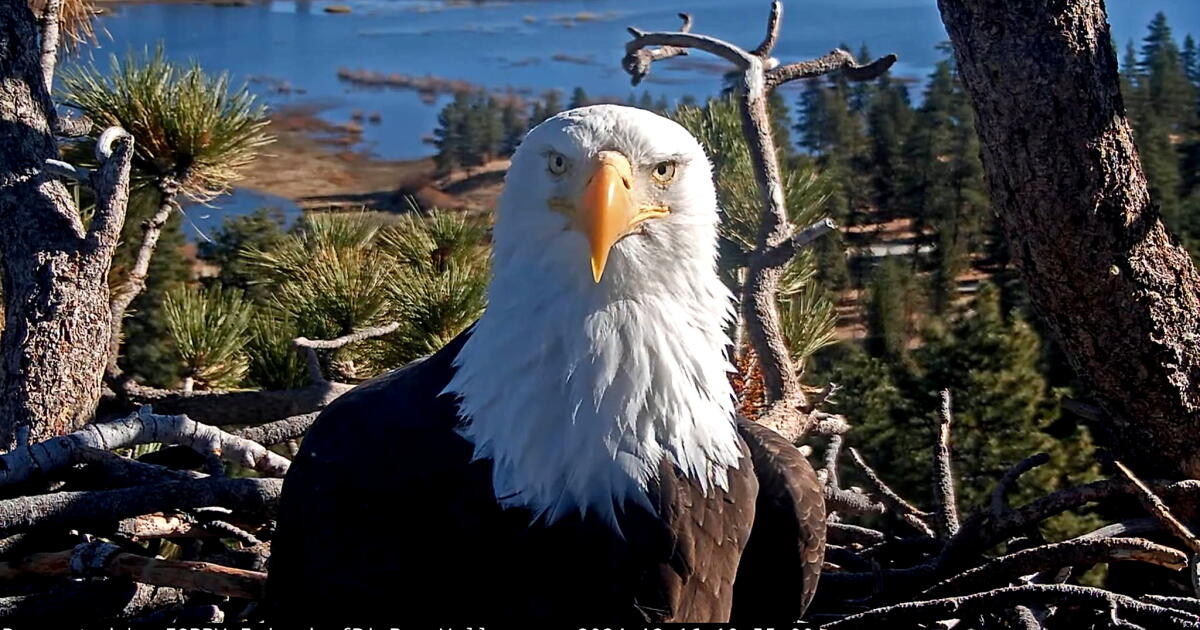
Jackie and her longtime mate, Shadow, were catapulted to internet stardom thanks to a webcam that livestreams their nest to 839,000 subscribers on YouTube. In June, their two eaglets took their first flight — a triumphant moment.
But in the wee hours of July 18, Jackie was found weak, dirty and underweight on the lakeshore. She was whisked to the Ojai Raptor Center, where an initial workup found she was severely anemic and suffering from inflamed kidneys.
Specialists puzzled over her condition. Despite intensive care, including a blood transfusion from another eagle, she died Aug. 10.
The mystery was finally resolved on Oct. 14 when the California Department of Fish and Wildlife issued a news release identifying avian flu as the primary reason for her decline.
It caused a severe ulcer in her stomach, which led to internal bleeding and anemia, according to Steve Kubiski, director of disease investigations for the San Diego Zoo Wildlife Alliance. The damaged tissue also let bacteria enter her body, leading to a serious secondary infection.
Jackie wasn’t tested for avian flu while in care because she did not show the “clinical signs that would ordinarily prompt testing for the disease,” the Ojai Raptor Center said in a statement. A postmortem summary obtained through a public records request described her presentation — primarily a gizzard ulcer — as “unusual in wild birds” but noted it had “been reported in other species.”
When eagles arrive at rehabilitation facilities with the flu, they’re often uncontrollably seizing, twisting their necks into unnatural positions, stumbling or showing other neurological problems. During flu season, state wildlife officials generally recommend euthanizing birds with severe symptoms like these.
The illness frequently kills raptors within days, and risk peaks at Big Bear Lake in the fall and winter, when migrating waterbirds and wintering eagles arrive. Jackie, on the other hand, was rescued in the summer and appeared to have been ailing for some time.
“Her main problems would not have set off my flu alarms,” said Dr. Victoria Hall, an epidemiologist at UC Davis’ One Health Institute and former director of the Raptor Center at the University of Minnesota. Yet it didn’t surprise her that the virus was manifesting in unexpected ways. Major gaps remain in our understanding of how it affects eagles, she said.
“We know everything about flu until tomorrow comes, and then it does something different, right?” she said. “It mutates, it changes.”
Even if her caregivers had diagnosed her earlier, it might not have changed Jackie’s fate.
There is no known cure for the illness in wild birds. When treated, birds typically receive supportive care, such as keeping the patient hydrated, providing nutrition and addressing other ailments, experts said.
That’s largely what the Ojai Raptor Center was doing, said Dr. Hugues Beaufrère, medical director of UC Davis’ California Raptor Center.
An earlier diagnosis might have clued them into the fact “that the prognosis was not great,” Beaufrère said.
Jackie was one of a kind, but her death was not.
She was one of millions of birds killed by the current strain of the H5N1 virus since it first appeared in North America in 2021. That includes at least 1,047 bald eagles in the United States, according to the U.S. Department of Agriculture, which monitors the virus in animals. Nine of the reported eagles, including Jackie, were from California, where the virus was first detected in 2022.
Researchers say the reported numbers are likely a vast undercount because they primarily reflect dead birds that have been collected and sent in for testing. And testing in wildlife remains limited.
During a 2022-23 outbreak in Michigan, it’s believed that more than 400 bald eagle breeding pairs perished, said Bill Bowerman, a University of Maryland professor who has studied the raptors for decades.
“The only thing in my entire career that scared me in 43 years was seeing vast areas of Michigan where there were no eagles in the nest sites,” he said.
The virus has spread across the globe. This summer, it reached Australia, triggering a seabird die-off, as well as New Zealand.
It’s also the same virus that has been devastating poultry operations nationwide and infecting dairy cattle. A new outbreak in dairy cows is surging in the Pacific Northwest, where one farmworker died and three others were reported infected.
In 2024, Chris Walzer, executive director of health for the Wildlife Conservation Society, described the virus’ march across the globe as “apocalyptic.” He said it presented an “existential threat to the world’s biodiversity.”
In Hall’s opinion, the best way to honor Jackie’s legacy would be to learn more about the virus’ effect on wild birds — and her star power could help make a difference. A fundraising campaign launched by the Ojai Raptor Center after it took Jackie in brought in about $1.57 million, according to records through mid-November.

Jackie and Shadow first paired up in 2018 and earned a devoted following due to a popular livestream of their nest.
(Friends of Big Bear Valley)
Jackie’s death left many of her devotees wondering whether other eagles that fly and forage in Big Bear are at risk, said Jenny Voisard, spokesperson for Friends of Big Bear Valley, the nonprofit behind the nest cam.
Jackie is the first known wild bird from the Big Bear Lake area to be infected with bird flu, but there have been other cases in San Bernardino County, according to the California Department of Fish and Wildlife.
It’s likely that Jackie got sick by feasting on a flu-carrying bird or through exposure to a contaminated environment, Hall said.
Hall considers all wild birds to be at risk.
How much of the virus might be circulating at the lake, if any, is unclear. The state wildlife department tracks the disease by testing dead birds. But many dead birds are never found.
One upside: There are signs that a good proportion of bald eagles survive infection, Beaufrère said, pointing to a study that found about 69% of eagles sampled in Minnesota had antibodies to influenza.
So far, nothing on the livestream suggests anything is awry with Shadow.
In the wake of Jackie’s death, Shadow began bonding with Kaydee, a female, engaging in “nestorations” and even “beaky kisses,” as Friends of Big Bear Valley puts it. But recently he’s been spotted with a “beautiful stranger” eagle, also believed to be female, the nonprofit said in a social media post.
Voisard said they’ll still be keeping a watchful eye.
Times staff writer Susanne Rust contributed to this report.