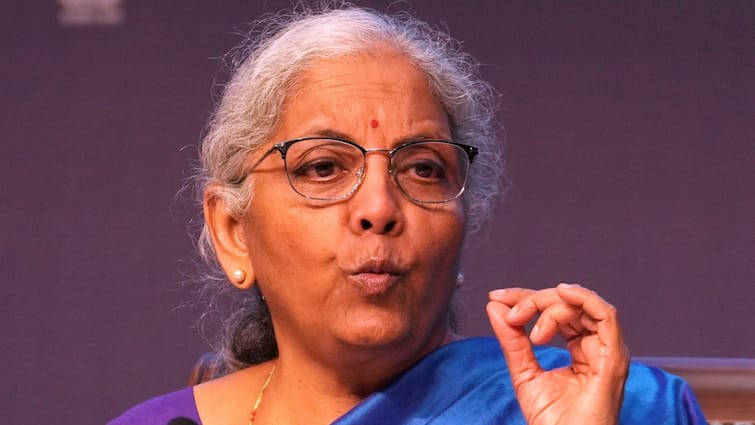
Union Finance Minister Nirmala Sitharaman on Wednesday underscored that the Goods and Services Tax (GST) system is a joint exercise between the Centre and the states, not a unilateral one. She said GST should not be viewed as a static framework, as rate cuts are designed to generate higher buoyancy, with consumers expected to spend more when taxes are reduced.
“The GST Council should be seen as a platform where the Centre and the states sit together—I mentioned this in the Council also. The Centre may be a one-third partner, and the states together may be a two-thirds partner. But we are all in this together. Whatever is gained or lost is shared by everyone. It is not as though if the states lose, the Centre gains. If we all lose, then all of us lose…” Sitharaman said, as quoted by news agency IANS.
Delhi: Union Finance Minister Nirmala Sitharaman says, “To look at the GST Council as a platform where the Centre and the states sit together—I mentioned this in the Council as well. The Centre may be a one-third partner, and the states together may be a two-thirds partner. But… pic.twitter.com/rxgbVJitix
— IANS (@ians_india) September 3, 2025
She added that any gains or setbacks are absorbed collectively, noting that the Centre shoulders a larger share when losses occur, since half its own share is redirected to states.
“Even Centre is losing; Centre is losing more in a way. If you divide it 50-50, 41 goes back to the states. The Centre and the states are together in it, no one is a donor and no one is a donee in it,” she remarked.
Revenue Impact Estimated at ₹48,000 Crore
Arvind Shrivastava, Secretary in the Department of Revenue, Ministry of Finance, clarified that the impact of the rate rationalisation is pegged at around ₹48,000 crore, calculated on the basis of 2023–24 consumption data.
“…The net revenue implication is expected to be around ₹48,000 crore, based on the consumption base of 2023–24, as that is the year for which we had segregated data. To better appreciate this exercise, it is important to understand that focusing narrowly on a single number may not reflect the full picture. Typically, a rate rationalisation exercise generates buoyancy effects. While the figure may be mathematically calculated using 2023–24 consumption data, in reality, outcomes will evolve differently, and buoyancy is expected to play a significant role in enhancing revenue. Consumer behaviour—what they spend on and how much—will also be positively influenced by lower prices resulting from this rationalisation…” Shrivastava told reporters.
Delhi: Arvind Shrivastava, Secretary, Department of Revenue, Ministry of Finance, says, “…The net revenue implication is expected to be around ₹48,000 crore, based on the consumption base of 2023–24, as that is the year for which we had segregated data. To better appreciate… pic.twitter.com/k14gIe630m
— IANS (@ians_india) September 3, 2025
He further stressed, “The money that the government does not collect as tax will remain in the pockets of consumers, who will spend it elsewhere in the economy. So, while there is naturally a revenue implication, it is a dynamic number. It will depend on consumer response, buoyancy factors, and compliance improvements.”
“Mathematically, revenue implications can only be calculated using historical data, but those numbers may not hold true, because consumer behaviour, buoyancy, and compliance are expected to improve. Historically, after the compensation cess was removed, GST buoyancy went up significantly,” he added.
Earlier, West Bengal Finance Minister estimated the revenue loss to be close to ₹47,700 crore.
Opposition-Ruled States Raise Alarm
Despite the Centre’s projection that GST reforms could raise medium-term growth by up to 0.5 percentage points, several opposition-ruled states expressed apprehension about revenue erosion. Ahead of the two-day Council meet from September 3 to 4, finance ministers from Himachal Pradesh, Jharkhand, Karnataka, Kerala, Punjab, Tamil Nadu, Telangana and West Bengal held a separate discussion seeking a clear compensation formula.
Himachal Pradesh Finance Minister Rajesh Dharmani told news agency ANI, “Unanimously, everyone has agreed in favour of GST rate rationalisation. Now there will be three slabs. Effectively, it will be 5% and 18% percent. 12% and 28% have been abolished. There will be 40% on luxury goods.”
Jharkhand Finance Minister Radhakrishna Kishore cautioned that his state could lose nearly ₹2,000 crore each year under the new structure. “If the Centre agrees to compensate us for whatever loss we would incur, then we have no issues in approving the agenda before the Council. I don’t think the issue will come up for voting, as in a federal structure, it is the responsibility of the Centre to compensate states for revenue loss,” he said, as per news agency PTI.
In a separate press note, Kishore added, “Jharkhand is a manufacturing state. The Goods and Services Tax (GST) system has adversely affected the state’s internal revenue collection.” He pointed out that between 2017 and 2024–25, the state has already faced a revenue hit of ₹16,408 crore, which could escalate to nearly ₹61,670 crore by 2029.
Highlighting Jharkhand’s structural disadvantage, Kishore stressed that “around 75 to 80 per cent of coal and steel production from Jharkhand is consumed outside the state. Thus, the benefits of GST are accruing to consumer states.” He called on the Centre to ensure a guaranteed annual support of ₹2,000 crore until the state’s revenue stabilises.