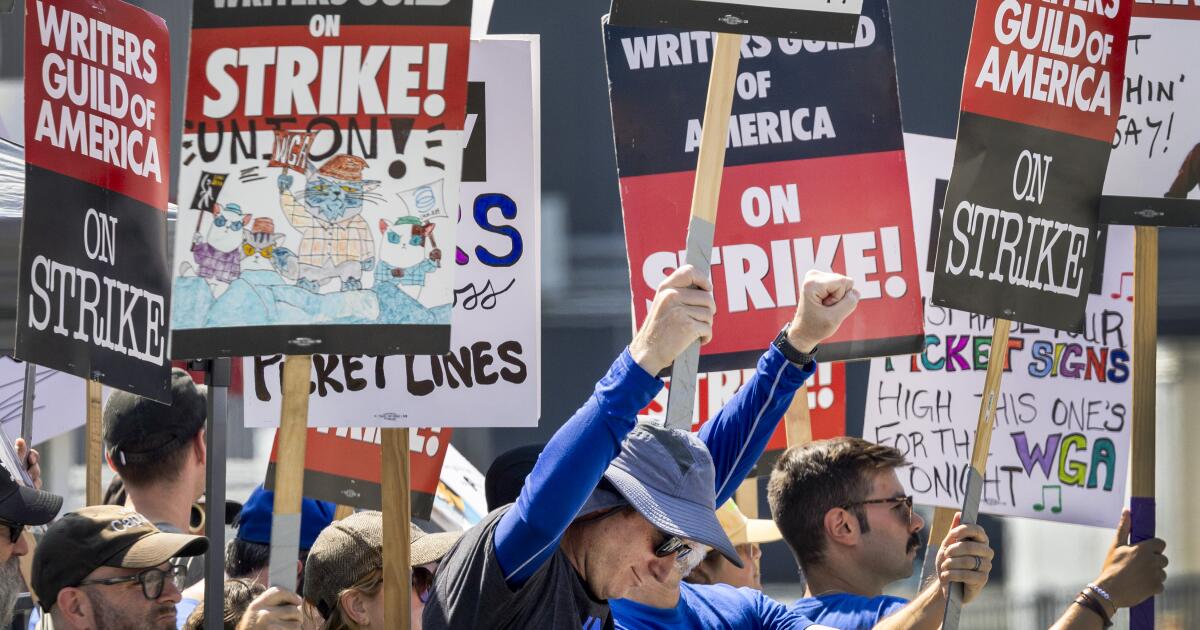
The historic, 146-day writers’ strike finally appears to be over. Details are scarce, but the Writers Guild of America sounds triumphant: It’s calling the deal “exceptional” and heralding gains in just about every arena. And though there are many reasons that the union ultimately won out — smart organizing and a memeable picket line, strong allyship from SAG-AFTRA, and tactical blunders by the studio execs among them — there’s one thing above all that lighted up the action: The way the writers refused to let bosses use AI to exploit them.
At a moment when the prospect of executives and managers using software automation to undermine work in professions everywhere loomed large, the strike became something of a proxy battle of humans vs. AI. It was a battle that most of the public was eager to see the writers win. It’s not the only reason why Americans overwhelmingly had the writers’ backs over the studios — according to one Gallup poll, the public supported them over the execs by an astonishing margin of 72% to 19% — but it was a big one.
As veterans of the five-month strike will tell you, concerns over the use of generative AI such as ChatGPT were not even top of mind when the writers first sat down with the studios to begin bargaining. The WGA’s first proposal simply stated the studios would not use AI to generate original scripts, and it was only when the studios flatly refused that the red flags went up.
That was when the writers realized studios were serious about using AI — if not to generate finished scripts, which both sides knew was impossible at this juncture — then as leverage against writers, both as a threat and as a means to justify offering lowered rewrite fees. That’s when the WGA drew a line in the sand, when we started seeing signs on the picket lines denouncing AI go viral on social media and headlines that touted the conflict gracing the newspapers like this one.
Every time I went down to the picket lines, AI was easily the top issue the writers wanted to discuss, in large part because it was the one that seemed a direct existential threat to the job of being a screenwriter itself. Opinions on the precise nature of the AI threat varied. Some thought the technology was utter garbage that couldn’t write a worthwhile script no matter the prompts it was given, and feared it would simply be used as an excuse to push down wages.
Others were legitimately worried that studios would try to use generative AI to take their jobs anyway, or that it would eventually get good enough to turn out a serviceable product. If that were the case, then many feared what would be lost in the process — films and series colored by real-life experience, that explored the human experience. You know, art. There was a palpable fear that tech products, built by rich and mostly white startup guys in Silicon Valley would churn out content that would reflect exactly that.
Regardless of the nature of the grievance, everyone agreed handing studios the power to decide how to use generative AI was a bad idea. All seemed to understand the importance of that red line against letting bosses automate their work away for the sake of cost-cutting, or improved efficiencies.
And the nature of that resistance was contagious. “I feel strongly about a lot of the things that the writers are striking over, from making sure that they have a minimum number of writers in a writers’ room to regulating AI,” the actor and SAG member Ellen Adair told labor journalist Alex Press in the early days of the strike.
When it became clear that studios were just as keen to automate acting as they were writing work — studios allegedly wanted the right to use motion capture to scan background actors, and use their likenesses in perpetuity — the actors pushed back too; SAG went on strike in July. Major celebrities such as Bryan Cranston and SAG negotiator Fran Drescher spoke out against AI, making common cause.
The red line that the writers drew was clearly inspiring, and unifying; not just among the screen actors who faced similar fears, but to all those watching the headlines touting an impending AI takeover, or reading memos from their managers announcing initiatives to explore the use of AI in their workplaces. That includes all the illustrators, journalists and copywriters who’ve been watching nervously as their work seemed to dry up as management embraced tools such as Midjourney and Bard.
A funny thing happened then. Observers, reporters, and even the Hollywood workers themselves began to refer to the strikers as Luddites. The real Luddites; not the caricatures. American culture has long derided anyone who protests technology by calling them a Luddite. It’s supposed to mean “ignorant” or “backwards-looking” — but that’s all wrong. The likes of Wired and Fast Co. were calling the protesters Luddites in a favorable sense, because more and more people understand that the real Luddites were not opposed to technology itself, but the way that it was used, and who it was used against.
I’ve spent the last five or so years researching and writing about those real Luddites, so I can assure you that they were smart, tech-savvy workers who saw entrepreneurs trying to automate their jobs or displace them with machines, and responded with force only after peaceful efforts to rein in the “machinery hurtful to commonality” failed. They were fine with most tech, but drew a line at the stuff that exploited them for the sole purpose of enriching another.
As such, in drawing that red line against AI, a tactic that proved so successful, the writers pulled a page out of the old-school Luddite playbook. And, like the Luddites of the early Industrial Revolution, who were for a time as beloved in England as Robin Hood, it proved extremely popular. It’s worth cheering too, as this is, I expect, just the beginning. Hollywood is far from the only industry eager to cut costs by automating work with generative AI.
From the beginning of the strike, I’ve argued that the writers are leading the way in showing workers everywhere how to resist potentially exploitative uses of AI in the workplace — and now, more than ever, that’s been shown to be true. There is great power in drawing a hard line, in refusing to let a boss use technology to erase your job, in speaking up about how you would or would not like technology to shape your life. And, if it seems that it’s only going to degrade or disrupt your way of life, there is great power in saying no. Just ask the writers.