If I see one more person saying that the only way to truly experience Christopher Nolan’s vision of “The Odyssey” is to see it in Imax 70mm, I am going to start turning cinephiles into swine.
I understand that this is a technically true statement. As we all know by now, Nolan went on his own hero’s journey with this film, using an unwieldy and extremely loud Imax camera to shoot it (a feat only he and perhaps a few other directors would be given the finances to do). Like many, I applaud his efforts and those that were made to increase the number of theaters capable of projecting Imax 70mm (and 70mm in general).
There is an undisputed cultural magnificence to reimagining a nearly 3,000-year-old tale in the most artistically immersive format currently available to filmmakers. Unfortunately, the vast majority of filmgoers will never be able to see this master vision; only 25 theaters in the country are capable of showing the film in Imax 70mm — eight in California (including four in the L.A. area); two in Colorado, New York, Texas and Tennessee; and one in Arizona, Florida, Georgia, Illinois, Indiana, Michigan, Nevada, Pennsylvania and Rhode Island.
So a little more than twice the number of U.S. World Cup venues this year. But then, you could watch the World Cup on TV.
Not that you’ll be able to watch “The Odyssey” on TV anytime soon. As a rigorous defender of the theatrical experience, Nolan requires that his films stay in cinemas and off streamers for much longer than the average movie — “The Odyssey” will likely not be available on NBCUniversal’s Peacock until early 2027.
It is a noble mission; movie theaters need all the help they can get and heading into its second weekend, “The Odyssey” has already more than recouped its $250 million production budget. It will need to make between $625 million to $750 million to break even, which seems more than doable. “The Odyssey” could well become the third-ever R-rated movie to gross $1 billion.
Film snobbery notwithstanding, however, much of that will be accomplished via non-Imax 70mm screenings, which come in a near-Homeric list of types. On top of reacquainting the populace with a story that most of us have not thought much about since that middle-school project or college classics class, “The Odyssey” is offering a lesson in “premium formats.”
On the film’s website, one can view the trailer in Imax 70mm, regular Imax, regular 70mm, Dolby Vision and large format. Given the limitation of personal screens, this only reveals the varying frame dimensions, but it’s pretty fun to flick through them.
What is less fun is trying to figure out on which, and where and when, you can actually see the damn thing. While not on par with battling carnivorous Cyclops or world-weary witches, getting a ticket to “The Odyssey,” even after opening weekend, is a voyage filled with many obstacles.
Including but not limited to the recent crash of the AMC app.
I may or may not have contributed to this crisis, having recently spent well over an hour trying to get a measly two tickets.
Though it went against all my anti-elitist beliefs, I did try to leverage my L.A. privilege and see “The Odyssey” as Christopher Nolan intended — in Imax 70mm. Alas, the only seats available for days, even in standard Imax and 70mm, were in the first row. I was forced to “downgrade” to Dolby Vision at the Burbank 16, where, by the grace of Athena, I found two non-front-row seats, albeit in the middle of a weekday. (Mercifully, this actually counts as work for me.)
I am not equipped to argue saturation levels or whatever else differentiates one format from the other, but the Dolby experience was quite immersive, both in cinematic detail (The storms! The slaughter! The suitors’ slopping wine!) and cardiac-disruptive bass notes.
Certainly, I felt a bit like Odysseus as I crept — drained, disoriented and trailing popcorn crumbs like Ithican sand — out into the sun. It was an experience like no other (seriously, to survive Imax 70mm, I might have to go into training).
So I am a bit bewildered as pundits declare that the success of “The Odyssey” reflects some larger theme about what film audiences want. Beyond, you know, a very powerful movie.
This is one of the most singular films made in recent years. So singular that it all but defies any kind of tea-leaf-reading or, heaven forbid, attempts at replication. I don’t see a future in Homeric spinoffs (unless someone wants to do a limited series on Circe, starring Samantha Morton), and while it is vital to celebrate the craft of Imax 70mm filmmaking and projection, the theatrical experience cannot afford to put all, or even many, of its eggs into that basket.
An increased reliance on “premium formats” may seem like an obvious weapon in the increasingly one-sided war between at-home and theatrical viewing, but it is not the answer. Or at least not the only answer. (For one thing, there aren’t enough Imax 70mm cameras or projectors to go around.)
Like sports fans, many cinephiles are happy to spend hours, and dollars, to have the ultimate experience — tales of folks driving across state lines and/or paying thousands to see “The Odyssey” in Imax 70mm echoed the recent stories of international visitors saving up for a year to see their team play in the World Cup.
Though marvelously affirming for film fans, this is not a sustainable business plan. Movies are supposed to be for everyone. Not just those with a neighborhood Imax 70mm theater or the ability to pay $30 for a regular Imax seat. Going to the movies should not require hours of research to choose a theater, negotiating with a scalper or finding AI-aided plots to game the system. And there shouldn’t be such an obvious and geographically rigged hierarchy.
Before you know it, Live Nation will be involved and then where will we be?
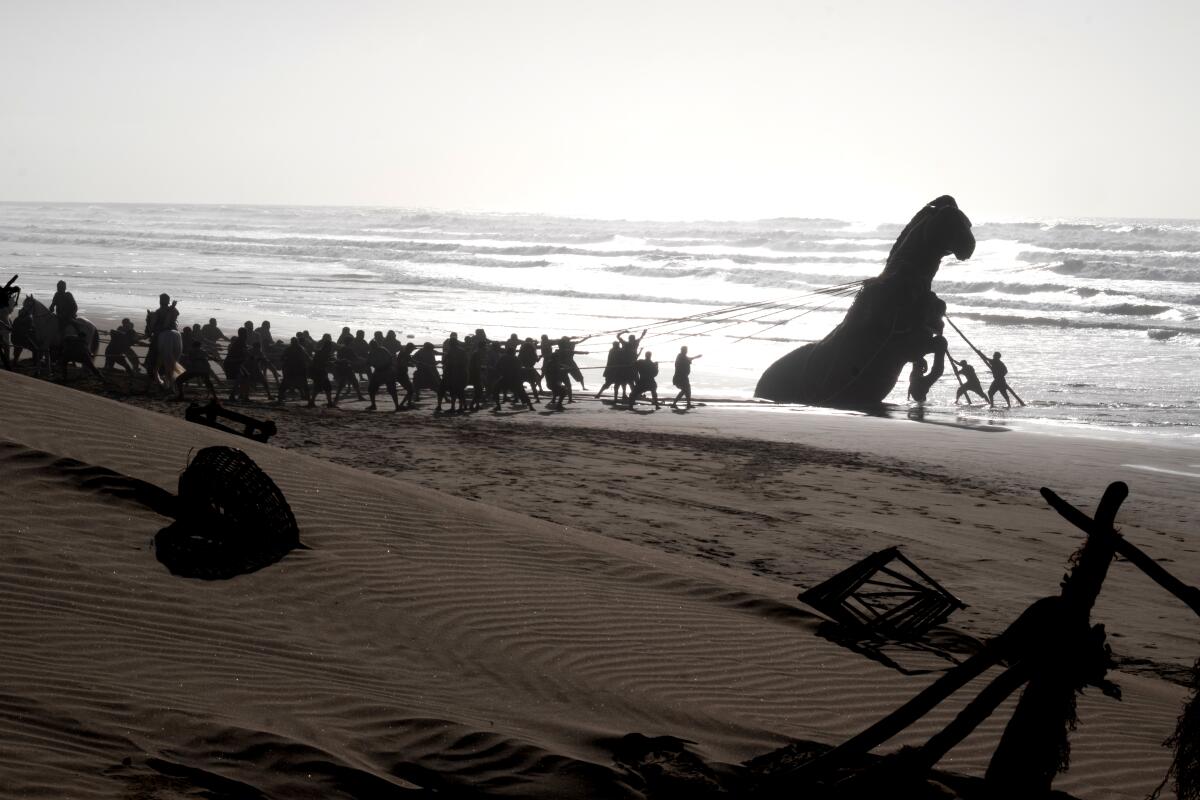
Christopher Nolan’s non-CGI visions of the Trojan Horse, the Cyclops, the sacking of Troy, the transformation of men into pigs do not require an “ultimate” aspect ratio to be remarkable.
(Melinda Sue Gordon / Universal Pictures)
“The Odyssey” is a legitimate phenomenon and that’s terrific; more power to Nolan and the theaters that benefit. As a solution to flagging box office, well, if Hollywood does not want to go the way of — as Timothée Chalamet famously said — ballet and opera, it cannot afford to become dependent on premium experiences that are accessible only to a small percentage of the audience.
Of course it’s great that “The Odyssey” was shot, and is being shown, in Imax 70mm and regular 70mm, especially in a year when stories that originated on YouTube are also burning up the big screen. Art should never be an equation of replacement. Supporting all manner of work is always the best way of preserving and celebrating the splendid diversity of filmmaking.
No matter how unparalleled the form, it still must follow function. “The Odyssey,” in whatever format it is seen, is an epic adventure with emotional undertones beyond the original story and an existential message that resonates far more than its smattering of modern language. Nolan’s non-CGI visions of the Trojan Horse, the Cyclops, the sacking of Troy, the transformation of men into pigs do not require an “ultimate” aspect ratio to be remarkable.
All the various formats have their proponents and the conversations about them have been entertaining and informative, but no matter the film or screen size, it’s a very good movie.
And that’s the only template Hollywood needs to follow.