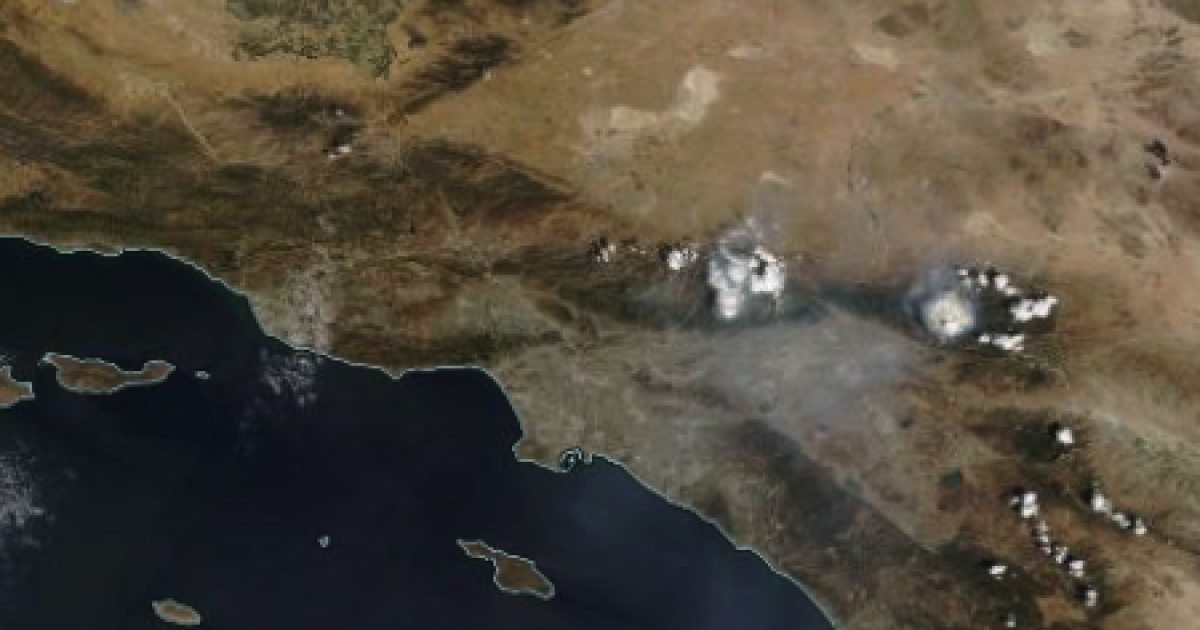
A year ago Los Angeles woke up to a red sky. Schools closed, and families packed into cars not knowing when or if they would return. In the end many couldn’t. The series of destructive fires that lasted throughout January also hurt those whose homes did not burn down — they displaced communities, strained public services, damaged infrastructure and worsened air quality for millions.
On the anniversary of the Palisades and Eaton fires, it’s easy to assume catastrophic fires are the new American reality. But they don’t have to be. If we can take advantage of technological innovations, we may be able to create a future that avoids such devastation.
Last year’s fires around Los Angeles showed that wildfire is a complex hazard, shaped by how we build, govern and respond. Across the country millions of Americans live in the wildland-urban interface, where homes and flammable landscapes meet. But many of these communities lack the resources to prepare for major fires or recover from them. Meanwhile hotter, drier weather that drives longer fire seasons is increasing risk.
But the story doesn’t end there. Land managers, fire chiefs, technologists and utilities increasingly agree: Catastrophic fires are often the consequence of a fragmented system that struggles to adopt technological innovations. Embracing new tech could prevent routine fires from turning into disasters.
Promising technologies already exist that could be used to combat wildfire. Satellites and sensors can detect new ignitions in minutes. Artificial intelligence models can project fire spread in real time. Drones can map hazardous vegetation so it can be cleared to reduce fire risk, sometimes by autonomous vehicles that can work faster, more safely and more efficiently than humans. Sensors can monitor power lines and shut them off before sparks ignite. New building materials can keep homes intact even when embers land on them.
These tools can’t eliminate wildfire, nor should they, because fire is a part of healthy ecosystems. But they can reduce wildfire’s destructive potential. They can lead to fewer evacuations, fewer neighborhoods lost, fewer lives turned upside down.
So why aren’t they widely deployed?
The United States lacks a coherent system for advancing and scaling wildfire technology innovation. Diverse actors — including federal and state fire and land management agencies, local fire districts, tribal governments, utilities, insurers, research institutions and private companies — operate under different authorities, budgets, procurement rules and data systems. Innovators who want to help don’t always know where to go. Philanthropies fund pilot programs, not adoption at scale. Fire agencies struggle to test or purchase new and unproven technologies.
And yet we have examples of what effective innovation can look like. Within the U.S. military the Defense Innovation Unit identifies promising commercial technologies and helps the services field them within a year or two. At the federal Department of Energy the Advanced Research Projects Agency-Energy identifies high-risk, high-reward technologies related to power generation, transmission and storage. In‑Q‑Tel, a nonprofit created by the Central Intelligence Agency, uses a venture capital model to invest in commercial technologies needed by intelligence and national security agencies.
None of these organizations invented every technology they advanced. Their success came from creating connective tissue. In a recent study, colleagues and I looked at how the models that led to those successes could help strengthen the wildfire technology innovation pipeline.
Wildfire needs its own version of a federal coordination entity dedicated to connecting innovators, funders, researchers, fire agencies, utilities and communities. As a neutral coordinator, such an entity could scan emerging technologies for broad situational awareness; establish shared standards to support interoperability; assist with testing and adoption to strengthen buy-in by end users; help innovators and state and local agencies navigate procurement challenges; and provide targeted funding to accelerate deployment. It also could ensure that innovators and investors look beyond headline-grabbing fire-suppression tools and instead toward mitigation and prevention technologies that can save lives and money in the long run.
Land management, controlled burns, updated building codes and community planning all remain essential. Technology can make those efforts more effective. It can give firefighters better information and residents more warning. It can help communities to avoid disaster or, failing that, to recover faster.
Some states, utilities and federal agencies already are pushing innovation. For example the California Department of Forestry and Fire Protection, known as CAL Fire, created a new Office of Wildfire Technology Research and Development. Colorado created a center of excellence to bring innovation to aerial firefighting.
But without national coordination, progress remains uneven. Communities with fewer resources risk falling further behind.
The anniversary of the L.A. wildfires is a reminder of what is at stake. Americans have transformed public risk systems before — in national security, earthquake preparedness, hurricane forecasting and aviation safety — through coordination and smart investment. Wildfire should be next.
Patrick S. Roberts is a senior political scientist at Rand and an author of the recent report “Accelerating Technological Innovation Across the U.S. Wildfire Management System.”