WASHINGTON — Miles of fencing and concrete barriers laced the nation’s capital ahead of President Trump’s military parade along the National Mall on Saturday night — an event intended to celebrate the 250th anniversary of the founding of the U.S. Army, but which also coincides with the president’s birthday.
The festivities are expected to draw hundreds of thousands of attendees, the Secret Service said, drawn to the rare spectacle of military hardware and soldiers filing down American streets. It is an event that Trump has sought ever since his first term, when he fawned over the sight of a military march down the Champs-Élysées during a Bastille Day celebration in Paris. Trump’s event, according to an Army spokesperson, will cost between $25 million and $45 million, depending on how much damage the tanks inflict on D.C. roads.
Ahead of the start of the parade on Saturday, visitors posed alongside tanks, jeeps and other military vehicles parked along the Mall, part of a large “festival” area between the Capitol and the Washington Monument. Some expressed frustration with navigating the maze of security barriers, or confusion about where the festival area ended and where they could find the entrance to the separate parade route.
One stand near the Mall had shirts reading, “The Big, Beautiful Military Parade,” a reference to the similarly named spending bill that Trump has championed of late in Congress.
Paul Brown, a 57-year-old Army veteran, had driven to the event from Ohio. On Saturday, he wore a shirt that said, “Jesus is my savior. Trump is my president,” and a hat reading, “Afghanistan War Veteran, U.S. Army.”
Brown said he served from 2010 to 2016, and deployed to Afghanistan for nine months in 2012 and 2013 before being medically retired. He told The Times that the parade was a great thing.
Soldiers take part in an Army fitness competition on the National Mall.
(Kayla Bartkowski / Getty Images)
“I was in the Army, and it’s nice to have somebody who gives a s— about the military, especially the commander in chief,” he said. “And if other countries are watching, they’ll see we can flex our muscles, too, if we have to.”
Of criticisms that such parades aren’t commonly held in America, he said, “that’s the problem — it’s something America should have been doing.”
Members of the military die for this country, he said, and deserve to be honored.
“It’s the best thing in the world,” he said. “This is history. I think this shows the military that we got a commander-in-chief who cares.”
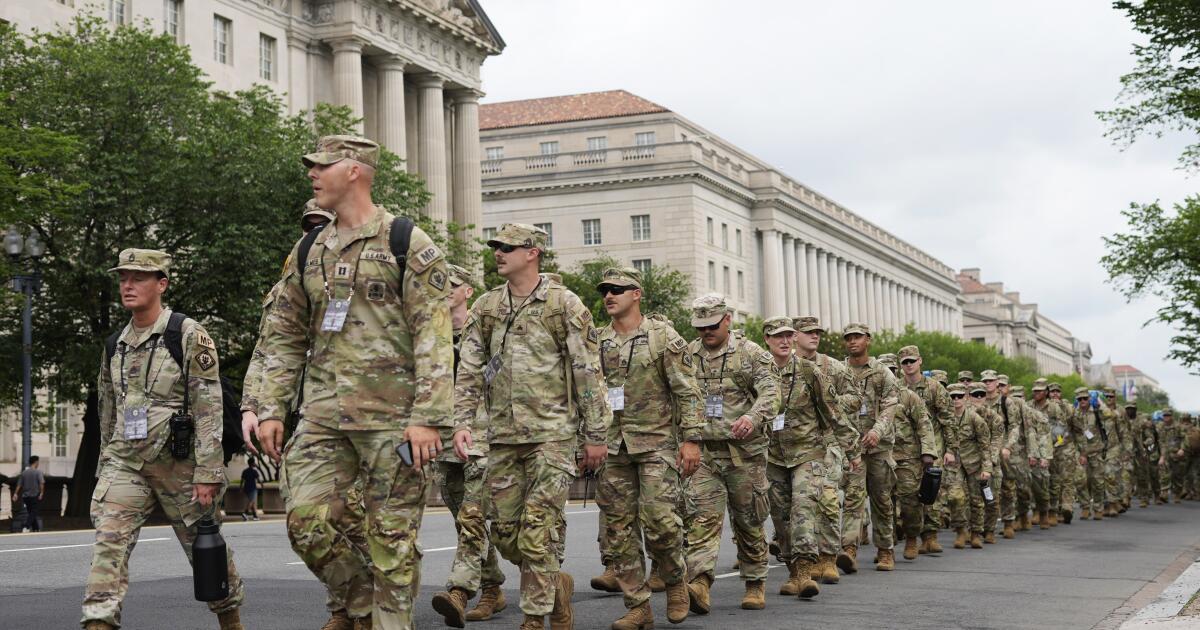
Dozens of U.S. aircraft, hundreds of military vehicles, and thousands of soldiers are expected to take part in the parade, followed by a fireworks show. Both uniformed and plainclothes officers were seen practicing their march through the city on Friday morning. But the extent of Trump’s participation is not entirely clear in light of the emerging crisis in the Middle East between Israel and Iran.
While a handful of counter-protests are expected within the district itself, dozens are planned around the country. The “No Kings” protests, according to their organizers, are meant to counter-program Trump’s “made-for-TV display of dominance for his birthday.”
“Real power isn’t staged in Washington,” the group’s website reads. “It rises up everywhere else.”
The Trump administration has said it welcomes peaceful protests throughout the country on Saturday. But that White House commitment was called into question earlier this week, when a federal judge in California ruled that Trump had violated the law by federalizing the National Guard in response to largely peaceful demonstrations in Los Angeles protesting its immigration enforcement tactics.
In the ruling, U.S. District Judge Charles Breyer said he was “troubled by the implication” inherent in the Trump administration’s argument that “protest against the federal government, a core civil liberty protected by the First Amendment, can justify a finding of rebellion.”
Trump wrested control over the National Guard troops from California from Gov. Gavin Newsom to deploy 2,000 to Los Angeles after less than 24 hours of protests across the city.
Thousands more were later called to Los Angeles, as were hundreds of Marines.
Late Thursday, following an appeal by the administration, the U.S. 9th Circuit Court of Appeals put Breyer’s decision on hold, leaving the forces in L.A. under Trump’s control as the litigation continues.

A U.S. Army sign is positioned in front of the White House for Saturday’s parade.
(Eric Thayer / Bloomberg via Getty Images)
The deployments of troops to march in D.C. were not challenged, though critics of the current administration have similarly criticized their presence in an American city — blasting the parade as the sort of spectacle more expected from a country such as North Korea.
Constitution Avenue, where the parade will be held, was closed to traffic. Tourists wandered through openings in the gates, some lamenting the lengthy detours the barriers required — especially given the humidity and heat that pressed down on the city.
City road closures and flight delays from nearby Reagan National Airport are expected throughout much of Saturday. There is also a chance it will rain on the president’s parade, with thunderstorms, lightning and flash flooding forecast for the district.
High chances of lightning, an Army spokesman said, could result in a cancellation of the festivities. But Trump addressed the weather forecasts on Saturday morning, writing on social media, “OUR GREAT MILITARY PARADE IS ON, RAIN OR SHINE. REMEMBER, A RAINY DAY PARADE BRINGS GOOD LUCK. I’LL SEE YOU ALL IN D.C.”
Small signs of protest against the Trump administration were already apparent around the Mall Friday, though it was unclear when they’d been put up. One sign stuck to a utility box read, “Immigrants are not the enemy,” while another read, “All You Fascists Bound to Lose.”
A man rode a bicycle along 14th Street near the Washington Monument holding up a large sign calling the president a “creep” and “unfit” — among other things.
The security measures were similar to those put in place during other major events in Washington’s downtown core — at least since Trump’s supporters stormed the U.S. Capitol on Jan. 6, 2021, in a failed attempt to keep Trump in office after his 2020 loss to President Biden.
The insurrection caused widespread damage to the Capitol and put many lawmakers at risk, but drew a decidedly different response from Trump than the recent protests in L.A. Shortly after he was reelected, Trump pardoned all of the Jan. 6 defendants.
Jeanette Mangia, 46, stood on the National Mall on Saturday afternoon waiting for a friend — a “fellow J6er,” as she put it.
Mangia was among those charged for participating in the Jan. 6, 2021, insurrection at the nearby Capitol. She faced a dozen charges, including multiple assault charges, she said, and was in jail for seven months before Trump won reelection and pardoned her and all the other Jan. 6 defendants, which led to the case against her being dropped and her release.
She had driven down from Pennsylvania for the parade. It was her first time back in Washington since her release, she said.
“It feels kind of strange, know what I mean?” she said, pointing around the Mall. “I seen these streets every time I went back and forth to court” from jail.
Mangia had a “Trump 2028” hat on, and said she wants him to run again — which the Constitution forbids — “if there’s no better option.”
“He’s the lesser of two evils, that’s for sure,” she said.
She was hoping to meet up with a group of other J6ers on Saturday to make some kind of statement about their deserving compensation for being jailed, she said. “Some people want millions. I don’t want that,” she added. “I just want to be made whole.”