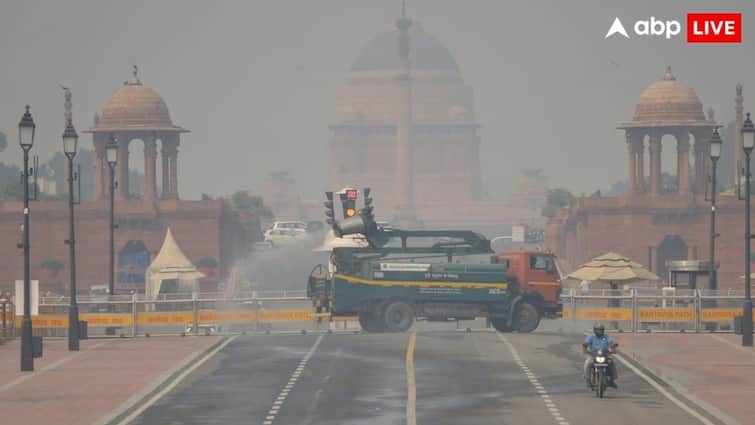
Delhi woke up on Saturday (November 15, 2025) under a blanket of dense smog, as the Air Quality Index (AQI) touched 386 at 8 a.m., firmly in the ‘very poor’ category, according to the Central Pollution Control Board (CPCB). Iconic landmarks like India Gate were barely visible, shrouded in a toxic haze that has made breathing outdoors increasingly hazardous.
The city’s air quality showed little improvement from Friday, when the AQI stood at 397, also classified as ‘very poor’. Certain pockets of Delhi recorded dangerously high pollution levels: Ashok Vihar (415), Bawana (441), Chandni Chowk (419), ITO (418), Mundka (426), Siri Fort (495), Wazirpur (447), among others. Most of these areas fall into either the ‘very poor’ or ‘severe’ categories, putting residents at significant health risk.
For context, CPCB classifies air quality on a scale where 0-50 is ‘good’, 51-100 ‘satisfactory’, 101-200 ‘moderate’, 201-300 ‘poor’, 301-400 ‘very poor’, and 401-500 ‘severe’.
Government Action and Court Orders
In response to the deteriorating air, the Commission for Air Quality Management (CAQM) has activated Stage III of the Graded Response Action Plan (GRAP) across the National Capital Region (NCR). These measures include curbs on non-essential construction, restrictions on older vehicles, limitations on industrial operations using non-clean fuels, and a ban on non-emergency diesel generator use. Schools for students up to Class 5 have shifted to hybrid or online learning.
Meanwhile, the Supreme Court has directed the Punjab and Haryana governments to submit a status report on actions taken to curb stubble burning, a major contributor to Delhi’s air crisis. Chief Justice of India B.R. Gavai and Justice K Vinod Chandran emphasised the urgency, noting that while GRAP-III is in place, conditions may require moving to GRAP-IV measures.
Pollution Patterns and Sources
Despite a slight improvement on Friday, with AQI dropping to 386 from 404, many areas continued to record ‘severe’ pollution levels. Out of 39 monitoring stations, 15 reported ‘severe’ AQI, with Wazirpur, Bawana, and Mundka among the worst-affected zones. The cleanest reading came from Lodhi Road, still in the ‘poor’ range.
Farm fires, particularly stubble burning in Punjab, Haryana, and Uttar Pradesh, contributed significantly to Delhi’s pollution. On Friday, these fires accounted for 8.54% of PM2.5 levels, down from 12% the previous day. Transport emissions remain the largest contributor, responsible for nearly 19.8% of air pollutants.
On Saturday, meteorological conditions, low temperatures and calm winds, are trapping pollutants close to the surface. Experts forecast that stubble-burning contributions could rise to 16.3%. Satellite data indicated 72 farm fire incidents in Punjab, 15 in Haryana, and 293 in Uttar Pradesh as of November 13. Shallow fog is expected, with temperatures ranging between 10°C and 28°C.
Health Concerns and Public Safety
Health risks are escalating, prompting calls for immediate action. Senior advocate Vikas Pahwa urged the Delhi High Court to temporarily shift to hybrid or virtual hearings to protect lawyers, litigants, and court staff. In a letter to Chief Justice Devendra Kumar Upadhyaya, Pahwa highlighted that PM2.5 levels have repeatedly crossed 190 µg/m³, more than three times the permissible limit of 60 µg/m³, placing them in the medically toxic and life-threatening range.
The central and Delhi governments had invoked Stage III and IV GRAP emergency measures on November 11 after the AQI breached 400, signalling a severe air quality crisis that continues to endanger public health.