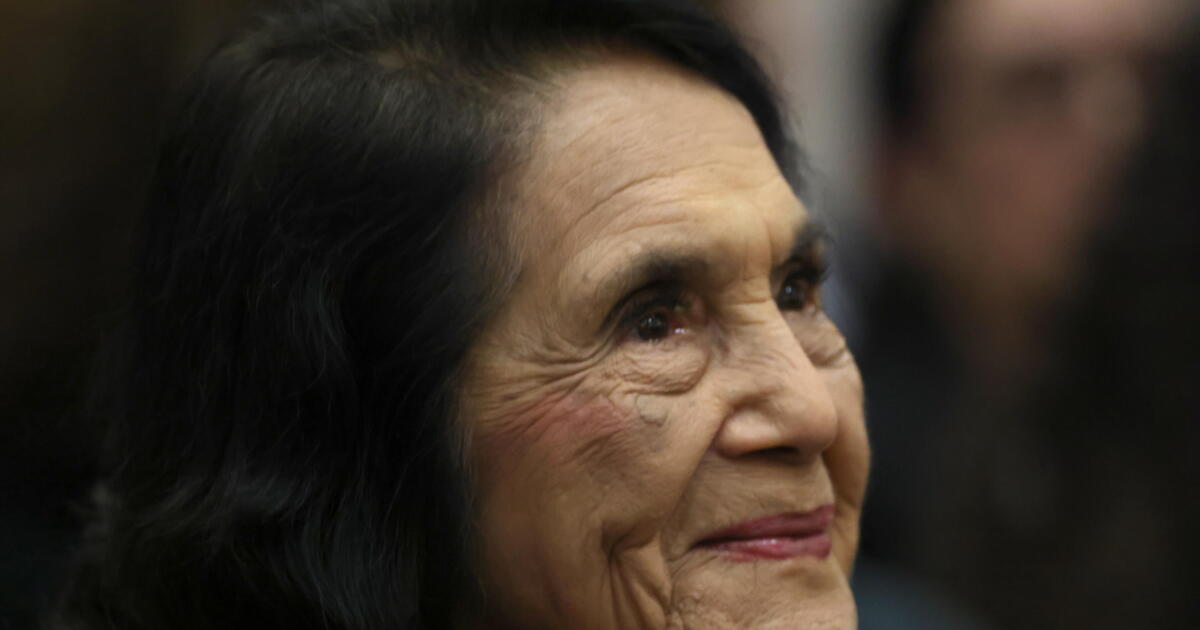
Dolores Huerta, the fiery and resolute activist who helped launch and guide the nation’s first enduring labor union for poor farmworkers and later became an inspiration to women and liberal true believers, has died. She was 96.
Erik Olvera, a spokesman for Huerta’s family, told The Times on Wednesday that Huerta died in Bakersfield, surrounded by members of her “huge family.” The cause, he said, was cancer.
“It’s a tough time,” Olvera said. “She was incredibly beloved, and not only was she beloved, but she was an icon to so many people around the country and around the world, really. If anything, her family is clinging to memories and clinging to each other as they mourn.”
Huerta never gave up on her dream of a more equitable distribution of wealth in America, campaigning for working people for years beyond standard retirement age.
The emotional compass of the United Farm Workers of America for decades, the petitemother of 13 attained singular stature as a rule-breaking proto-feminist, godmother of the Chicano power movement and doyenne of American labor.
Huerta’s fervent crusading for the dispossessed made her the potent alter ego to her union co-founder, the soft-spoken and methodical César Chávez, though the full complexity and pathology of their relationship only became apparent late in her life.
The duo’s history took an unexpected and dark turn in March 2026, when two women came forward to say they had been sexually assaulted by Chávez when they were teenage girls, with Huerta telling the New York Times that the venerated labor leader also had twice forced sex on her, resulting in two pregnancies.
Nearly 96 at the time, Huerta said she had remained silent for six decades to protect the farmworker movement. But she added: “I now understand that I am a survivor — of violence, of sexual abuse, of domineering men who saw me, and other women, as property, or things to control.”
Some wished Huerta had spoken out earlier, at least within the insular union, in order to prevent others from being victimized. But her many champions insisted the late-life revelation reflected badly only on Chávez, who for decades before his fall from grace had been an American civil rights icon and a virtual secular saint to the political left.
Some historians insist that Huerta be given full recognition for teaming with Chávez during much of the early foundational work that produced the UFW, from its founding in 1962 in the San Joaquin Valley farm town of Delano through her leave from full-time work with the union in the late 1980s.
It was Huerta who hurried from pickup truck to back stoop to pool hall, to recruit many of the union’s first members; Huerta who stormed up and down the picket lines to keep striking workers out of the fields; Huerta who helped negotiate one of the first contracts ever for farmworkers in North America; and Huerta who struggled to keep the union relevant, as its membership and clout faded. She turned the phrase “Sí, se puede!” into a chant that animated rallies and marches well into a new century.
Complications and byzantine controversies helped stymie the union in its adolescence, with Huerta usually supporting Chávez, even as he became distracted from the union’s central work and demanded absolute power. Their obsession with loyalty and often-imagined conspiracies ended with purges of some of the UFW’s most dynamic leaders and organizing stagnation, even as field hands continued to labor under abysmal conditions.
Huerta later devoted much of her time to women’s rights, Democratic Party politics and community organizing.
In 1999, the 69-year-old great-grandmother helped obtain extra government benefits for workers who lost their jobs in a citrus freeze and stared across the contract bargaining table at lawyers for the giant Gallo wine company. Even late in life she still toured the nation as a public speaker and used her foundation to register voters and campaign for progressive causes. Liberal groups clamored to have Huerta at the front of their marches. Often sporting a jaunt red beret, she locked arms with activists one-quarter her age.
Her Dolores C. Huerta Foundation supported endeavors as diverse as a performing arts camp for children, higher education mentoring for high school students and food distribution to victims of floods that inundated the Central Valley in 2023. The foundation became something of a family business — headed by her daughter, Camila Chávez, and supported by legal advice from her son, Emilio Huerta, while four other relatives served on the board.
In another step to cement Huerta’s legacy, one of her nonprofits broke ground in 2025 for the Dolores Huerta Peace & Justice Cultural Center in Bakersfield, the San Joaquin Valley city she called home. The $35-million project, paid for largely by the state of California, will include an academy to teach future generations how to become community organizers. “They are the ones who are going to guide us forward,” the 95-year-old told a crowd, which stood under a scorching sun for the groundbreaking.
Through it all, Huerta insisted her primary loyalty remained la causa — the struggle to win better wages, working and living conditions for poor people, particularly farmworkers.
Beginning with the early organizing days in the 1960s, Huerta inspired passions almost as intense as her own. She won almost breathless admiration from followers for the way she faced down sometimes violent anti-union forces, worked for days with little rest and negotiated late into the night, while others faded. She alienated others with a waspish temper, an unwillingness to forgive even small slights and inattention to some of the details that make a union work.
To the union faithful, she was the “Madonna of the Fields.” Some said Huerta reminded them of the soldaderas, a handful of women warriors who followed Emiliano Zapata and Pancho Villa into battle during the Mexican Revolution. The growers, whom she almost always scorned, had another name for her: “the dragon lady.”
A woman of frenetic energy who lived in a world of myriad contradictions, Huerta was one of the only women in many board rooms and union halls full of men. She was a jet-setting, president-schmoozing pragmatist, who in unguarded moments spoke mystically about her two youthful encounters with UFOs. She was the devout Catholic who had the last four of her children with a man she never married, Richard Chávez, Cesar’s younger brother. (Only in 2026 did she acknowledge having two other daughters, given to others to raise, fathered by César Chávez.)
Her relationship with Cesar Chávez was as complex as it was volatile — a fact acknowledged by UFW regulars long before Huerta’s charges about his sexual misconduct.
The two met through their work for the Community Service Organization (CSO), a progressive group that sought better government services and equal rights for poor and minority people. Both were called to the cause by the organization’s founder Fred Ross Sr. — Huerta in Stockton and Chávez in San Jose — and later united over their common concern for farmworkers. But even when he became statewide leader of the CSO, Chávez could not persuade the group to focus its energies on organizing field workers.
It was 1961 and Chávez was living in East Los Angeles when he called Huerta to his home one day and said, “We have got to start the union. If we don’t do it, nobody else will,” Huerta once recalled. He left the CSO, and Huerta followed.
Both soon moved their families to the Kern County farm town of Delano. Chávez relied on Huerta for nearly everything. When she wasn’t going door-to-door to recruit new members, Huerta negotiated with growers and created union hiring halls. She formed farmworker ranch committees and moved to the East Coast for months to promote the union’s national grape boycott.
But Chávez and his right hand also clashed routinely during their decades-long collaboration. The two would explode in shouting matches over strategy, while other union leaders shrank from the room. In audio recordings of one 1979 confrontation reviewed by the New York Times, Huerta fought back and demanded respect as Chávez called her a “stupid bitch” and accused her of stealing. Huerta might quit, or be fired. Inevitably, she would be back in the fold within a few days or weeks.
“Their commitment to the cause trumped all else and grew into a mutual dependence that survived decades of discord,” wrote Miriam Pawel, a former Los Angeles Times editor, in the biography “The Crusades of Cesar Chávez.” Asked by ABC News if she tried to protect Chávez, Huerta replied, “Always. Always.”
During a wine grape strike in the Central Valley, Huerta and other UFW women once locked arms in a human blockade between the union’s male picketers and replacement workers wielding two-by-fours. She blocked one worker’s car with her own, to prevent him from going to work and breaking a 1965 strike against rose growers in McFarland.
Chávez never doubted Huerta’s resolve. He once called her “totally fearless, both mentally and physically.”
Her years of community organizing in Stockton taught Huerta how to inspire even the most humble of her poor constituents.
In the union’s founding days, Huerta helped recruit a 19-year-old grape picker named Eliseo Medina to perform a one-man picket at the Port of Los Angeles — supposedly to stop the loading of a shipment of non-union grapes. The grapes never materialized. But Medina recalled how Huerta’s spirit and determination galvanized him.
“Dolores had a gift for making you believe in yourself,” Medina said. “She has an ability to inspire you and urge you to do things you could not think were possible. She is one of those life-changers.”
An Echo Park mural features Dolores Huerta alongside artist Frida Kahlo.
(Genaro Molina / Los Angeles Times)
Medina left the Chávez-Huerta led union, believing it had strayed from its core work. He went on to become the international secretary treasurer of the more than 2-million-member Service Employees International Union (SEIU) — just one of many UFW acolytes who fueled the labor movement as it staged a modest resurgence in the 21st century.
Huerta was at the center of many of the union’s landmark achievements, including the negotiation of a contract in 1966 with the Schenley Wine Co. It was the first labor agreement obtained by farmworkers themselves with an agricultural company, according to the union’s history.
But the UFW’s fortunes would rise and fall. One low ebb came in 1973 with the loss of many contracts to the Teamsters Union, which struck sweetheart deals with growers. But some union insiders also complained that the UFW had failed by not winning enough concessions for the workers it represented. The union’s membership plummeted.
Two years later, momentum swung again, as the union helped persuade California Gov. Edmund G. “Jerry” Brown Jr. to impose the toughest farm labor regulations in the nation.
The union’s membership would spiral downward until Chávez’s death, at 66, in 1993. There was a sense among many insiders that the union became overly insular, with repeated purges designed to promote absolute fealty to Chávez.
In one incident, students graduating from English classes at the union’s headquarters, La Paz, ended a slide show with the words: “The Union is not César Chávez, the Union is not La Paz, the Union is the farmworkers.” Huerta, fuming, demanded to know which of the teachers had planted this message, which she viewed as an act of treason against Chávez — an episode detailed by one of the teachers, Jeffrey W. Rubin, who went on to become a history professor at Boston University.
“Confronted there by Huerta, Richard Chavez, and Cesar Chavez himself, we were accused of being part of a subversive plot, railed at, called ‘chicken s—’ by Cesar, and thrown out of La Paz and the union,” wrote Rubin, who kept the episode quiet for years.
At the same time, the UFW lost contracts and sometimes failed to provide the benefits it promised to workers. Huerta was one of many union leaders unable to set Chávez, and the UFW, on a better path.

Dolores Huerta at rosary, standing next to the body of labor leader and civil rights activist Cesar Chavez (1927 – 1993) at rest in the pine coffin in Delano, Calif., on Wednesday, April 28, 1993.
(Jose Galvez/Los Angeles Times)
As Chávez’ son-in-law Arturo Rodriguez took control of the union in 1993 and began clawing to regain members and clout, Huerta remained the UFW’s most public persona.
At hundreds of marches across the nation that she attended with regularity throughout her life, parents would push forward, telling their children they were witnessing a historic figure. Asked for an autograph, she would boldly scrawl: “Sí, se puede.”
The phrase — “Yes, it can be done” — had been part of the union’s fabric since 1972, when some doubters suggested the union would fail in its campaign against an anti-union law in Arizona. Huerta responded, “Sí, se puede,” creating a mantra for the American left.
Born April 10, 1930, in Dawson, a small mining town in the mountains of northern New Mexico, Dolores Clara Fernandez moved to Stockton when she was 3, along with her mother, two brothers and two sisters. Her father and mother had divorced, but Juan Fernandez’s legend had been fixed — a brawling union leader and New Mexico state legislator. Her mother, a hotel operator, believed in public service and would not let the poorest guests go hungry.
Dolores thrived on a middle-class upbringing of Girl Scouts, violin lessons and tap dancing, describing her mother’s generosity as a guiding force. She was bright and popular and even founded a teen center where she and other kids hung out.
But Dolores would recall her high school years as a time of slights and rewards not received — injustices she linked to her Mexican American heritage. When police ordered her teen center shut down, it became clear it was because they did not like whites socializing with Mexican American, Black and Filipino kids.
Those setbacks would not be forgotten.

Dolores Huerta in Santa Fe, N.M., in 2019.
(Associated Press)
After community college in Stockton, Huerta became a teacher. But she left after just a year, because, she said: “I thought I could do more by organizing farmworkers than by trying to teach their hungry children.”
Soon she met Ross and Chávez and her life’s path would be set. Even her name seemed to brand her for the work. When she divorced her second husband, Chávez advised her to hold on to her last name. Dolores Huerta means Sorrows of the Orchard.
Along the way, there would be great personal heartache.
In 1968, she was at the Ambassador Hotel in Los Angeles on the night Sen. Robert F. Kennedy was shot. The Democratic presidential front-runner had just finished his California primary victory speech — thanking Chávez and Huerta — when an assassin gunned him down.
Twenty years later, her politics thrust Huerta even more directly in the path of violence. A television camera captured the images of a San Francisco police officer clubbing her as she and others peacefully picketed an appearance by Vice President George H.W. Bush. The blows ruptured Huerta’s spleen and nearly killed her.
She later won an $850,000 settlement from the city for the attack. Some in the union said that Chávez‘s insistence that Huerta give the money up to the UFW created another rift that caused her to leave the union.
Huerta would struggle, as well, to find time for her expansive family — which in the end included 13 children, counting the two fathered by César Chávez.
Among her greatest heartaches grew out of the struggles of her oldest daughter, Celeste, a schizophrenic who, on occasion, would leave the institutions where she lived and wander the streets.
Huerta’s union zealotry would inspire a range of emotions from her other children.
“We understood very quickly she wasn’t ours to have,” said son Emilio, the lawyer, a Central Valley activist.“She sort of belonged to the farmworker movement. And it was our job to support her.”
He and several other of the Huerta offspring devoted their lives to the UFW and related causes, basking in a sense that their family played a part in history. That did not always make up for the personal slights — the times their mother would fob them off on union allies or neighbors, or miss a birthday.
In a bittersweet essay, Dolores’ daughter Juanita once recalled how her mother forgot to pick her up from junior high school. She compared Huerta to a train “rattling all the windows behind me, blaring out its horn, announcing its simultaneous arrival and departure with an incredible clamor, but rushing constantly forward.”
At a 69th birthday party in 1999, Huerta told a large dinner gathering that her own sacrifices had been overblown.
“It was our families who sacrificed,” she said. She then told a story about driving a carload of children to school one day in an automobile limping along because a tire had been slashed by union opponents. “That,” she said, “was kind of how we made it through life.”
Approaching her 90th birthday in 2020, Huerta spent a day that might have been more typical for someone half her age. She protested at the Fresno County Board of Supervisors for increased pay for home healthcare workers, who made just $12 an hour. Huerta hadn’t planned on being arrested that day, but when she felt police used excessive force on one of the protest leaders, she changed her mind. Take me too, she said, according to USA Today. Officers cinched a plastic zip-tie around her wrists and led her away.
More typically in her later years, she supported her foundation. In one moment, she might be campaigning for a bond measure for a middle school gym in the poor San Joaquin Valley community of Weedpatch; in seemingly the next, she would be stumping via Zoom for Joe Biden, during his fight to take the White House from President Trump.
In 2020, USA Today named Huerta one of the 100 women “who’ve made a substantial impact on our country or our lives over the past 100 years.” By then, at least half a dozen schools across America bore her name. Others considered taking her name after they removed Chávez’s following the sexual abuse revelations.
President Obama presented Huerta with the country’s highest civilian honor, the Presidential Medal of Freedom, in 2012; the one-time community organizer, who made his way to the White House, honoring a woman still doing the work.
“The great social justice changes in our country have happened when people came together, organized and took direct action,” Huerta said in accepting the honor. “It is this right that sustains and nurtures our democracy today.”
Olvera, the family spokesman, said Wednesday that Huerta’s relatives would be announcing the details of a public memorial in the coming days.
Times staff writer Hailey Branson-Potts contributed to this report.