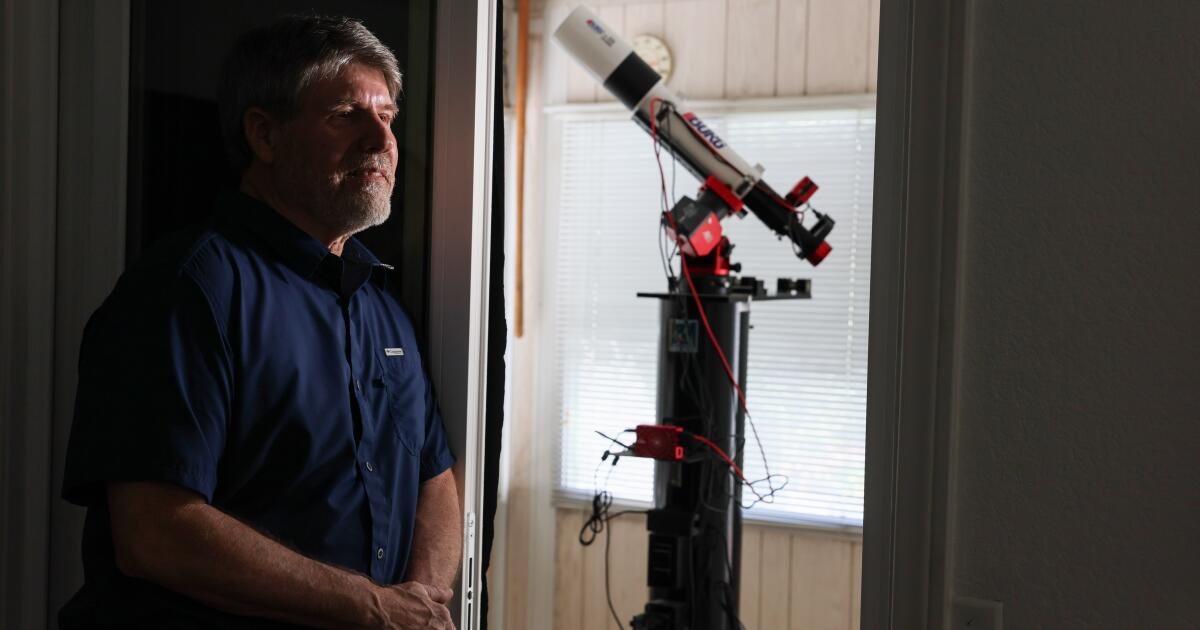
Every clear night for the last three weeks, Bob Stephens has pointed his home telescope at the same two stars in hopes of witnessing one of the most violent events in the universe — a nova explosion a hundred thousand times brighter than the sun.
The eruption, which scientists say could happen any day now, has excited the interest of major observatories worldwide, and it promises to advance our understanding of turbulent binary star systems.
Yet for all the high-tech observational power that NASA and other scientific institutions can muster, astrophysicists are relying on countless amateur astronomers like Stephens to spot the explosion first.
The reason? It’s just too costly to keep their equipment focused on the same subject for months at a time.
“I think everyone will look at it while it happens, but sitting there just looking at it isn’t going to make it happen,” said Tom Meneghini, the director of telescope operations and executive director emeritus at the Mt. Wilson Observatory. “It’s like a watched pot,” he joked.
The star is so far away that it takes 3,000 years for its light to reach the Earth, meaning the explosion occurred before the last of the Egyptian pyramids were built. It will appear about as bright as the North Star for just a few days before fading into the darkness.
Once it’s spotted, some of the most advanced observatories on Earth and in space will join in watching, including NASA’s James Webb Space Telescope.
“A lot of people are eagerly waiting to spot the new jewel in the crown,” said Mansi Kasliwal, the Caltech astronomy professor who is planning to use the Palomar Observatory in northeast San Diego County to observe the event. The nova will erupt in the Corona Borealis, or Northern Crown, constellation.
Steve Flanders, outreach coordinator for Palomar Observatory, shows the observatory’s Gattini-IR telescope, which Caltech professor Mansi Kasliwal’s team will use to observe the Blaze star explosion.
(Hayne Palmour IV/For The Times)
T Coronae Borealis, also called the Blaze Star, is actually two stars — a hot, dense white dwarf, and a cooler red giant.
The dwarf star, which ran out of fuel long ago and collapsed to roughly the size of Earth, has been siphoning hydrogen gas from its larger neighbor for about a human lifetime.
This stolen gas has accumulated in a disk around the dwarf like a hot, messy version of Saturn’s rings. Soon, the disk will grow so heavy that it will become violent and unwieldy, and inevitably, explode like a thermonuclear bomb.
Neither star is destroyed however, and the process repeats itself roughly every 80 years.

Stephens has data from T Coronae Borealis going back years. The oscillations in the data represent the two stars orbiting around each other.
(Robert Gauthier/Los Angeles Times)
This time around, there’s an army of enthusiasts like Stephens ready to sound the alarm when the star goes nova.
Far from mere hobbyists, a number of these amateur observers have published their own scientific research. Stephens even built his own observatory as an addition to his house in Rancho Cucamonga.
“The city thinks it’s a sunroom,” Stephens said. After the inspector stopped by, he removed the screws securing the roof, allowing him to roll it off to reveal the clear sky to his telescope.
Every night, he turns on the telescope and spends more than an hour taking data, which he later posts to an online community of amateur astronomers who monitor the star almost nonstop.
Major observatories simply cannot keep such constant watch. Hundreds of scientists compete for time to look at a wide range of astronomical targets every night. For them, keeping these telescopes glued to the Blaze Star is a waste of valuable observation time.
Estimates on when the nova will occur vary, but most astrophysicists agree it will happen before the end of the year, and likely by the end of August.
Once it blows, there are a few alert systems set up to notify amateurs and professionals. Some observatories have even programmed their telescopes to autonomously ditch their current observation plan and look at the star when the notification comes in, Stephens said.
Major observatories also face another complication. Many of their telescopes are designed to look at the faintest and dimmest targets, but the Blaze Star nova will be anything but faint. Pointing these telescopes at the nova would overwhelm sensors, resulting in a washed-out, overexposed picture.
That’s why Palomar Observatory, Caltech’s research station in north San Diego County, isn’t using its iconic 16-foot-wide Hale telescope under its massive white dome. Instead, it’s using a much smaller telescope, called Gattini-IR, located in a small brick building about a quarter mile down the road.
Once the nova happens, Gattini-IR will go from observing the Blaze Star every couple nights to every couple hours.

Steve Flanders enters the small building on the Palomar Observatory grounds where the Gattini-IR telescope is set up. The Gattini-IR telescope is monitoring the Blaze Star, which is expected to go nova.
(Hayne Palmour IV/For The Times)
Scientists say they still have a lot to learn about novas. For example, physicists are still unsure why some erupt every decade while others likely don’t for millennia.
Some researchers suspect that novas like the Blaze Star could be precursors to supernovas. These explosions — billions of times brighter than the sun — destroy the star, often leaving behind a black hole. Supernovas are also a useful tool for astronomers to measure distance.
Studying similar events has already led to discoveries, however.
Recently, scientists determined that novas tend to fling material into space at faster speeds than what would be predicted based on the intensity of the explosion.
“We want to understand the physics of novae, so having a nova that’s as close as T Coronae Borelias, which will hopefully be very well studied by all telescopes … we can get a very full picture,” said Caltech professor Kasliwal.
Some of that understanding will be due in part to amateur astronomers.
Thanks to the rapid development of telescopes, amateurs are working with technology that professionals didn’t have just 20 years ago, let alone 80, said Forrest Sims, an amateur astronomer from Apache Junction, Ariz., who is also observing the star every clear night.
And the amateurs can achieve better coverage than the big telescopes because “we typically have complete control over when and where we can point [our telescopes],” said Sims. “A professional may have to write a grant to get a half hour or two hours time on a big telescope.”
That allows them to collect a lot of data. And with hundreds in the community observing from around the world, they can achieve almost continuous coverage of the Blaze Star. Many, including Sims and Stephens, post their data to the American Assn. of Variable Star Observers website, allowing everyone to use the data.
Stephens remembers reading a journal article from a professional who managed to observe five asteroids over two years. “I thought, I could do that in a month,” Stephens said. He went on to publish a paper with 10 observations.

In his at-home observatory, Bob Stephens is using a Borg 101 telescope. “Resistance is futile!” Stephens said when introducing the telescope, a reference to the phrase uttered by “the Borg” in “Star Trek.”
(Robert Gauthier/Los Angeles Times)
One professor was so shocked by the number Stephens was able to see that she reached out and agreed to fly to Puerto Rico for an asteroid conference just to meet him. They ended up working together — Stephens had the telescopes; she had the connections in the field.
Today, amateur astronomers’ work is getting so sophisticated, many in the field have a hard time calling them amateurs.
“We call ourselves ‘small telescope scientists,’ ” said Sims. “It sounds more fun, and in some respects, professionals — and not even grudgingly — will admit that the work we’re doing is often professional caliber.”