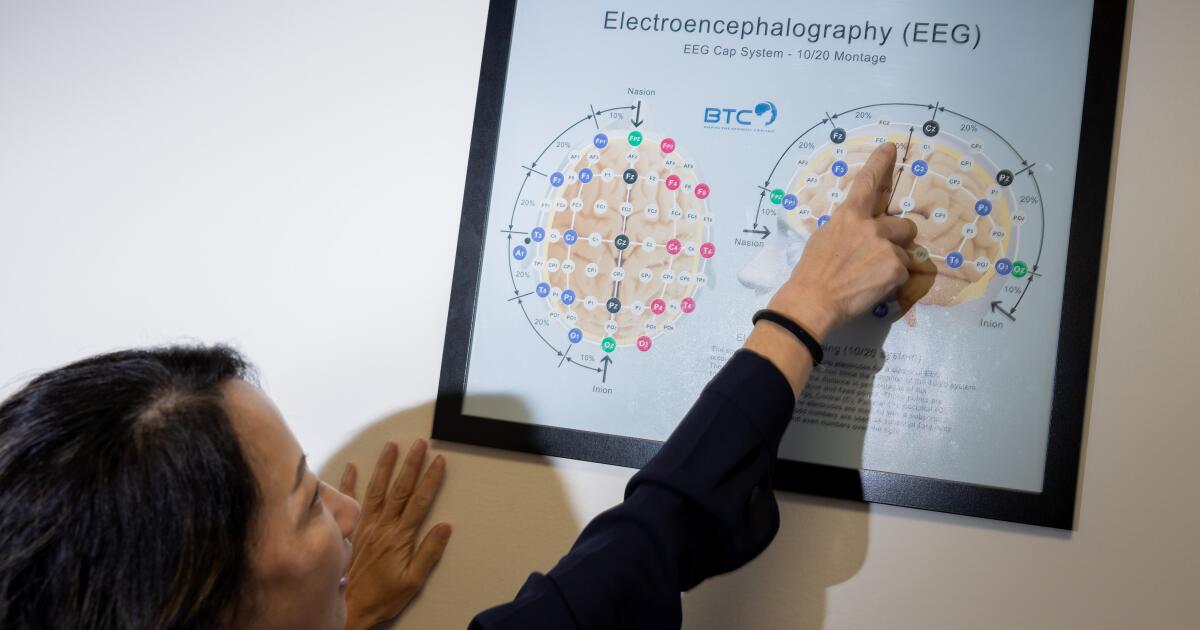
Over the last decade, clinics have popped up across Southern California and beyond advertising something called magnetic e-resonance therapy, or MERT, as a therapy for autism.
Developed by the Newport Beach-based company Wave Neuroscience, MERT is based on transcranial magnetic stimulation, a type of brain stimulation that’s approved by the Food and Drug Administration to treat depression, obsessive-compulsive disorder, migraines and smoking addiction.
Clinics licensing MERT have claimed that their trademarked version of the treatment can also produce “miraculous results” in kids with autism, improving their sleep, emotional regulation and communication abilities. A six-week course of MERT sessions typically costs $10,000 or more.
The FDA hasn’t approved MERT for this use. However, prescribing drugs or devices for conditions they aren’t approved for, which is known as off-label prescribing, is a legal and common practice in medicine.
But when such treatments are offered to vulnerable people, a group of researchers argue in a new peer-reviewed editorial in the medical journal Transcranial Magnetic Stimulation, they should be evidence-based, clearly explained to patients and priced in a way that reflects the likelihood that they will work as advertised.
Most clinics advertising off-label TMS as a therapy for autism don’t meet those standards, the researchers say.
Autism is “the biggest off-label business . . . [and] the one that is the greatest concern,” said Dr. Andrew Leuchter, director of UCLA’s TMS Clinical and Research Service.
Leuchter is one of three researchers with TMS expertise who recently called for the establishment of ethical guidelines around off-label TMS marketing in the field’s primary journal.
Written with Lindsay Oberman, director of the Neurostimulation Research Program at the National Institute of Mental Health, and Dr. Holly Lisanby, founder of the NIMH Noninvasive Neuromodulation Unit and dean of Arizona State University’s School of Medicine and Advanced Medical Engineering, the editorial singles out MERT as an “example of off-label TMS where there is negligible evidence of efficacy.”
“There is extremely limited scientific evidence at present that any form of TMS has efficacy and safety in improving the core symptoms of language, social skills, or behavioral disturbances associated with ASD,” the editorial states. “Websites and other promotional materials that fail to acknowledge this limited evidence-base can create a risk of bias and potential for false expectations.”
Dr. Erik Won, Wave’s president and chief medical officer, did not respond to requests for comment.
A Times investigation last year found there are no large scientific studies demonstrating that MERT is significantly better than a placebo at improving speech and communication challenges associated with autism. Wave has not conducted any clinical trials on MERT and autism.
Won said last year that Wave is working to obtain funding “for further studies and ultimately an FDA indication.”
Websites for clinics offering MERT often feature written testimonials from parents describing what they saw as positive changes in their children’s moods or spoken-language abilities after treatment sessions.
Without data, however, there is no way to know whether a patient’s anecdotal experience is typical or an outlier, according to Zoe Gross of the Autistic Self Advocacy Network, a nonprofit group run by and for autistic adults.
“Be wary of therapies that are sold to you with testimonials. If you go to a clinic website and they have dozens of quotes from parents saying, ‘This changed my child’s life in XYZ ways,’ that isn’t the same as evidence,” Gross told The Times last year.
A therapy could have only a 1% success rate, she said, and still yield dozens of positive testimonials once thousands of people have tried it.
For families unsure of whether a particular commercial therapy might be valuable for their child, “ask the advice of a clinician or an autism scientist who is not connected to the facility providing a service, just to get a frank appraisal of whether it’s likely to be helpful or likely to be worth the money,” said James McPartland, director of the Yale Center for Brain and Mind Health, who is currently studying the relationship between TMS and social perception in autistic adults. “Before you want to ask someone to spend resources on it, you want to have a certain degree of confidence [that] it’s going to be useful.”