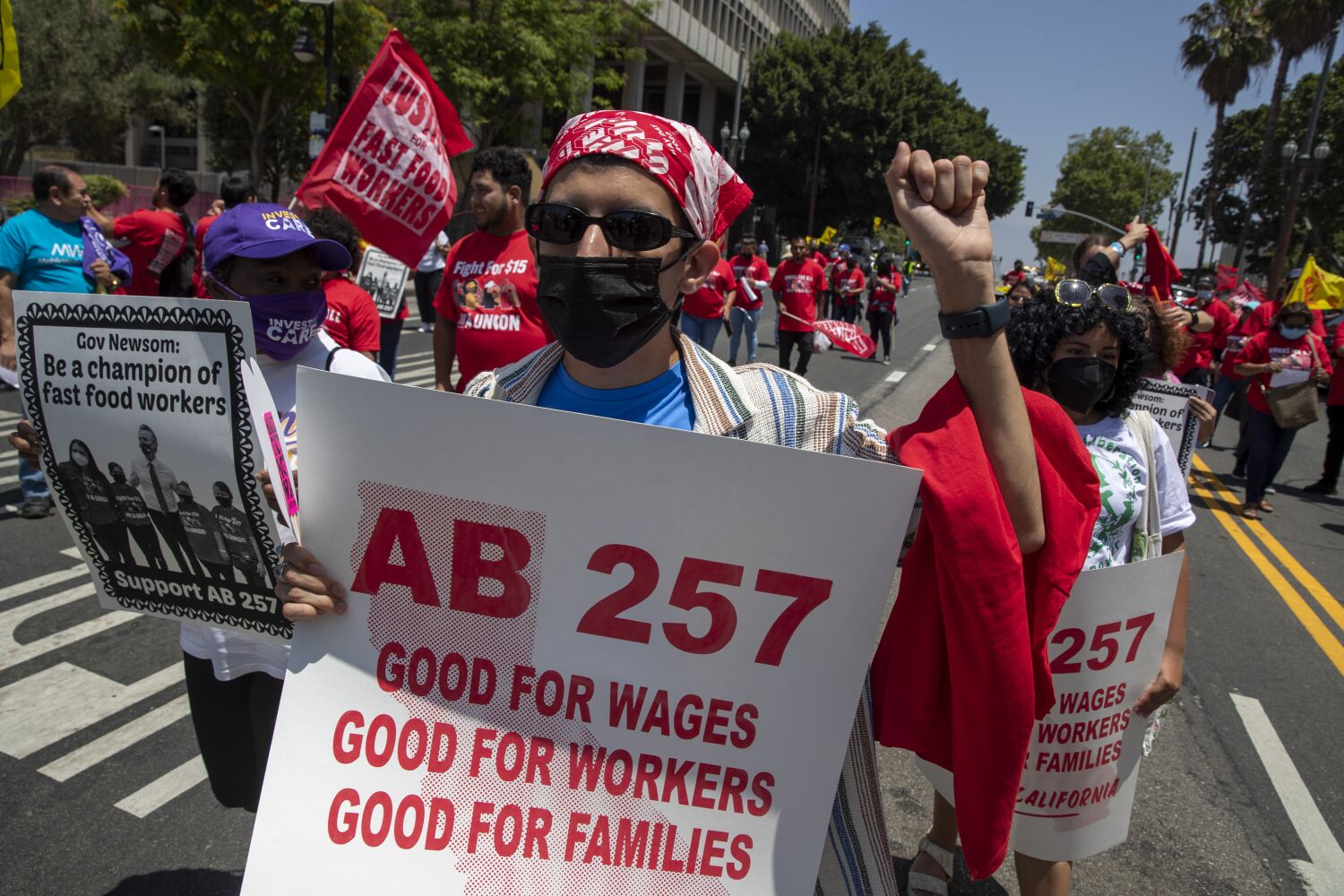
A group of businesses and restaurant trade groups sued Thursday to stop California from implementing a new labor law boosting protections for fast-food workers.
The landmark California law would, among other things, create a worker representative body with the power to raise wages.
The group, known as the Save Local Restaurants coalition, is attempting to qualify a referendum that would put the law on hold and ask California voters whether to uphold or repeal it on the November 2024 ballot. Save Local Restaurants submitted slightly more than 1 million unverified signatures this month, well above the required minimum, making it likely the referendum will be certified for the ballot.
With the process of verifying the signatures still underway, California’s Department of Industrial Relations said in a letter to the coalition that the law would go into effect Jan. 1.
Gov. Gavin Newsom’s office in a statement Thursday reiterated the plan to enforce AB 257, also known as the Fast Recovery Act, on Jan. 1.
“The … act gives fast-food workers a seat at the table to set fair wages and important health and safety standards. Although industry is backing a referendum measure, the secretary of state has not certified that it has enough signatures to qualify for the ballot,” Erin Mellon, a spokesperson for the governor, said in an email. “The state has an obligation to implement this important law unless and until that occurs. We will, of course, abide by any court order.”
The industry coalition said putting the law into effect would set a “dangerous precedent” that threatens voters’ right of referendum. The group filed the lawsuit in Sacramento County Superior Court to “ensure the democratic process established by the California Constitution is respected.”
When the secretary of state issued a notice Dec. 9 acknowledging a sufficient raw count of signatures submitted, AB 257 became “ineffective and unenforceable in its entirety,” the coalition said.
The lawsuit represents yet another tussle over AB 257, amid allegations by labor advocates who sponsored the law that signatures were obtained fraudulently and criticism that industries with deep pockets have increasingly turned to the ballot to delay progressive laws enacted by the state Legislature.
More than 50 referendum measures have qualified for the California ballot in the century since the creation of the referendum process, but “not in a single one of those prior instances did the state ever attempt to temporarily enforce the referred statute while the signature review process was underway,” said Kurt Oneto, an attorney with law firm Nielsen Merksamer who is representing the referendum proponents.
“By moving forward with implementing AB 257, the state would create a harmful precedent that would effectively render the state’s referendum process meaningless,” Oneto said in a statement.
In the Tuesday letter to the coalition, Industrial Relations Department Director Katrina Hagen said she and her staff were working to establish the Fast Food Council created by AB 257 and had “an obligation to proceed” with implementing the law “in the absence of clear authority providing that AB 257 is suspended merely upon submission of unverified signatures.”
Hagen wrote that the law would be put on hold “if and when” the referendum challenging it qualifies for the ballot.
The lawsuit argues in response that referendum proponents have the power to suspend an “objectionable law from otherwise taking effect” by completing their end of the process — collecting and filing the minimum number of signatures with county election officials — before the 90-day deadline.
“Any additional, purely administrative time taken by elections officials to complete the signature verification process or ‘certify’ the measure for the ballot, cannot undermine or interfere with this constitutional right of referendum,” the lawsuit says.
The lawsuit seeks an injunction requiring California officials to suspend the Jan. 1 implementation of the law until the signature verification process is completed and, if there are enough valid signatures to qualify the referendum for the ballot, until voters weigh in.
AB 257, signed into law by Gov. Gavin Newsom on Labor Day, creates a mandate for a first-of-its-kind council to set standards for fast-food wages, hours and other workplace conditions.
The law requires the signatures of 10,000 fast-food restaurant employees to move forward with creation of the council once the law goes into effect. Service Employees International Union California, which sponsored AB 257 and opposes the effort to overturn it, said it has submitted nearly double the number of signatures required by the statute to establish the Fast Food Council.
The coalition’s effort “comes right out of the corporate playbook Californians have, unfortunately, come to know too well. … This abuse of the referendum system must stop” Tia Orr, executive director of SEIU California, said in an emailed statement. “While eager to get to the table to begin improving their industry, workers respect the constitutional and democratic processes of the state and look forward to the administration’s verification of their signatures.”
The lawsuit names state officials responsible for enforcement of AB 257, including Hagen of the Department of Industrial Relations, California Secretary of State Shirley Weber and state Atty. Gen. Rob Bonta.
Representatives for the Department of Industrial Relations and the secretary of state’s office did not immediately respond to requests for comment.
A spokesperson with the state Department of Justice said the California Department of Industrial Relations is the state attorney general’s client in this matter and declined to respond to questions.
Counties have until Jan. 25 — 30 business days from the Dec. 9 notice — to complete a random sample verification of signatures.