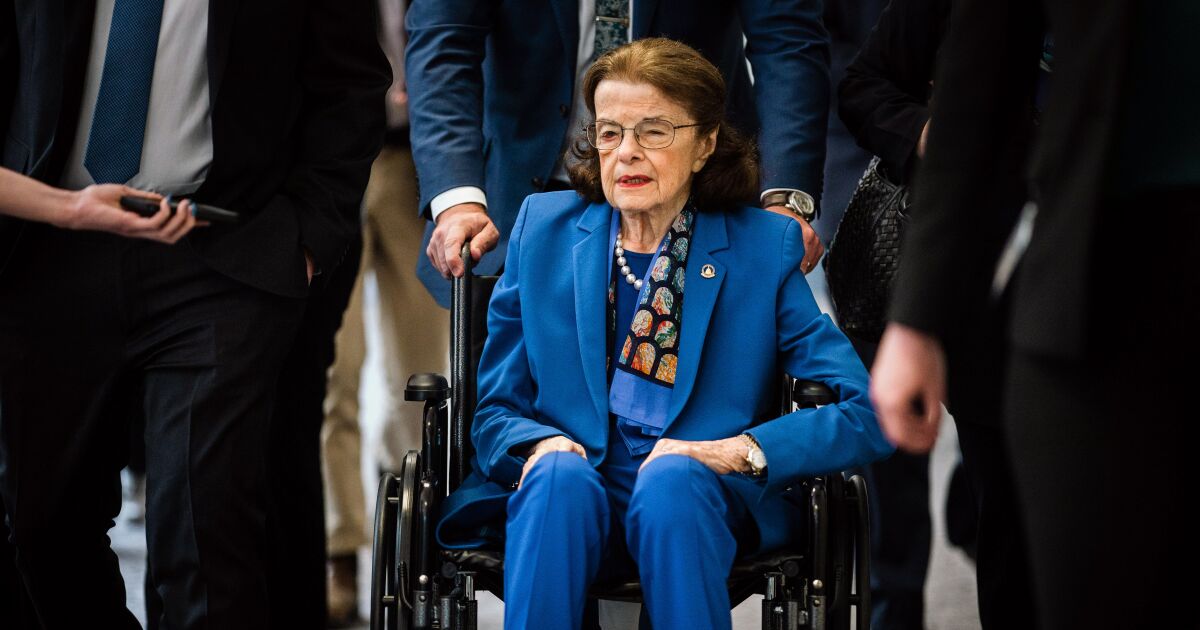
Sen. Dianne Feinstein was hospitalized Tuesday afternoon after suffering a “minor fall” in her San Francisco home, her office confirmed.
Feinstein’s spokesperson Adam Russell said the hospitalization was a “precaution” and that she returned home after “all of her scans were clear.”
San Francisco Fire spokesman Capt. Jonathan Baxter confirmed that the department responded to a “reported medical emergency” in the “early afternoon” on Tuesday to an address that property records show belongs to the California senator.
In a statement, Senate Majority Leader Charles E. Schumer (D-N.Y.) said that he spoke with Feinstein and that she said “she suffered no injuries” He added: “I’m glad she is back home now and is doing well.”
Feinstein, 90, has faced scrutiny over her health and cognitive decline.
Last month, she tried to deliver a speech during a roll call vote of the Senate Appropriations Committee. She was interrupted by an aide. Sen. Patty Murray (D-Wash.), the chair of the committee, told her to “just say, ‘Aye.’ ”
Feinstein’s health problems have occasionally derailed her appearances in California. Last week, she failed to show at an event celebrating San Francisco’s first cable car trip due to a cough, the San Francisco Chronicle reported.
She has missed half of all Senate votes this year, more than any other senator, according to a ranking by ProPublica. Pennsylvania Sen. John Fetterman, who was hospitalized for depression earlier this year, was the second-most absent member, missing 36.3% of votes, the nonprofit reported.
A majority of Californians believe Feinstein’s declining health makes her unfit for office, according to a May UC Berkeley Institute of Governmental Studies poll cosponsored by the L.A. Times. A June survey from the Public Policy Institute of California found that her job approval among Californians had dropped from 41% to 31% in the last eight months, falling below 40% for the first time in the history of the institute’s polling.
Feinstein’s defenders have denounced questions about her fitness for office as sexist and ageist, arguing that aging male lawmakers do not face the same calls to resign.
But powerful male politicians have alsobeen unable to escape scrutiny of their fitness to serve in recent months. Senate Minority Leader Mitch McConnell (R-Ky.), for example, froze, unblinking, during his weekly news conference with reporters last month before being escorted away by colleagues. A crowd jeered at the senator at an event in his home state on Saturday, chanting “Retire! Retire! Retire!”
Feinstein missed weeks of votes in the spring while fighting a severe case of shingles. Her absence threatened to delay confirmation of several of President Biden’s nominees.
She tried to solve that problem by tapping another Democratic senator to temporarily replace her on the Senate Judiciary Committee, but Republicans blocked the effort. In May, she returned to Washington after a nearly three-month absence. She stayed in the city for the two-week Fourth of July recess.
She plans to return to D.C. after August recess for a funding fight that could lead to a government shutdown. Democrats will need all their member’s votes to help fend it off.
Feinstein began her Senate career in 1992 and plans to retire when her term ends in January 2025.
Three Democratic lawmakers — Reps. Barbara Lee, Katie Porter and Adam B. Schiff — are running to replace her.


:quality(70)/cloudfront-us-east-1.images.arcpublishing.com/tronc/LFISDY4W4NESPOGWBKPJ5K5VRQ.jpg)