On Jan. 1, 1927, NBC Radio presented coverage of the Rose Bowl football game from Pasadena, the first sporting event to be broadcast coast-to-coast. It was a remarkable reach for a network that had launched six weeks earlier, with about two dozen stations.
Over the 100 years that followed, NBC used live sports to drive its expansion into television and later streaming video. Sports became the company’s laboratory, where it tested new cameras, new platforms and new ways of programming. Its constant was storytelling, an approach that created an emotional connection with fans and made stars out of the personalities who described the events.
“I leaned into storytelling and narratives to begin with, but then it was just amplified when (former NBC Sports President) Dick Ebersol came along,” longtime NBC Sports analyst Bob Costas said in a recent interview. “He had learned that whole approach under Roone Arledge at ABC, primarily with the Olympics, and we carried it over.”
At every public appearance Costas makes today, he’ll meet fans in their 50s saying they grew up watching him call Major League Baseball, the Olympics or Michael Jordan’s six NBA titles. He is the voice of their sports memories.
NBC helped shape the country’s sports viewing experience, from fans gathering in taverns in 1947 to watch the first televised World Series on a black and white set to streaming Katie Ledecky’s ninth career gold medal on their phones in 2024.
Technology has disrupted entertainment, music and news, said Jon Miller, president of acquisitions and partnerships for NBC Sports. “But for sports, technology has been great,” he said. “Sports is appointment television. You have to watch it live. Now you don’t have to be sitting at home to watch.”
“The impossible has happened”
From the 1940s into the ’80s, Major League Baseball helped define NBC Sports, which in turn influenced how fans would experience the game on TV.
Longtime NBC Sports director Harry Coyle introduced the use of a camera in center field to capture a head-on view of the batter at the plate. He introduced close-ups and handheld cameras to the coverage to get the expressions of players on the field. Coyle created one of baseball’s most memorable images during Game 6 of the 1975 World Series. A camera installed in the left field wall at Fenway Park captured Red Sox star Carlton Fisk as he waved for his game-winning home run ball to stay in fair territory.
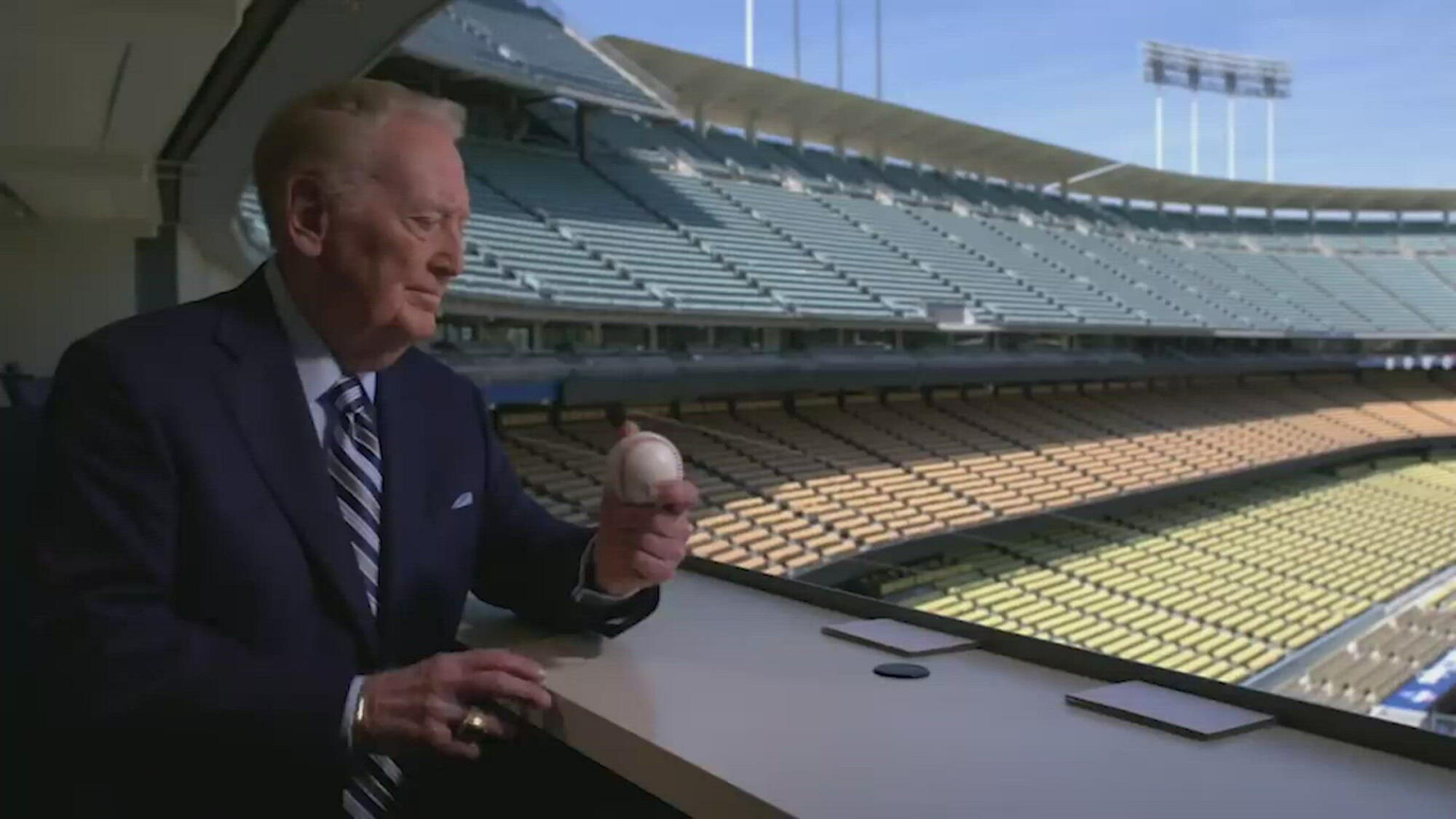
Vin Scully was in the broadcast booth for NBC’s Major League Baseball coverage throughout the 1980s.
(Vin Scully was in the broadcast booth for NBC’s Major League Baseball coverage throughout the 1980s.)
NBC’s World Series coverage and Saturday “Game of the Week” gave national exposure to two Southern California voices in Dick Enberg, who handled local broadcasts for the California Angels, and the legendary Los Angeles Dodgers announcer Vin Scully, who famously declared “The impossible has happened” when a hobbled Kirk Gibson hit a walk-off home run in Game 1 of the 1988 World Series. Both inspired Costas, who became the signature talent for NBC Sports in the 1990s and beyond.
This year, Major League Baseball returned to NBC after a 26-year hiatus with “Sunday Night Baseball” and the postseason Wild Card round, and Costas is back as host of the pre-game show. NBC also used baseball to show streaming’s potential: On July 5, NBC and Peacock presented all 15 Major League games played that day, the first time a single media company carried every game on the schedule.

Olympic rings are on display in New York on Tuesday, July 9, 2024, ahead of the Summer Olympics in Paris. d Shaffrey)
(Ted Shaffrey / Associated Press)
The Olympics laboratory
NBC‘s first Olympics came in 1964 from Tokyo, a modest line up of 14 hours that included the opening ceremony, the first live color program transmitted to the U.S. by satellite from overseas. For decades after, the network used the Games to test what consumers wanted next.
“The Olympics gives us a great opportunity because it’s every four years, and you can really see the consumer shifts, like rings on a tree almost,” said NBC Sports President Rick Cordella. “If something didn’t work, you can then reassess and reevaluate for the next Olympic Games.”
The first experiment was a business failure. In 1992, NBC and cable company Cablevision launched the Olympics Triplecast, offering expanded coverage of the Barcelona Games on pay-per-view. Not enough viewers would pay $125 for the two weeks, and the companies lost $100 million. “It happened before the audience was ready to actually consume sports content that way,” said Molly Solomon, executive producer and president of NBC Olympics.
But the Triplecast proved to be ahead of its time. NBC spread events across its growing cable channels in the 1990s, streamed its first live Olympic event, the men’s hockey gold medal game, in 2006 and offered every minute of every sport online from London in 2012. By Paris in 2024, Peacock had become the comprehensive home of the Games, with a “Gold Zone” whip-around of medal events and viewer-curated personalized recaps narrated by an AI-generated voice of longtime NBC broadcaster Al Michaels.
Solomon, who started as a researcher during the Triplecast days, said NBC executives long viewed the Olympics as a laboratory for ideas that could be adapted to other NBC coverage, from new camera angles to athlete bios.
Storytelling has long been the mantra. Ebersol, who ran NBC Sports from 1989 to 2011, apprenticed under ABC’s legendary sports and news executive Roone Arledge, who taught him that coverage needed to connect viewers emotionally with the athletes through their stories.
“If you’re going to watch Alpine skiers and ski jumpers, you’ve got to get to know them,” Solomon said. “You have to make the viewers care. Otherwise, it’s just, six lanes of swimmers or eight lanes of runners.”

American swimmer Janet Evans passes the Olympic flame to Muhammad Ali during the 1996 Summer Olympic Games Opening Ceremony in Atlanta Friday, July 19, 1996.
(Associated Press)
The Jordan years
The innovation at NBC Sports went beyond technical advancements. It was also finding the right properties and personalities to elevate.
When NBC landed the NBA in 1989, the league was coming out of a slump that had led CBS to air NBA Finals games on late-night tape delay. Ebersol promised Commissioner David Stern he would promote the league’s young stars, and he had his eye on one in particular on the Chicago Bulls.
“If you had to bet on anything, it was that Michael Jordan was on the precipice of being the biggest force in the league,” Ebersol wrote in his 2022 autobiography.
Ebersol created a Saturday morning kids show, “NBA Inside Stuff,” to initiate younger fans and commissioned John Tesh to write “Roundball Rock,” which went on to rival “Monday Night Football’s” “Heavy Action” as the most iconic theme in TV sports. “Dick kept pushing the envelope, whether it was doing triple headers on Sunday, prime time games, or positioning big NBA games after other big events,” Miller said.
Jordan’s final game as a Bull, the 1998 NBA Finals clincher against the Utah Jazz, attracted 36 million viewers, still the most watched NBA game in history.

Pat Riley and Bob Costas, co-hosts of “NBA On NBC” in the 1990s.
(NBC/NBCU Photo Bank)
Live TV also produces moments no one can plan. During the 1994 NBA Finals, NBC split the screen between the Knicks and Rockets and live video of the Los Angeles Police Department’s pursuit of O.J. Simpson, then an NFL analyst for the network, in his white Bronco.
The NBA returned to NBC in 2025 in an 11-year deal combining over-the-air broadcasts on NBC with a heavy schedule of games on Peacock — and the “Roundball Rock” theme as well.
Sunday Night Lights
Baseball and boxing ruled early television, but the tide began to shift in 1958, when NBC broadcast the Baltimore Colts’ 23-17 sudden death overtime win over the New York Giants in the NFL Championship Game. The greatest game in NFL history made the league a dominant television property.
NBC learned how deep that passion ran on Nov. 17, 1968, when it cut away from a Jets-Raiders game to air the TV movie “Heidi” on the East Coast. Viewers missed the Raiders scoring 14 points in nine seconds to win. They jammed the NBC switchboard, and no network dared to switch away from an NFL game again.
NBC put its own stamp on the NFL in 2006, when ESPN took over “Monday Night Football” and NBC acquired “Sunday Night Football.” Cris Collinsworth, now in the booth with Mike Tirico, was still playing when the Sunday night game began on ESPN in 1987.
“I probably thought the same thing that everybody else thought — ‘are people gonna want to watch a third game on Sunday?’” Collinsworth said in a recent interview.
Ebersol, who had pulled NBC out of the NFL in 1998 because the price no longer made financial sense, insisted on strong match-ups. He got the league to agree to flexible scheduling, which lets it move a more appealing afternoon game into NBC’s prime time slot. He also hired Al Michaels and John Madden, and NBC’s first Sunday night game pitted Eli Manning’s Giants against his brother Peyton’s Indianapolis Colts.
With the 2011-12 season, “Sunday Night Football” became the first sports series to rank as prime time’s most watched program, according to Nielsen. It has held the top spot for 15 consecutive years. It was also the first NFL package to stream, in 2008, and NBC was the first to put an NFL playoff game exclusively on Peacock.
Collinsworth credits Ebersol’s emphasis on storytelling, carried over from the Olympics. “When you created human beings underneath the helmet, it made it more compelling,” he said. “So we worked very hard at turning athletes into people. And it sounds easy, but it takes a lot of time.”
A century after the Rose Bowl, NBC’s sports strategy has come full circle to appointment viewing. With “Sunday Night Football,” “Sunday Night Basketball” and “Sunday Night Baseball,” NBC is the first broadcast network to offer prime time sports on the same night every week of the year.
The formula Ebersol inherited from Arledge still holds, whether fans are watching at a sports bar or on a phone: Give them the game live, and give them a reason to care about the athletes on the field.