If your yard is tiny, or even just a balcony, Jordan Karambelas has a suggestion for growing food organically: a good-looking aquaponics system that uses recycled water enriched by fish poop to irrigate vegetables planted above.
Karambelas, a junior at Mira Costa High School in Manhattan Beach, is a longtime Girl Scout who was looking for a Gold Award project, the organization’s culminating achievement. She started a Permaculture Club at the school this year to make her fellow students more aware of ways to grow food “in harmony with nature,” and chose the aquaponics project as a way to promote that message.
Jordan Karambelas’ raised vegetable bed at Mira Costa High School in Manhattan Beach.
(Christina House / Los Angeles Times)
Her work was inspired by Mike Garcia, a South Bay landscape contractor and “certified permaculturist” with Enviroscape LA who has spent decades working on water conservation and recycling methods.
With Garcia’s help, they completed the project in a weekend, building a handsome two-tiered, 4-by-8-foot redwood structure in one of the school’s courtyards that would easily fit in a front yard, patio or even a balcony.
“Most people don’t have that much land to recycle water [using storage tanks], but something like this can be put together in a relatively short amount of time,” Garcia said.
Many of the materials were donated, Karambelas said, but it would have cost her about $1,500 to build the structure at full price. The materials included 26 redwood boards, pond liner, Arqlite Smart Gravel — lightweight nuggets made from recycled food-safe plastics — PVC pipe, 40 small goldfish and an Oase AquaMax Eco Classic 3600 pump, which Garcia recommended because of its low energy use.
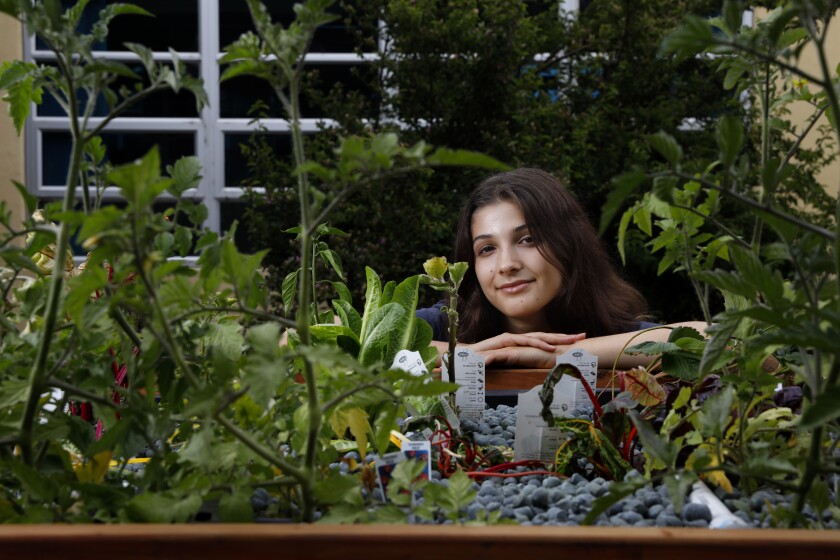
Jordan Karambelas poses with her redwood vegetable bed that is watered by an attached fish pond.
(Christina House / Los Angeles Times)
The lower box is covered with pond liner, filled with water and the little fish. Garcia helped install the pump, which pushes the water from the fish tier to the peppers, chard, eggplant, tomatoes and other vegetables planted in Smart Gravel above. The constantly recycling water drenches the planting boxes, and the runoff drips back into the fish tank, keeping the water aerated.
If the water level gets too low in the fish tank, the pump automatically draws from the city water, and as an added bonus, the sound of running water is a balm in the dry courtyard outside a row of classrooms.
Aside from a few pranksters throwing Smart Gravel around, student response has been positive, Karambelas said, and she’s hoping it creates enough interest to swell membership in her new club next year.

Jordan Karambelas’ aquaponics vegetables are planted in lightweight nuggets of recycled plastic known as Arqlite Smart Gravel.
(Christina House / Los Angeles Times)

(Christina House / Los Angeles Times)
Karambelas has big plans to rebuild the broken greenhouse and neglected raised beds in the courtyard — left over from now-defunct clubs at the school — and replant them all using recycled water. This summer will be the test to see how much water her aquaponics system requires, but she plans to visit frequently and expects a good organic crop.
“It’s important for students to know about this because a lot of people don’t have land, and this can be done literally anywhere,” she said. “A lot of students don’t know anything about this, so even starting a conversation is important because then they’ll be more likely to implement what they learn in their daily life.”