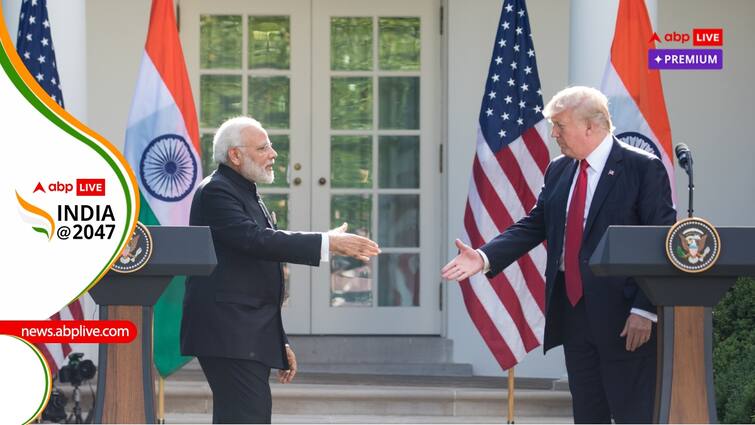
India-US Relations: India is believed to be keeping a blueprint of sorts ready when it comes to dealing with the United States under incoming President Donald Trump who will be re-entering the White House in a few weeks from now, even as bilateral ties between Washington DC and New Delhi seem to have hit turbulence over some of the traditional issues like H1B visas and high tariffs on imported American goods, ABP Live has learnt.
According to highly placed sources, while New Delhi is considering Trump’s latest remarks on tariffs and the entire imbroglio in Washington on H1B visas as political rhetoric, India is not taking any chances with the incoming Trump administration which is expected to be “tough” on the Narendra Modi government.
Last time when Trump was the President, the United States had — in 2018 — imposed tariffs on steel and aluminum imports from other countries, including India, citing national security concerns. Thereafter, in 2019, Washington took a drastic step of removing India from the Generalized System of Preferences (GSP) programme under which its exports used to receive trade benefits worth $6 billion.
President-elect Trump, who is going to take oath of office on January 20, will have Jaimeson Greer as the next US Trade Representative (USTR) who will be instrumental in driving his international trade and investments agenda.
“Jamieson will focus the Office of the U.S. Trade Representative on reining in the Country’s massive Trade Deficit, defending American Manufacturing, Agriculture, and Services, and opening up Export Markets everywhere,” Trump said in November.
ALSO READ ON ABP LIVE | With Trump In White House, India To Feel Pressure On Tariffs, Transnational Repression Allegation
US Trade Deficit With India
This is not the first time, though, that Trump has raised concerns of having a trade deficit with partner countries, which includes India. Currently, India enjoys a trade surplus of about $40 billion with the United States, which is its topmost trading partner, according to official statistics.
During his previous tenure from 2017 till 2021, Trump had repeatedly raised concerns of having a trade deficit with India.
Last month, while addressing the media at his Mar-a-Lago resort Trump said: “I’ve always said, if they tax us, we tax them the same amount… The word reciprocal is important because if somebody charges us – India, we don’t have to talk about our own – if India charges us 100 per cent, do we charge them nothing for the same?”
Former Indian Ambassador to the US Meera Shankar told ABP Live: “While there is a bipartisan consensus in the US on strengthening ties with India, sharp political, economic, social and strategic polarisation within the US can potentially pose challenges.”
She said: “India cannot afford to take ties for granted and has to work with the incoming Trump Administration to ensure that we continue to build on our areas of convergence and to dialogue on areas where our approaches may be different.”
New Delhi is hoping to deal with the Trump administration by giving impetus to some of the strategic initiatives that were kickstarted by him during his previous tenure, sources said.
India, the sources said, is even willing to “give more teeth” to some of the strategic groupings like the Quad even if that tantamount to upsetting China.
“We will need to discuss the whole gamut of our Strategic Partnership with the new Administration to ensure continuity. There could be potential friction on issues of trade and technology cooperation and also on visas for our professionals. There could also be differences on Climate Change, if Trump chooses to walk out on US global commitments,” said Shankar.
Jaishankar Visits US, Sullivan In India Next Week
Meanwhile, External Affairs Minister S. Jaishankar visited the United States for a week last month from December 24-29 during which he was able to meet Congressman Michael Waltz, Trump’s nominee for National Security Advisor.
While speculations were rife that Jaishankar’s visit will also result in PM Modi receiving an invite to Trump’s inauguration, that has not happened yet.
“The Jaishankar visit was an opportunity to seek closure with the Biden administration and set some initial goals with the incoming Trump team. I suspect Jaishankar also wanted to send a message of reassurance amid the deep levels of partisanship and polarization in both countries—a message that Mike Waltz and any other interlocutors in the incoming Trump administration with whom Jaishankar spoke likely reiterated. The emphasis would have been on maintaining a commitment to advancing partnership, come what may and despite some obstacles,” Michael Kugelman, Director of the South Asia Institute at the Washington-based Wilson Center, told ABP Live.
He also said: “It’s not clear if Trump plans to invite Modi to his inauguration. But either way, I don’t see this as something that will impact the relationship. There’s never been an expectation that foreign leaders attend a U.S. presidential inauguration, and there’s no precedent for it.”
Kugelman added: “If it happens this time and a few do attend it, the relationship won’t lose out if Modi isn’t invited or if he’s invited and declines. The Indian ambassador would most likely attend. And there will be plenty of Trump-Modi encounters, perhaps initially next year when India hosts the next Quad meeting.”
On Monday, US’ outgoing NSA Sullivan will be on a short visit to India. He will be meeting NSA Ajit Doval on January 6 and hold a meeting on the US-India Initiative of Critical and Emerging Technologies (iCET).