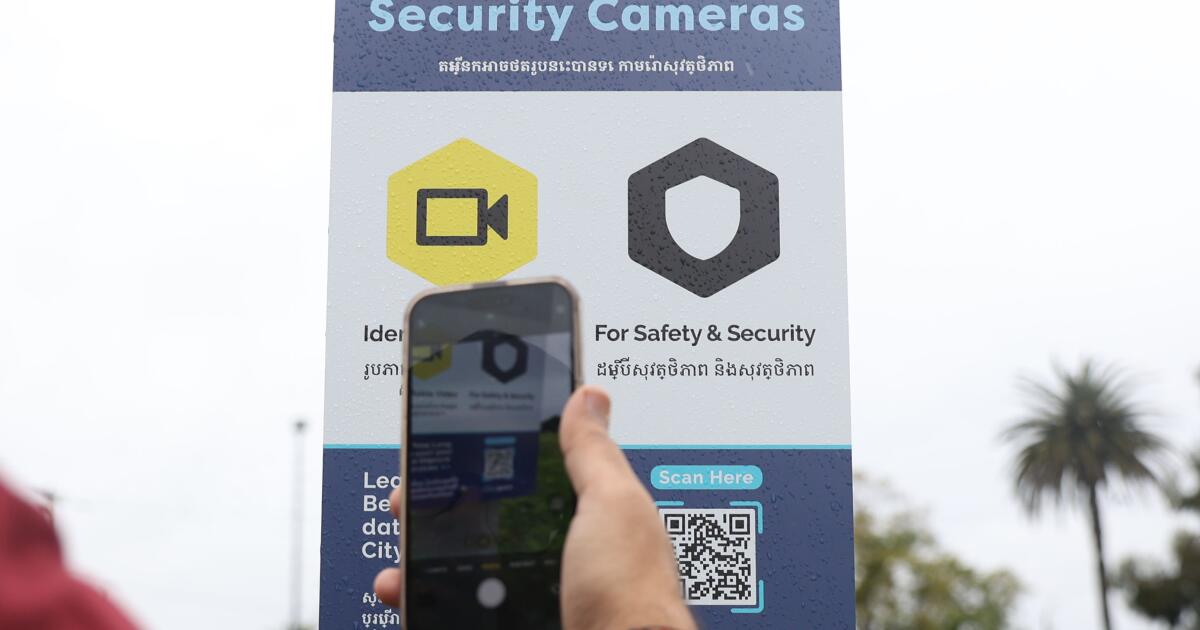
Rain was falling steadily as the group huddled underneath umbrellas outside the Mark Twain Neighborhood Library in Long Beach in early March, equipped with their smartphones and a mission.
Their goal: take a “data walk” around a few blocks of the city to see various technologies — security cameras, public Wi-Fi hotspots, the library self-checkout kiosk — with signs explaining how the city collects residents’ data, how it stores that information, and why.
How much does your city know about you? A lot, it turns out.
On any day in Long Beach, residents encounter dozens of technologies that collect their personal information. Some are easier to spot than others.
Police patrol cars scan license plates. A camera logs how many vehicles pass through an intersection. Smart water meters track each time a resident turns on their tap. Beachgoers heading to the sand enter their license plate number and credit card information into a mobile app to pay for parking.
Even in-person shopping is an opportunity for data collection. A parking structure at 2nd & PCH, the city’s newest outdoor shopping mall, can tell exactly how long you’ve been parked there and whether or not you’ll have to pay.
That’s just a sliver of what officials collect. And Long Beach offers just one example of how personal data is being hoovered up by local governments statewide.
Gwen Shaffer, a professor at Cal State Long Beach, who is spearheading the project in partnership with the city of Long Beach, asked participants before they launched on the stroll whether the services being provided were worth the trade-off in data privacy.
The group of roughly a dozen residents hesitated.
“That’s a hard question for me to answer if I’m not aware of what technology the city is in fact utilizing,” 72-year-old Genevieve Vigil responded. More information, she said, could help foster some acceptance of the technologies being used and the personal data being collected.
That’s exactly what researchers — and the city — are seeking to do with the recently launched digital rights platform.
Gwen Shaffer, right, guides data walk participants through a questionnaire in Long Beach in March.
(Michael Blackshire / Los Angeles Times)
The platform, which is funded through a National Science Foundation grant, consists of data privacy notices for nearly two dozen unique city-deployed technologies that collect personally identifiable information. Each sign features a QR code that takes residents to an online platform where they can learn how the city stores and uses the data. It also details the length of time data is stored and whether it is shared or encrypted.
“The whole project is about transparency,” Shaffer said. “When the city is using data for certain purposes, they want to make sure residents understand those uses.”
Ryan Kurtzman, technology partnerships officer for Long Beach, hopes the initiative will become a model for other California cities. Boston, Washington, D.C., and cities in Canada, Australia and France have rolled out similar signage on technologies in recent years.
“We’ve known from the beginning that data privacy is something our residents are concerned about, and it’s our responsibility as city government to make sure we’re being transparent about the data that’s being collected, how it’s being shared and how it’s protected,” Kurtzman said.
The United States, unlike the European Union, does not have a comprehensive law regulating how personal data are collected, stored and sold. Instead, California has been a leader on that front, adopting broad data privacy laws and creating an agency to enforce them.
The 2018 California Consumer Privacy Act and the 2020 California Privacy Rights Act combine to form the strictest data privacy regime in the country. Under these laws, Californians have the right to know about the personal information a business collects about them and how it’s used and shared, the right to delete personal information and the right to opt out of the sale of their information. The measures were bolstered by the Delete Act, passed last year, which lawmakers say will make it easier for consumers to get sensitive information erased.
But these laws apply only to businesses, not government. The idea behind the digital rights platform is to move Long Beach closer to complying with the “spirit of the law,” Shaffer said.
Advocates with the Center for Democracy and Technology have been pushing public agencies to provide community members with input and choices surrounding what data are collected about them. Long Beach’s platform is a positive start, but consumers should understand that the list isn’t an exhaustive one, said Elizabeth Laird, the director of equity and civic technology at the nonprofit.
“Using technology responsibly means you’re conscious of the ways it can harm people, especially vulnerable communities,” Laird said. “One of the core tenets of being able to use technology responsibly is the forcing mechanism of telling people what you’re doing.”
During the March data walk, the residents’ first stop was the self-checkout kiosk at the public library. This technology, created to help streamline library services, encrypts data and doesn’t store it indefinitely. Next, they scrutinized the public computers and printing inside the library. Many said they were fine with this kind of technology.
The group traveled outside into the rain where the technologies — the city’s bike share program, public Wi-Fi hotspot and a security camera affixed to a light pole high above MacArthur Park — got a bit more sophisticated and, for some, troubling. The security camera, which captures video that can be accessed by law enforcement, made Vigil uneasy.
In 2020, Long Beach and Pasadena faced scrutiny for sharing data from license plate readers with the Immigration and Customs Enforcement agency despite pledges not to do so.
Long Beach police launched a review in 2020 and determined that an employee had inadvertently granted ICE access to automated license plate reader data through its vendors’ “group approval” feature, the agency said at the time.

People participate in a data walk to test out Long Beach’s new digital rights platform near the Mark Twain Neighborhood Library in March.
(Michael Blackshire / Los Angeles Times)
The camera at the park collects video and still images at a resolution high enough to identify individuals and license plate numbers.
“The surveillance that’s in the park, it’s stored indefinitely, and it’s assumed that there will always be good actors that are handling that information,” Vigil said. “But I don’t know that.”
Researchers are seeking another round of funding to develop a privacy assistant mobile app that will give residents the ability to set privacy preferences, if feasible, when they encounter some of the city-operated smart tech around Long Beach.
If funded, the app would enable residents to opt out of data collection in some instances, Shaffer said. They also would be able to set their preferences for how often they’re notified about certain smart technologies around them.
“We want to show this is a way for cities to boost trust among their residents,” Kurtzman said. “I believe that cities have a responsibility to be open and honest about the technologies they are using.”