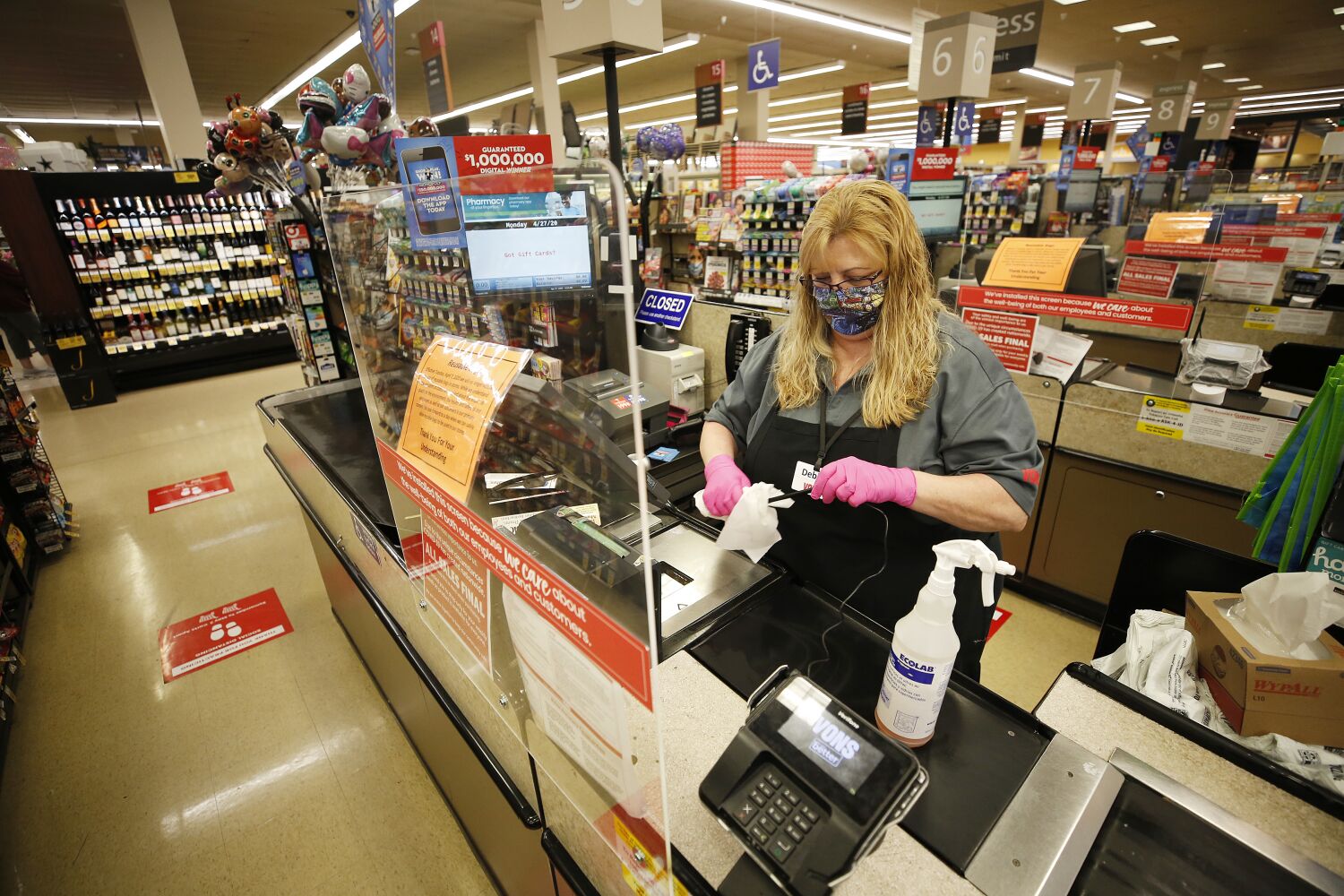
Kroger’s $20-billion bid to buy smaller rival Albertsons would bring together several well known Southern California grocery chains, including Ralphs and Vons, to create a supermarket giant in an era of increased competition for shoppers’ money.
As the hottest inflation in 40 years eats into buying power, Kroger Chairman and Chief Executive Rodney McMullen vowed to use $1 billion in annual savings created by the proposed merger to lower shelf prices, remodel stores and improve worker wages and benefits.
“We will take the learnings from each company to bring greater value and a better experience to more customers, more associates and more communities,” McMullen said Friday in a conference call with investors.
Consumer advocates and union representatives quickly decried the proposed deal and urged the government to take a hard look at the potential effects and block the combination.
Jamie Court, president of Consumer Watchdog, a Santa Monica-based consumer advocacy group, called the proposed merger “a terrible idea.”
“It’s going to drive down competition,” he said. “This would give too much market power to one big giant, especially in California. … We would urge the administration to reject this merger.”
The United Food and Commercial Workers Union, which in April signed a new three-year contract covering 47,000 employees at 540 Ralphs, Albertsons, Vons and Pavilions stores from San Diego to San Luis Obispo, said the proposed merger “would significantly harm Southern California’s grocery industry — thousands of essential grocery store workers could potentially lose their jobs, and it will affect customers’ access to fresh, healthy groceries at a time when they’re already battling rising inflation.”
Shoppers also were worried by the news, particularly by the prospect of store closures.
“Any time you hear about something like this you know it’s not going to be good,” said Katrina Medina, who has shopped at the Albertsons store in the Baldwin Hilll Crenshaw Plaza shopping center for years. “The quality and service here is better than any other store in the neighborhood. It would be awful if they closed another Albertsons.”
Mel Henderson had driven from the San Fernando Valley to the store on Crenshaw Boulevard just to get cupcakes for his daughter. Albertsons is his favorite chain and few of the stores are left in Southern California.
“There were two of them not too far from here, and they closed both of them,” Henderson said. “I just hate that they always seem to be taking stuff away from us, Black people, when they talk about mergers.
Kroger, based in Cincinnati, operates 2,800 stores in 35 states, with chains that include Ralphs, Food 4 Less, Smith’s and Harris Teeter. Albertsons, based in Boise, Idaho, operates 2,273 stores in 34 states, under names that include Vons, Pavilions, Safeway, Jewel Osco and Shaw’s. Together the companies employ around 710,000 people.
Kroger is offering to pay nearly bid $20 billion for Albertsons Cos., or $34.10 per share. Kroger will also assume $4.7 billion of Albertsons’ debt. Shares in both companies fell Friday.
The deal will likely be heavily scrutinized by U.S. antitrust regulators, especially at a time of high food price inflation.
The Justice Department and the Federal Trade Commission were already in the process of updating merger guidelines to better detect and prevent anticompetitive deals. In July, President Biden signed an executive order promoting competition in business and calling for tougher scrutiny of mergers.
Utah Sen. Mike Lee, the senior Republican member of the Senate Judiciary Committee’s antitrust subcommittee, said in a statement: “I will do everything in my power to ensure our antitrust laws are robustly enforced to protect consumers from anticompetitive mergers that could further exacerbate the financial strain we already feel in the grocery store checkout aisle.”
If approved by regulators, the deal is expected to close in early 2024.
To ease the regulatory process, Kroger and Albertsons said they would divest stores in markets where they overlap. The companies said they would spin off up to 375 Albertsons stores in a standalone public company.
“We are confident, from the extensive work that we’ve done, that we have a clear path to achieve regulatory approval with divestitures,” Kroger Chief Financial Officer Gary Millerchip said.
McMullen said the company would decide market by market whether stores would change their names.
“We’ll want to evaluate each market individually, who has the stronger market share,” he said.
Together, the stores would control around 13% of the U.S. grocery market, assuming the sale or closure of around 400 stores for antitrust reasons, according to JPMorgan Chase analyst Ken Goldman.
Still, that is a distant second to Walmart’s 22% share. Amazon, which bought Whole Foods in 2017, is also a growing player in the space, with 3% share. Warehouse store Costco controls 6%.
Value chains like Aldi and Dollar General — which have a combined 4% market share — have also been squeezing traditional grocers like Kroger and Albertsons.
Goldman said a stronger combined company could possibly help tame food price inflation, since it would have more power to reject food producers’ price increases. The two chains combined have 34,000 private label products at various price points that compete directly with food manufacturers.
Kroger said it would reinvest approximately $500 million into price reductions. It said it would also spend $1.3 billion updating Albertsons stores and $1 billion on higher employee wages and improved benefits.
Kroger also said the combined stores would provide greater and faster access to fresh food, with a combined 66 distribution centers and 52 manufacturing plants. Together, the stores operate in 48 states and the District of Columbia.
But critics questioned a merger at a time of high food price inflation. Food prices rose 13% in September compared with last year, according to U.S. data released Thursday.
“A Kroger-Albertsons deal would squeeze consumers already struggling to afford food, crush workers fighting for fair wages and destroy independent, community stores,” said Sarah Miller, executive director of the American Economic Liberties Project, a nonprofit that supports stronger corporate accountability and antitrust measures.
Both Albertsons and Kroger themselves have grown into huge operations partially through acquisitions.
Albertsons was bought by a consortium of investors including Cerberus Capital Management, a private equity firm, in 2006. Cerberus helped finance Albertsons’ 2015 purchase of the Safeway grocery chain and attempted a failed merger with Rite Aid in 2018. Albertsons became a publicly traded company in 2020.
Cerberus currently holds nearly 30% of Albertsons shares. The merger deal includes a $4-billion dividend to Albertsons shareholders.
In 2015 alone, Kroger purchased four chains: Roundy’s, Pick ’N Save, Metro Markets and Mariano’s. It bought the meal kit company Home Chef in 2018.
Kroger has long outperformed Albertsons in key areas, including the development of store brands and advanced technology, said Neil Saunders, managing director of Global Retail Data, a market research company. Last year, for example, Kroger opened the first of 20 planned warehouses where robots help fulfill delivery orders.
But Saunders said Albertsons allows Kroger to expand into markets where it has less presence, like Nevada, Oregon and Washington.
The Associated Press contributed to this report.