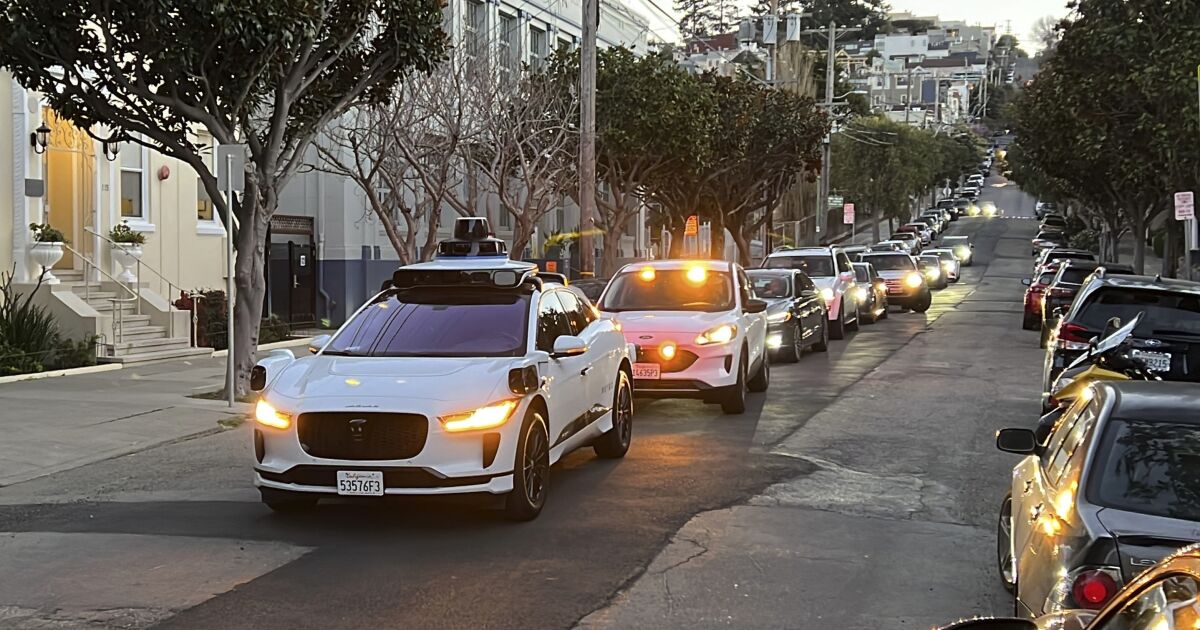
Get ready, San Francisco: The state government on Thursday approved a major expansion of driverless robotaxi service throughout the city.
And get ready, Los Angeles: The industry is planning to push for driverless rides here as soon as it gets permits to do so.
The state’s green light, on a 3-1 vote by the California Public Utilities Commission, signals a historic turning point for the robotaxi business as it evolves from fascinating experiment to commercial reality. It also marks the beginning of a grand experiment in public safety as thousands of multi-ton vehicles operated via artificial intelligence attempt to safely negotiate the hills and narrow streets of San Francisco.
It highlights California’s messy multiagency regulation of new automobile technology: Two agencies are in charge of the robotaxi business, the CPUC and the California Department of Motor Vehicles. And it shines a spotlight to expose Silicon Valley’s influence on California government.
Although the approval delights the industry and proponents of rapid technological innovation and economic growth, it’s provoked anxiety among automotive safety advocates and local public officials, who have little regulatory power over the vehicles.
San Francisco’s robotaxis have become notorious for “bricking”— or coming to a dead stop — in traffic, clogging lanes for emergency vehicles, blocking firetrucks from exiting stations, stopping on fire hoses and driving directly into emergency scenes where Police and Fire Department lights are flashing, rather than going another way.
“They’re not ready for prime time,” San Francisco Fire Chief Jeanine Nicholson told The Times recently.
The Fire Department made public reports of 55 such incidents over the last year and a half, most of them occurring just in the last several months.
The CPUC, which approved the measure, regulates rides for hire. The CPUC also regulates ride-hailing services Uber and Lyft. Both companies plan over time to replace their human drivers with robot cars.
The approval allows robotaxi companies Waymo and Cruise to charge fares and expand operations to all parts of the city, 24 hours a day. Each has deployed several hundred vehicles in the first phase of the commercial rollout. With the expansion, that will grow to thousands of vehicles, Cruise Chief Executive Kyle Vogt recently said on an earnings call.
The sole no vote was cast by Commissioner Genevieve Shiroma, who said the commission shouldn’t allow rapid expansion before Waymo and Cruise are required to explain why their vehicles keep interfering with emergency responders and what they’re going to do about it. “The commission lacks at present sufficient information … to evaluate the safety aspect of this,” she said. “It is premature to approve these resolutions today.”
Voting in favor were Commissioners John Reynolds and Darcie Houck, and commission Chair Alice Reynolds. Commissioner Karen Douglas was absent. All five commissioners were appointed by Gov. Gavin Newsom.
John Reynolds, who came to the CPUC after serving as top lawyer at Cruise, said safety is the DMV‘s concern. He called the dozens of Fire Department incidents “anecdotal data analysis lacking sufficient rigor.” He added that earlier deployment rules passed by the CPUC are set in stone and can’t be changed without a lengthy rulemaking process.
Although Reynolds recused himself from voting on those rules, he did help Cruise advise the CPUC in the early stage of the rules’ creation. Reynolds said before his vote that his professional role has now switched to “consumer advocate.”
Shiroma took issue with describing the emergency responder data as “anecdotal” and asked how those pushing for an immediate vote would feel if “a member of your family was trapped in a burning building.”
She made clear she wasn’t opposed to robotaxi deployment, but more time was needed for the industry to explain why its software gets confused in emergency scenes, and how it’ll be fixed. “Given their financial backing” it’s reasonable to ask Cruise and Waymo to take the time to get things right before a major expansion.
The driverless industry has a reputation as a bunch of scrappy startups, but the key companies are all owned by corporations with deep pockets. Cruise, by General Motors; Waymo, by Google’s Alphabet; Motional, by Hyundai; and Zoox, by Amazon.
City officials fought hard to delay an expansion until the companies could figure out how to program their vehicles to prevent interference with first responders. They won a two-month delay, but on Thursday the CPUC made its decision. Opponents, meanwhile, won an acknowledgment that their concerns are real.
In its lengthy resolution, the official document approving the expansion, the commission said it “acknowledges continuing and emerging challenges related to passenger and public safety.” It said “we remain concerned about potential risks, known and unknown, to passenger and public safety as driverless [automated vehicles] scale up.”
No concrete plans to address those issues were mentioned. The commission did say that it “will engage with stakeholders” and that “we see the need for continued development in our approach to AV regulation and policy.”
The resolution also addressed city officials’ concerns about lack of local control over safety and traffic flow not only in San Francisco but also in Los Angeles and Santa Monica. The commission noted that cities are allowed to issue traffic tickets.
The CPUC did signal an intention to review California government’s spotty rules around safety data collection and address the driverless industry’s propensity to keep stats out of public view sometimes with the help of the state’s own regulators. In 2021, after the DMV received a public records request for Waymo crash data, the agency invited the company to seek a court injunction to prevent the DMV from releasing full crash reports.
After the injunction was granted, the DMV and Waymo cut a deal to keep the basic crash information concealed on the grounds of protecting company trade secrets. California Atty. Gen. Rob Bonta helped the DMV and Waymo craft the deal, which was approved by a state court.
The robotaxi expansion was supported by state and local chambers of commerce, merchants’ associations, advocates for the disabled, and California Assemblyman Evan Low, who represents Silicon Valley. A large number of individuals spoke in favor or against the move before the CPUC vote. Several blind people testified in favor. Several others in wheelchairs were opposed, noting that current robotaxis cannot accommodate them, and that human taxi drivers are able to help them in and out of their vehicles.