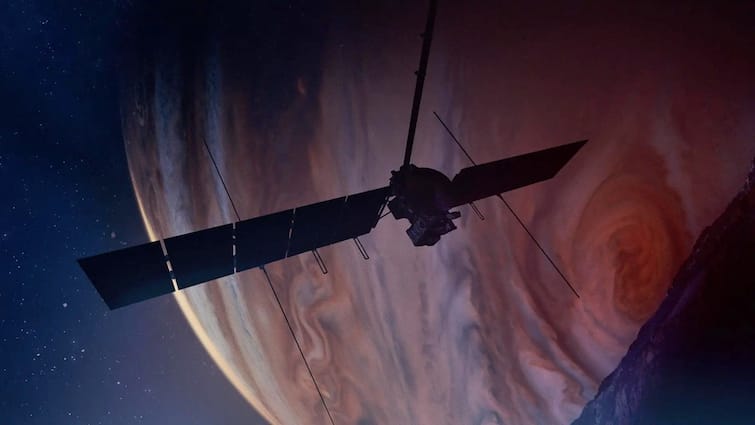
NASA’s Europa Clipper spacecraft, designed to explore Jupiter’s moon Europa, launched aboard a SpaceX Falcon Heavy rocket on Monday at 12:06 p.m. ET from Kennedy Space Center, Florida, according to a live stream on NASA’s website. The mission aims to study the ice-covered moon, considered one of the solar system’s most promising environments for potential life.
The launch, initially set for October 10, was delayed due to Hurricane Milton. After thorough evaluations of the launch facilities, crews cleared the spacecraft for liftoff. Mike McAleenan, launch weather officer at the 45th Weather Squadron of the US Space Force, confirmed that weather conditions were 95% favourable for the launch, CNN reported.
Leaving our water world, to explore another 🚀@EuropaClipper launched from @NASAKennedy at 12:06pm ET (16:06 UTC) on a @SpaceX Falcon Heavy, beginning a 1.8-billion-mile journey to explore the mysteries of Europa, Jupiter’s ocean moon. pic.twitter.com/IQ7uRSviMb
— NASA (@NASA) October 14, 2024
The Europa Clipper is equipped with nine science instruments and a gravity experiment, aiming to investigate the ocean believed to exist beneath Europa’s thick ice shell. Scientists estimate this ocean could contain twice as much liquid water as Earth’s oceans. The spacecraft will fly by Europa 49 times, coming as close as 16 miles (25 kilometres) from its surface.
“The instruments work together hand in hand to answer our most pressing questions about Europa,” said Robert Pappalardo, project scientist for the mission at NASA’s Jet Propulsion Laboratory in Pasadena, California. “We will learn what makes Europa tick, from its core and rocky interior to its ocean and ice shell to its very thin atmosphere and the surrounding space environment.”
Europa Clipper: NASA’s Mission Overview And Trajectory
With its massive solar arrays, Europa Clipper is the largest spacecraft ever built by NASA for a planetary mission, spanning over 100 feet (30.5 metres). It is expected to begin orbiting Jupiter in April 2030 and will conduct its flybys over a year starting in 2031. The spacecraft will loop around Mars and Earth, gaining speed as it heads towards Jupiter, covering a distance of approximately 1.8 billion miles (2.9 billion kilometres).
NASA’s official statement highlighted that “Its sights are set on Jupiter’s ice-encased moon Europa, which the spacecraft will fly by 49 times, coming as close as 16 miles (25 kilometres) from the surface as it searches for ingredients of life.”
After lifting off from historic Launch Complex 39A, the Falcon Heavy’s side boosters separated, followed by the core stage being expended into the Atlantic Ocean. The second stage fired its engine to help Europa Clipper escape Earth’s gravity. Around 50 minutes after launch, the payload fairing separated from the rocket, and the spacecraft separated from the upper stage about an hour post-launch. Stable communication with the spacecraft was expected to be established approximately 19 minutes after separation.
About three hours after liftoff, Europa Clipper deployed its solar arrays and directed them towards the Sun. Mission controllers are set to reconfigure the spacecraft for its operational mode over the next three months. This phase includes a commissioning period to ensure all systems are functioning as expected.
ALSO READ | SpaceX Successfully Launches Starship 5, Achieves Midair Booster Catch Using ‘Mechazilla’ Arms
Europa Clipper: Search For Habitability Beyond Earth
Though the Europa Clipper is not a life-detection mission, it seeks to determine if the moon holds the potential for habitability. Scientists believe that Europa’s ocean, situated beneath its icy crust, may contain essential ingredients for life — water, energy sources, and organic compounds. The spacecraft’s detailed observations will focus on understanding the thickness of the ice shell, the ocean’s composition, and the moon’s geological features, according to NASA.
For its probe, Europa Clipper is outfitted with cameras and spectrometers to take high-resolution images and generate maps of the moon’s surface and thin atmosphere. With this, the spacecraft includes a thermal instrument to detect locations for plume activity and spots where the ice is warmer. Its magnetometer will find out the moon’s magnetic field to reveal the existence of Europa’s ocean along with its depth and salt content, CNN reported.
Ice-penetrating radar will be used to pierce the outer shell, approximated to be about 10 to 15 miles (15 to 25 kilometers) thick, to get proof of the existence of the moon’s ocean.
In case Europa’s ocean is detected venting particles into space with active plumes, the spacecraft’s mass spectrometer and dust analyser can “sniff” the particles and determine their composition, Haje Korth, deputy project scientist for Europa Clipper at Johns Hopkins University’s Applied Physics Laboratory, said. “The mass spectrometer and dust detector data will show whether Europa harbors the composition and chemistry required to host life,” Korth added, as per CNN.
The Europa Clipper mission is managed by NASA’s Jet Propulsion Laboratory (JPL), which partnered with the Johns Hopkins Applied Physics Laboratory (APL) for NASA’s Science Mission Directorate. JPL, based in Pasadena, leads the development, while APL designed the spacecraft body in collaboration with NASA centres, including Goddard Space Flight Center, Marshall Space Flight Center, and Langley Research Center.
NASA’s Launch Services Program, headquartered at Kennedy, managed the launch of the Europa Clipper spacecraft on the SpaceX Falcon Heavy rocket.