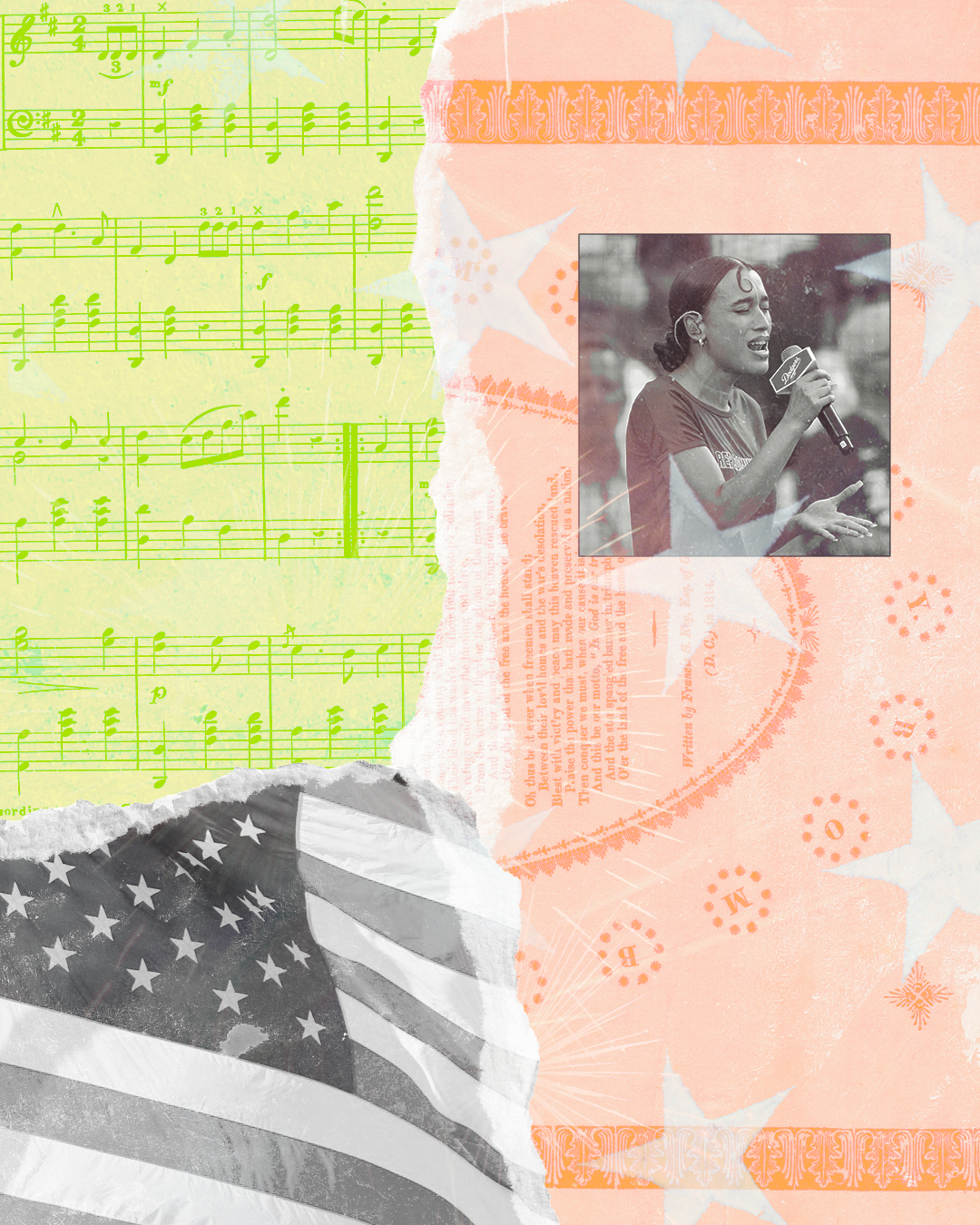
On Saturday night, singer Nezza sang a Spanish version of “The Star-Spangled Banner,” also known as “El Pendón Estrellado,” at Dodger Stadium, despite being told by an unnamed representative of the baseball organization that she sing it in English.
The 30-year-old pop singer, whose real name is Vanessa Hernández, uploaded the interaction on TikTok, where she proceeded to sing the Spanish version anyway. She captioned the video, “para mi gente [heart] I stand with you.”
In a tearful follow up TikTok video, she clarified that her decision to follow through with singing “El Pendón Estrellado” was in response to the ongoing immigration sweeps throughout Los Angeles
“I’ve sang the national anthem many times in my life but today out of all days, I could not,” Nezza said in the TikTok video.
The Dodgers did not issue a public comment on Nezza’s social media posts, but a team official said there were no consequences from the club regarding the performance and that Nezza would be welcome back at the stadium in the future.
“I just don’t understand how anyone can watch the videos that have been surfacing and still be on the wrong side of history,” Nezza told The Times.
Nezza’s performance has also sparked conversations about the origins of “El Pendón Estrellado,” resurfacing the legacy of a trailblazing Latina composer, Clotilde Arias.
“The lyrics and the story are the same,” said Nezza. “We’re still saying we’re proud to be American.”
In 1945, the U.S. State Department looked to commission a Spanish version of the national anthem, per the request of President Franklin D. Roosevelt, who looked to strengthen political and business partnerships with Latin American countries amid World War II. His cultural efforts aligned with his 1933 Good Neighbor Policy, a Pan-Americanism objective that he implemented at the start of his first term to distance the U.S. from earlier decades of armed intervention.
Although “The Star-Spangled Banner” had already been translated to various languages by the time that President Roosevelt entered office, including two Spanish versions, no versions of the anthem were considered singable. In 1945, the Division of Cultural Cooperation within the Department of State, in collaboration with the Music Educators National Conference, invited submissions for the song in Spanish and Portuguese to promote American patriotism throughout Latin America.
Composer and musician Arias — who immigrated to New York in 1923 at the age of 22 from Iquitos, Peru — answered the call.
At the time, Arias had already established herself as a formidable copywriter for ad agencies, translating jingles and songs in Spanish for companies like Alka-Seltzer, Campbell Soup, Ford Motor Co., Coca-Cola (including the translation version of Andrews Sisters’ “Rum and Coca-Cola”) and others.
She submitted “El Pendón Estrellado,” which included singable lyrics that conveyed the original patriotic essence of “The Star-Spangled Banner.” It was accepted as the only official translation of the national anthem allowed to be sung, according to the National Museum of American History.
However, Arias would die in 1959 at age 58, leaving the song’s existence publicly unknown until 2006, when Roger Arias II, her grandson, dug out drafts of the sheet music and drafts hidden in the garage.
The unexpected find caught the attention of Marvette Pérez, the late curator of the Smithsonian National Museum of American History who at the time was programming Latino exhibits like “!Azúcar!: The Life and Music of Celia Cruz.”
To honor Arias’ legacy, Pérez organized an exhibit in 2012 titled “Not Lost in Translation: The Life of Clotilde Arias,” featuring real documents and photographs of the songwriter. The exhibit also commissioned the first-ever recording of “El Pendón Estrellado,” sung by the a cappella ensemble Coral Cantigas under the musical direction of Diana Sáez. The DC-chamber choir also performed during the exhibit’s opening day, which Arias’ son, Roger Arias, age 82 at the time, came to see.
“I was there when she was writing it,” Roger Arias told NPR at the time. “She’d sing it in her own way to see if it fits, and she would say, ‘How does that sound, sonny?’ And I would say anything she did sounded good to me. So, yes, she struggled through it, but she made it work.”
For Nezza, Arias’ “El Pendón Estrellado” is not only a symbol of American pride, but also a living piece of forgotten Latino history.
“Latino people are a huge part of building this nation,” said Nezza. “I think [the song] shows how we are such an important piece to the story of America.”