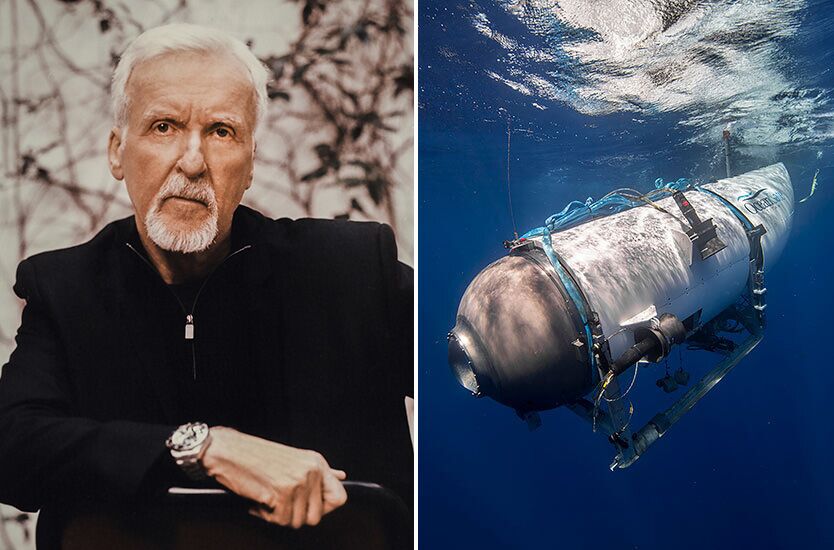
OceanGate co-founder Guillermo Söhnlein is defending his former company against criticism from “Titanic” director James Cameron about the tourist submersible Titan‘s design after it imploded this week, killing all five of its passengers.
The submersible had been on a dive to the Titanic wreck site when it was reported missing Sunday after losing contact with a research vessel on the surface.
After news of the tragedy broke, Cameron, a longtime member of the diving community who famously dove to the deepest known point on Earth and who has visited the Titanic wreck more than 30 times, told ABC News on Thursday evening that the carbon-fiber design of OceanGate’s submersible was “too experimental to carry passengers and that it needed to be certified.” He has since appeared on various news outlets repeating his concern about the sub’s lack of certification and has called for greater regulation of similar sea vehicles.
Söhnlein, who co-founded the deep-sea tourism company in 2009, responded directly to Cameron’s comments on the U.K.’s Times Radio on Friday, explaining that in the diving community, “there are completely different opinions and views about how to do things, how to design submersibles, how to engineer them, build them, how to operate in the dives.”
“But one thing that’s true of me and the other experts, is none of us were involved in the design, engineering, building, testing or even diving of the subs,” Söhnlein continued. “So it’s impossible for anyone to really speculate from the outside.”
In a separate interview on BBC Radio 4’s “Today,” Söhnlein echoed his defense and mentioned Cameron by name, saying that the film director wasn’t there for the submersible’s construction and “rigorous test program.”
He added, “This was a 14-year technology-developed program, and it was very robust and certainly led to successful scientific expositions to the Titanic in the last few years.”
Söhnlein co-founded OceanGate Expeditions with Stockton Rush, who piloted the failed Titan and died on board. He and Rush led several dives in the early days of the company. Söhnlein served as its CEO before leaving the company in 2013, remaining a minority equity owner, with Rush taking over as chief executive. The company had been using the Titan sub for expeditions with “citizen explorers” to the Titanic since 2021.
“I was involved in the early phases of the overall development program during our predecessor subs to Titan, and I know from firsthand experience that we were extremely committed to safety, and risk mitigation was a key part of the company culture,” he told Times Radio.
During a Thursday-evening interview with CNN, Cameron described the certification process by oversight groups, such as the American Bureau of Shipping or Norway-based DNV, as an essential part of diving safety.
“I think it was unconscionable that this group did not go through that rigorous process,” Cameron said of OceanGate, adding that the incident was preventable.
When pressed by BBC Radio 4’s Martha Kearney on whether he thought greater certification standards and regulations were needed to prevent other underwater tragedies, Söhnlein deferred to policy experts and said it is a common question across the underwater exploration industry, as well as in space tourism.
“It’s a matter of what happens when technology innovation outpaces regulations,” he said. “And oftentimes the people developing the technology innovations are in a better position to understand the risks and figure out ways to best minimize them.”
Representatives for Cameron did not immediately return The Times’ requests for comment, while Söhnlein could not be reached Friday afternoon.
Also in the ABC News interview, Cameron said the diving community had been concerned about OceanGate’s submersible for years, with the community’s top engineering figures writing letters to the company expressing concern.
The Times obtained a 2018 letter, privately written to Rush, stressing the need for a third-party safety review of OceanGate’s submersibles. Also in 2018, David Lochridge, a former OceanGate employee, sued the company for terminating him after he raised safety red flags about the submersible and the company’s alleged refusal to put its hull through certain critical nondestructive testing.
“I’m struck by the similarity of the Titanic disaster itself, where the captain was repeatedly warned about ice ahead of his ship and yet he steamed at full speed into an ice field on a moonless night and many people died as a result,” Cameron continued, referring to the sinking of the Titanic in 1912 in which more than 1,500 died. “For us, it’s a very similar tragedy, where warnings went unheeded. To take place at the same exact site with all the diving that’s going on all around the world, I think it’s just astonishing. It’s really quite surreal.”
Around the time communications were lost, the U.S. Navy had picked up the sound of the submersible imploding. The detected sound was kept secret as the rescue and recover efforts continued over the next four days. The detection wasn’t known to the public until the Wall Street Journal reported the event on Thursday, which was later confirmed by The Times.
But Cameron claimed that he had also known of the detected “loud bang” days before the public. He told Reuters that his sources in the tightknit submersible community had notified him of the sound and had already suspected that the submersible had imploded.
Cameron had begun to email colleagues as early as Monday, writing that “we’ve lost some friends” and “it’s on the bottom in pieces right now.”
While testing is underway to determine the exact cause of the implosion, Cameron has repeatedly homed in on the Titan’s carbon-fiber composite hull as among the likely contributing factors to its demise. “You don’t use composites for vessels that are seeing external pressure,” such as in deep-sea diving, the “Avatar” director said Friday on “Good Morning America.” “They’re great for internal-pressure vessels like scuba tanks, for example, but they’re terrible for external pressure, so this was trying to apply aviation thinking to a deep submergence engineering problem.”
Yet OceanGate co-founder Rush believed that the carbon-fiber material, which is commonly used in the aerospace industry, is what would propel deep-sea research and his company forward. The new material allowed them to design sea vehicles that allowed for more space within the hull, giving scientists more room to operate, or for tourism, to carry more enthusiast passengers.
Rush knew research was expensive and hoped to offset its costs with high-end adventure tourism, such as the Titan’s dives to the Titanic wreck site. He also looked to collaborate with other industries such as oil and gas, mapping the sea floor for dig sites, as well as inspection of bridges or ship hulls.
“The long-term value is in the commercial side,” Rush told Fast Company in 2017. “Adventure tourism is a way to monetize the process of proving the technology.”
Times staff writers Alexandra E. Petri and Noah Goldberg and the Associated Press contributed to this report.