California’s largest inland body of water is in trouble. Inflows to the Salton Sea have decreased, salinity is growing, the ecosystem is collapsing, and neighboring communities are suffering high rates of respiratory illnesses caused, many believe, by contaminants in dust blowing off the exposed former seabed.
It’s not possible to import enough water quickly enough to save the ecosystem and cover the contaminants. The solutions must be more practical: Fixing the salinity will be the key to saving this crucial habitat. A targeted approach can also reduce dust.
After decades of neglect, a foreseeable problem has devolved into an urgent crisis. Each year more salt flows in while the sea shrinks due to agriculture-to-urban water transfers and the West’s years-long drought, making the ecosystem less habitable to remaining wildlife.
The longer this continues, the harder it becomes to fix. California and the federal government must act now before it’s too late.
The state commissioned an independent review panel a year ago to consider ways to import water and restore the Salton Sea, which is northeast of San Diego. We participated in the panel’s review process and concur with its recent conclusion that a no water importation approach would restore the ecosystem and mitigate air pollution within a reasonable period of time.
The sea shouldn’t be refilled. Instead, it should be allowed to arrive at its new equilibrium volume and elevation. When talking about California’s largest lake, a smaller Salton Sea still means an enormous body of water. Saving the Salton Sea ecosystem is about reducing its salinity, not increasing its volume.
The panel rejected the idea of building a desalination plant on Mexico’s Sea of Cortez and pumping purified ocean water north to refill the Salton Sea. Instead, a large desalination plant could be built right on the shore of the Salton Sea as part of the solution.
The facility would pull salty, polluted water out of the lake and return purified water. The brine effluent would be dried in evaporation ponds and the dried salt — initially a massive amount until the sea became purer — could be transported to landfills using railroad cars and existing tracks.
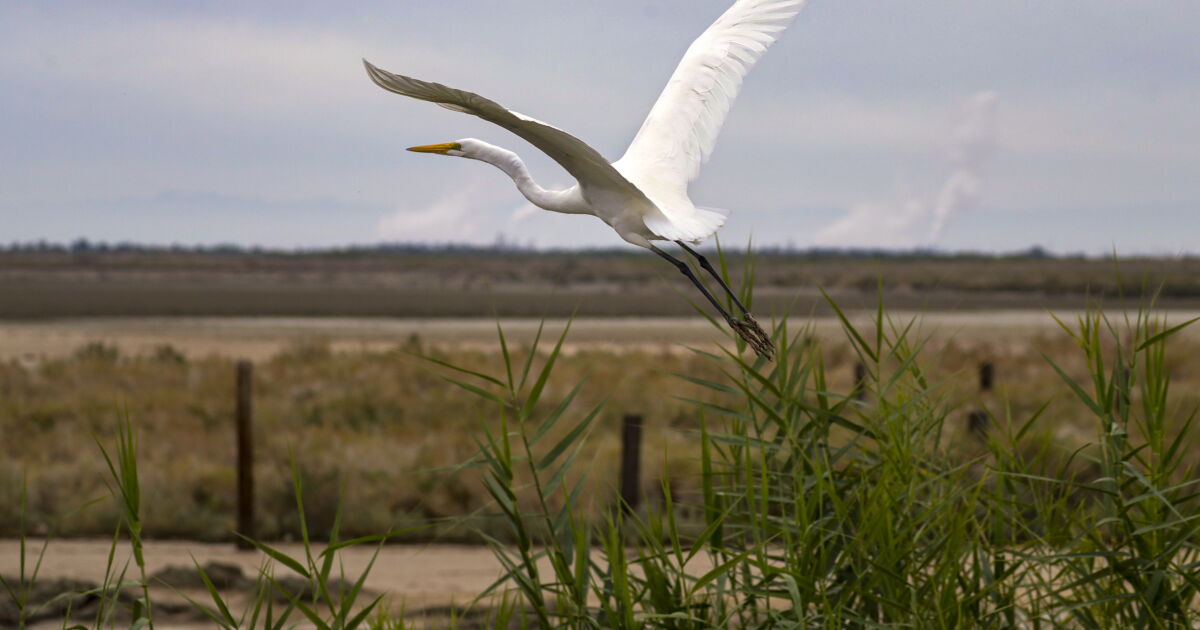
Over time, the sea would arrive at a new equilibrium of ocean-level salinity fit for fish and birds. As other Southern California water sources disappeared in recent decades, the sea became a crucial stopover on the Pacific flyway for migrating birds and a year-round home for others. More than 400 bird species have been found at the sea, and 46 of those have some level of state or federal protection. They are at risk today because of the sea’s collapsing food web, but they could thrive following its restoration. So could fishing and other recreation.
The desalination plant would have to be large — twice the size of the Carlsbad desalination facility. A plant this size is needed to save remaining sea life and reduce the water’s salinity over time. The state should commence design and permitting for such a plant immediately.
California also needs to secure water each year to make up for water lost from the desalination process. This could be acquired through a voluntary, compensated fallowing program at the nearby Imperial Irrigation District. In addition to paying farmers for fallowing fields and letting their irrigation water flow to the sea, the state would compensate the irrigation district, Imperial County, farmworkers and agricultural businesses harmed by fallowed farm fields. Expensive, yes, but it would solve a century-long water problem.
Critically, this combination of desalination and voluntary fallowing could be in operation as soon as 2033, with steady improvement and ocean-level salinity achieved less than 20 years after that. The panel found that the proposal to pull water from the Pacific would begin to deliver purified water in 2045 at the earliest.
A smaller Salton Sea, however, will result in a larger playa, as the exposed former seabed is known locally. Projects are already underway to stabilize the playa and reduce how much dust is stirred up by wind. The state announced in 2017 a plan to minimize dust and restore habitat across almost 30,000 acres near the Salton Sea. The state needs to be more aggressive in funding these projects.
Like the rest of the review panel, we believe the ecology of the sea can be restored. Its elevation can be stabilized with its salinity close to ocean salinity, and the playa’s risk of dust pollution can be greatly reduced. A robust program can revive opportunities for the tourist economy and protect human health. The sea can again be a bird haven and tourist destination, not a looming disaster.
Brent M. Haddad, a professor of environmental studies at UC Santa Cruz, is the author of “Rivers of Gold: Designing Markets to Allocate Water in California.” Robert Glennon, a professor emeritus of law at the University of Arizona, is the author of “Unquenchable: America’s Water Crisis and What to Do About It.”


:quality(70)/cloudfront-us-east-1.images.arcpublishing.com/tronc/OEG6M77YTRBGJKOXBRUQP2XU7Y.jpg)