As the movie “Oppenheimer” has shown to millions, scientists disagree, have fragile egos, experience office politics and have problems in their personal lives. And they do something else that all humans do — make mistakes. That’s because science is a process, not a set of fixed facts. It doesn’t fall out of the sky fully formed. It’s messy and iterative.
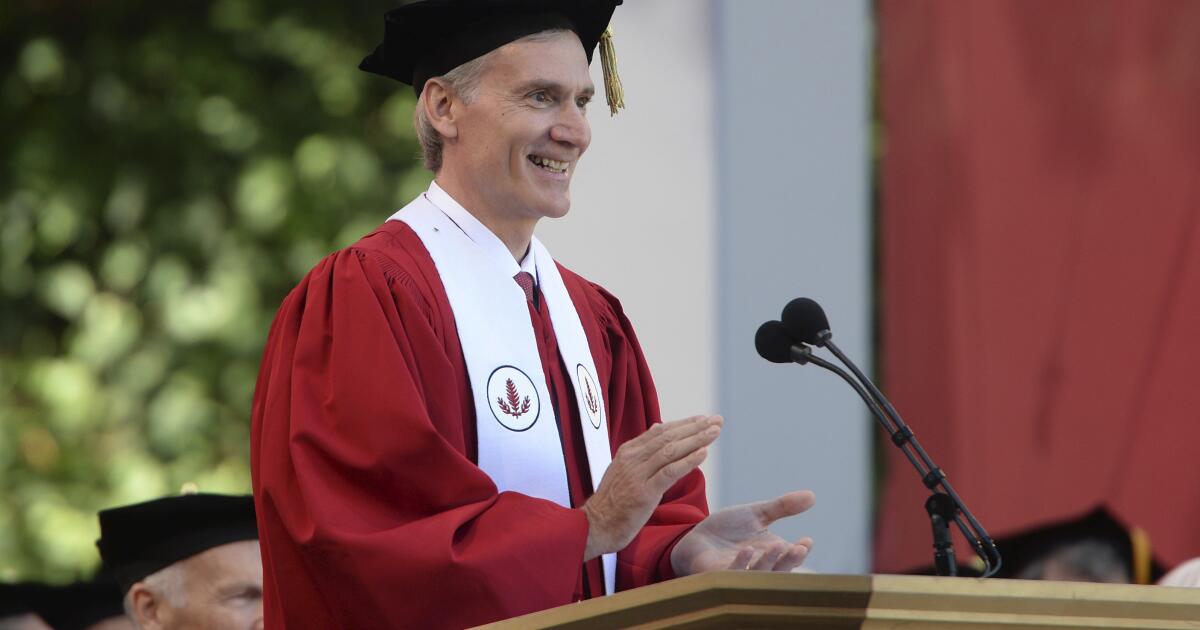
On Thursday, Science issued retractions of two research papers it published from the outgoing president of Stanford University, Marc Tessier-Lavigne, who officially leaves his post Sept. 1. As editor in chief of Science, I hope that this move will help illustrate the importance of transparency in our field, especially around the fallible humanity of its scientists, their work and the publishing system that disseminates it.
Prior to publication, research papers have traditionally been seen only by the authors of the paper, the journal editor who handles the paper, and the authors’ peers who advise the journal on whether the work is of sufficient interest and reliability to be published. Only when the results are published are they pored over by many other experts.
If problems are spotted, they are sometimes shared and discussed online at websites such as PubPeer, on social media or by email among editors and authors. The now widespread online dissemination of “preprints,” which are unpublished versions of the paper, means that a broader group will see the results ahead of time on sites like bioRxiv. But even then, lots of mistakes still don’t get caught until after publication.
Then comes the challenge of how to react to identified mistakes. In an ideal world, the authors would engage collaboratively with journals and those who have raised concerns on determining how to adjust the scientific record to account for these problems, and journals would post updates quickly. This rarely happens, and that needs to change.
In the case of Tessier-Lavigne, scientists on PubPeer raised concerns in 2015 about papers he had co-authored in Science and Cell several years earlier. Images in the papers appeared to have been altered inappropriately prior to publication. Tessier-Lavigne contacted the journals to post corrections. Cell decided that they were not significant enough to warrant a correction. Science approved the corrections, but because of human error they were never posted to its website (our current staff was unable to nail down why that lapse occurred).
Theo Baker, an enterprising student journalist at Stanford, took interest in this and started writing extremely detailed stories about the specifics of this case, along with new concerns about the papers. That ignited a firestorm in Palo Alto. Because it involved the president of Stanford, the national media followed Baker into the story.
In keeping with what usually happens when high-profile institutions face uncomfortable matters, Stanford’s board of trustees commissioned an investigation by independent experts. Their report concluded that Tessier-Lavigne did not have direct knowledge of the errors, but that he did not catch or make enough effort to correct them and that “there may have been opportunities to improve” his lab’s oversight and management. He resigned after the release of the review.
Much has been written about why incidents like this happen, but the main reason is that securing a paper in prestigious journals such as Science, Cell or Nature can be so significant to the careers of the authors and their research that errors often either get overlooked or, in a subset of those cases, are carried out intentionally. This fact creates a high burden of responsibility for all involved. Journals, authors, institutions and funding organizations would all be best served if errors were corrected quickly and without a lot of drama over who is at fault.
Unfortunately, that seldom happens. Authors often contest corrections, even to the point of hiring attorneys to threaten legal action. While Tessier-Lavigne and other authors requested the retractions Science published, one author disagreed that the papers should be retracted. Institutions are afraid of legal action and running afoul of onerous requirements from funders over how to adjudicate these matters. And journals do not have the ability to carry out our own investigations, so we depend on other entities, which are bogged down by legal and public relations bureaucracies.
Journals are often the first to be criticized for the sluggishness and ineffectiveness of this process. We are an obvious, perhaps even easy target, as it is ultimately our decision to publish and then correct or retract papers. Some of the criticism is warranted. Journals have their own bureaucracies that we all need to manage better. More importantly, journals are often timid about explaining the details of errors in the scientific record for fear of further eroding public confidence in their practices and, more broadly, of wearing away public trust in science.
That needs to change. It’s time for everyone involved in recording the progress of science to start talking about its woes as well as its glories in plain language, without delays and before scandal forces the conversation. For all the triumphs of the scientific process, mistakes are part of it too. Whether they are allowed to erode trust is up to us.
Holden Thorp has been editor in chief of the Science family of journals since 2019.