Greek tragedy is often treated as pure drama but the surviving plays are only a blueprint for a more multilayered theatrical event. Scholars have speculated that the texts might be closer to libretti for an operatic experience that is as intellectual as it is emotional — and therefore difficult for us to precisely imagine.
For me, Greek tragedy in performance is most satisfying when it approaches the intensity of a Mass. What Sophocles makes possible in “Oedipus the King,” the cornerstone drama of the Western canon, is a communal meditation on some of the profoundest mysteries of the human condition.
Oedipus, paragon of problem-solvers, discovers by the end of the play the limits of his own keen intellect. In trying to outrun his fate, he learns that he is part of a design that is larger than his understanding. But it is as a victim of fate that he finds the freedom to assume a courageous responsibility for deeds committed in ignorance.
Objectively guilty of slaying his father and marrying and bearing children with his mother, he knows that he has become a pariah for all mankind. Nothing can extenuate the horror of acts he spent his adult life trying to avoid. Yet in accepting his suffering, he leaves an image of terrifying, sacrificial nobility, a figure of blind humanity shouldering the shame and error of his life.
Jon Wolfe Nelson as Creon in the foreground, with Russell Harvard as Oedipus in the production at the Getty Villa.
(Craig Schwartz)
A new version of “Oedipus,” adapted and directed by Jenny Koons at the Getty Villa’s Outdoor Theater, retells the tale in a theatrical mode that combines American Sign Language and spoken English. A collaboration with Deaf West Theatre, the production never lets the audience forget that the tragedy is greater than the sum of its dialogue.
Gesture and movement express the passion and fury beneath the play’s words. Andrew Morrill and Alexandria Wailes adapted the play into American Sign Language, but it’s the art of the actors that augments the effect of universal physical communication.
Video projections by Yee Eun Nam extend the discreet lyrical dynamism of Tanya Orellana’s scenic design and Jared A. Sayeg’s lighting. The blend of Peter Bayne’s music and sound design operates almost subliminally. The costumes of Jojo Siu, at once chicly modern and timeless, further the sense that the play is happening in a classical now.
Initially, the staging seems as though it might be closer to dance than drama. But those familiar with Deaf West (perhaps from the L.A.-based company’s two biggest successes, “Big River” and “Spring Awakening”) will recognize the playing pattern of having a role seamlessly signed and spoken by separate actors.
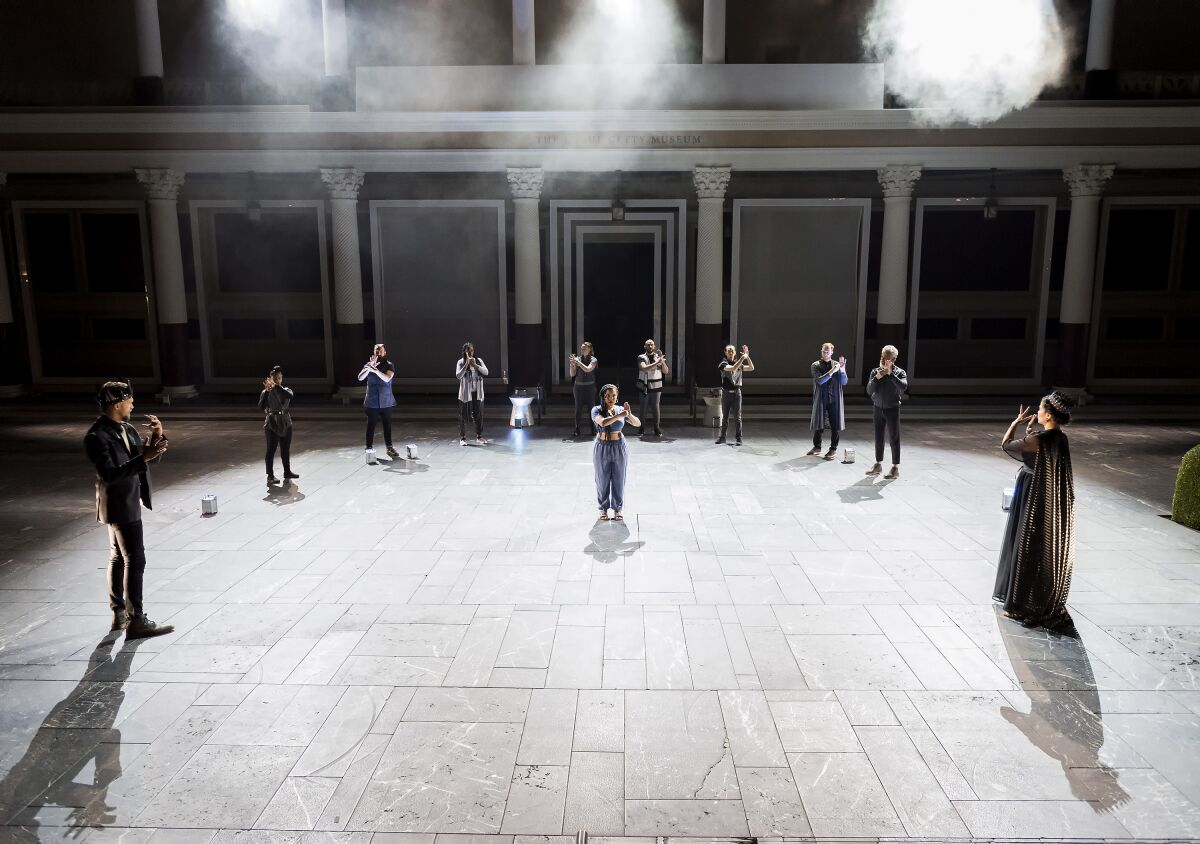
Cast of “Oedipus” at Getty Villa.
(Craig Schwartz)
Some of the chorus members are more eloquent when not speaking. The obviousness of dramatic intonation can detract from the abstract aesthetic Koons scrupulously achieves. I preferred the production in its dispassionate mode. Of course, Oedipus is a passionate drama, regularly exploding in fury and ending in agony. But the emotion is most potent when held in the vise of controlling or fearful human minds.
Russell Harvard’s Oedipus is tyrannical without understanding himself to be so. Headstrong, impatient and quick to condemn, he struts around with an arrogance he believes is utterly justifiable. He attained kingship after solving the riddle of the Sphinx. Having rescued Thebes from one plague, he is eager to prove his superiority again by rescuing it from another.
All he must do is find the murderer of Laius, the former king whom he replaced both on the throne and in Queen Jocasta’s bed. Never having met a riddle he couldn’t answer, he won’t stop until he gets to the bottom of his own identity.
Harvard wears an unfortunate crown that looks like something a child might don in a school play. Perhaps the point is the flimsiness of such royal symbols, but the toy cornet robs Harvard’s Oedipus of some dignity. Yet the star quality this seasoned performer brings is impossible to deny.
Matthew Jaeger, who plays Oedipus Advisor and shadows the protagonist, is afforded proper gravity. His close interaction with Harvard’s Oedipus helps embody the tragic journey. Harvard would benefit at times from more restraint, but he intrepidly travels to the extreme verge of Oedipus’ saga.
The production’s grip on our attention tightens as the story unfolds. This is a credit both to the miracle of dramatic construction that is Sophocles’ play and to the bold originality of some of the characterizations.
Tiresias is re-created by Ashlea Hayes as a Black woman who has long had to endure the benighted privilege and superciliousness of those who see less than they can possibly know. Creon is vibrantly transformed by Jon Wolfe Nelson into a Beverly Hills aristocrat, a little shallow perhaps but able to hold his own when Oedipus turns against him. Wailes’ Jocasta, a royal matron with sensuality intact, would rather her husband stop digging into truths that she increasingly suspects might reveal the cracked foundation of their marriage.
This version of “Oedipus,” based on a translation of “Oedipus the King” by Ian Johnston, softens a bit at the end. A sentimentality foreign to Sophocles makes a brief but noticeable appearance. But the power of a play that answers few questions but leaves us full of weighty thought is reborn in a manner that may be closer to the theatricality of the Ancients than more academic revivals.
‘Oedipus’
Where: Getty Villa, Outdoor Theater, 17985 Pacific Coast Highway, Pacific Palisades
When: 8 p.m. Thursdays-Saturdays. Ends Oct.1
Tickets: $40-$48
Information: (310) 440-7300 or tinyurl.com/OedipusGettyVilla
Running time: 1 hours, 30 minutes