It’s a long way from becoming law, but three senators released a draft of legislation Thursday that would standardize name, image and likeness across the nation.
The intent is to address issues with athletes’ money-making activities that have surfaced since the NCAA lifted its ban on NIL compensation in 2021, and to establish federal standards and regulations for athletes’ health are and safety that would preempt state laws.
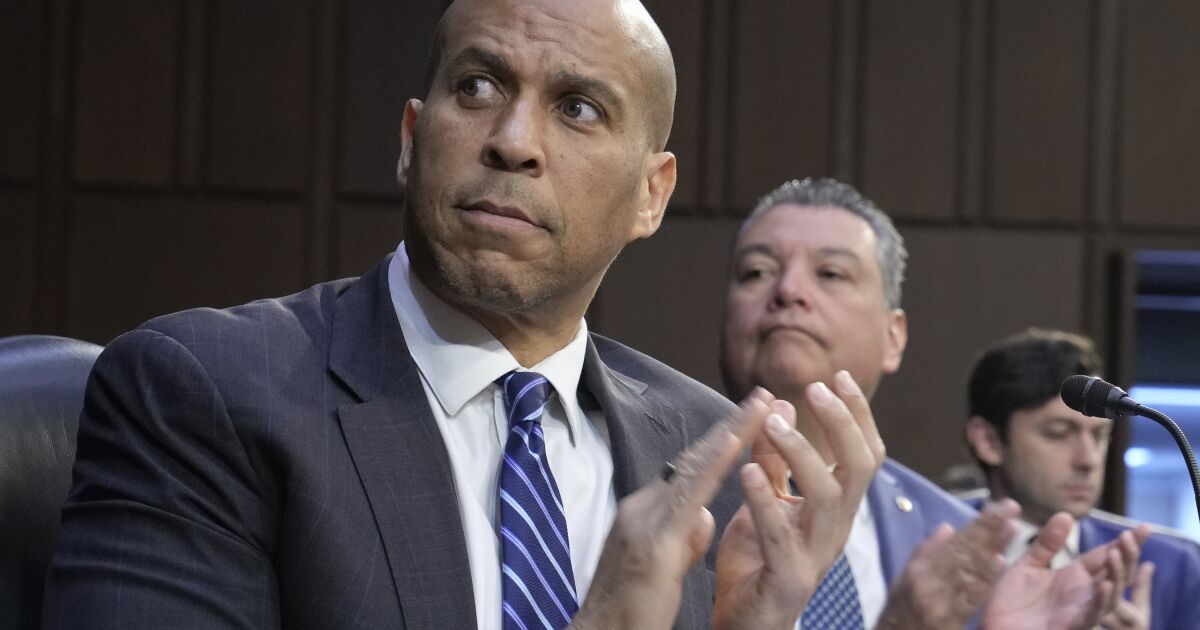
The proposed College Athletes Protection & Compensation Act from Sens. Cory Booker (D-N.J.), Richard Blumenthal (D-Conn.) and Jerry Moran (R-Kan.) would create the “College Athletics Corporation,” a non-government entity that would hold investigative and subpoena powers.
The corporation would advocate transparency by maintaining a publicly available database including every athlete endorsement contract broken down by sport, gender and ethnicity. A certification procedure would be implemented for anyone seeking to represent athletes in NIL deals.
“This bipartisan proposal represents a major step forward, and I’m grateful for the partnership with Senators Blumenthal and Moran,” Booker said in a statement. “It would make college athletics fairer, safer, and more just, and empower more young people to succeed in sports and beyond.”
The NCAA has declined to establish rules that set a national standard for NIL since a unanimous vote by the Supreme Court two years ago upheld a lower court’s decision that NCAA restrictions on “education-related benefits” for college athletes violated antitrust law.
“Nowhere else in America can businesses get away with agreeing not to pay their workers a fair market rate on the theory that their product is defined by not paying their workers a fair market rate,” Justice Brett M. Kavanaugh wrote in a concurring opinion. “The NCAA is not above the law.”
Since that emphatic rebuke of business as usual in college sports, conference commissioners have lobbied Congress to regulate NIL. Congress has been slow to respond, however, with nearly a dozen bills dying in the first step in the legislative process.
Meanwhile, a slew of state laws passed that created a confusing and fundamentally unfair playing field. Many of the laws are toothless, seemingly designed to give schools in those states a competitive advantage in recruiting and retaining top players.
“The reality is, only Congress can fully address the challenges facing college athletics,” Southeastern Conference commissioner Greg Sankey said this week at SEC media days. “Congressional action is the only way to provide a national uniform standard for name, image, and likeness activity and to draw the lines around the boundaries that do not become simply pay for play.”
In a rare display of bipartisanship, the three senators took the first step toward a federal solution.
Included in the draft of the bill:
- Athletes would keep their scholarships until they finish their undergraduate degrees as long as they remain in good academic standing and do not transfer.
- Schools would be required to provide athletes with at least 15 hours a year of financial literacy and life skills training that would count as college credits.
- Schools would be forbidden from discouraging athletes from choosing rigorous academic majors.
- College athletes could enter drafts by professional leagues without losing their NCAA eligibility if they decide to return to school within seven days of the end of the draft.
- A medical trust fund for sports-related injuries would be developed, with schools obligated to cover athletes’ out-of-pocket medical expenses for two or four years, depending on the school’s athletics revenue.
“[Athletes] need a level playing field with guarantees of economic opportunities, educational outcomes, and essential health care,” Blumenthal said in a statement.