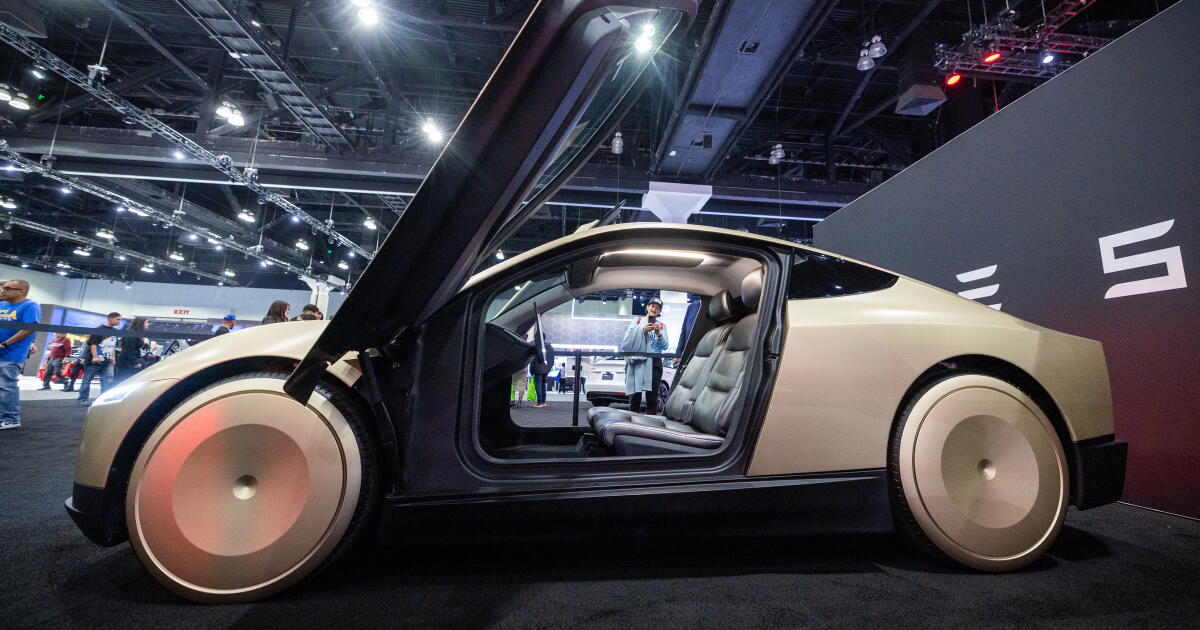
Tesla’s robotaxi services may have hit a roadblock following the highly-anticipated launch of the Cybercab.
The electric vehicle company deployed its first Cybercabs in Austin, Texas, on Thursday night, prompting federal regulators to investigate whether the vehicle was properly certified.
The gold-colored, two-door vehicle was first unveiled nearly two years ago in Los Angeles. It lacks a steering wheel, gas pedal and mirrors.
The National Highway Traffic Safety Administration said it opened an audit query to examine the process and technical data Tesla used to certify the Cybercab. Regulators will also determine whether Tesla acted based on assumptions that certain Federal Motor Vehicle Safety Standards don’t apply to the Cybercab.
Tesla’s launch Thursday night was shrouded in mystery and closed to media. In a surprise to Tesla investors and fans, the company did not provide a livestream link and Musk was not present at the event.
Details on deployment and growth plans for the Cybercab were sparse. According to the Texas Department of Motor Vehicles, 45 Cybercabs are registered in the state.
“We’ve made a car that looks like the future, designed and optimized around the passenger” said Ian Kettle, site manager for the Cybercab, on Thursday. “We always promised amazing abundance, and this is it.”
Tesla’s vice president of AI, Ashok Elluswamy, also spoke at the event. The speakers emphasized that the Cybercab is safer than a human driver.
As the robotaxi race heats up, NHTSA is in the process of overhauling safety standards that regulate vehicle components such as brake pedals and rearview mirrors. The review is designed to remove “unnecessary barriers” to purpose-built robotaxis, NHTSA’s announcement said.
Last month, NHTSA granted Amazon’s robotaxi company Zoox a first-of-its-kind exemption to operate purpose-built autonomous vehicles in Las Vegas and charge for it.
Like the Cybercab, Zoox taxis lack driver’s controls such as a steering wheel and gear shift. Alphabet-owned Waymo, which leads the robotaxi race with operations in 14 cities, uses existing traditional vehicles retrofitted for autonomy.
NHTSA’s audit query will examine an estimated 1,000 Cybercabs, a NHTSA document said. Tesla notified the agency that it had self-certified all the vehicles as compliant with federal safety standards and plans to gradually expand commercial deployment.
“NHTSA fully supports the safe development and deployment of automated vehicles,” said NHTSA Administrator Jonathan Morrison in a statement. “But as the federal regulator, we need to ensure that all of our laws are followed.”
Tesla has long promised a profitable robotaxi business, powered primarily by the Cybercab and supplemented by self-driving Tesla Model Y vehicles. Driverless Teslas began serving customers in Texas in 2025, though several glitches were reported. That year, Musk said Tesla’s autonomous ride hailing would be available to half the U.S. population by the start of 2026.
As electric vehicle sales have slowed for Tesla and other manufacturers, Musk has emphasized the potential of AI-powered technology, including his company’s humanoid robot dubbed Optimus.
Tesla shares had risen 26% since the end of July as anticipation built for Thursday’s launch, but investors were disappointed Friday, with shares falling nearly 6% to $354.08
The company’s shares have fallen 19% this year while the S&P 500 Index is up 12% as of Friday.


:quality(70)/cloudfront-us-east-1.images.arcpublishing.com/tronc/ZZA2AFD2MVCSLH564IHNSCHJYU.JPG)