Book Review
Unnatural Habitat: The Native and Exotic Wildlife of Los Angeles
By Craig Stanford
Heyday: 264 pages, $24
If you buy books linked on our site, The Times may earn a commission from Bookshop.org, whose fees support independent bookstores.
Los Angeles tends to strike outsiders as a borderless mishmash of suburbs spread over an unfriendly landscape with no significant natural source of water. When it’s not on fire, it seems to be sliding into the ocean or collapsing under the weight of its own untamable development.
And yet Los Angeles transplants will still brag to their loved ones across the country that they could go skiing and surfing in the same day (if for some reason they felt so inclined). As the conservationist Craig Stanford reminds us, however, you don’t have to drive to Big Bear or the beach to feel the pulse of nature in L.A.
In “Unnatural Habitat: The Native and Exotic Wildlife of Los Angeles,” Stanford offers Angelenos — and anyone interested in the function and dysfunction of (sub)urban ecosystems — a guide to the natural life that teems beneath our freeways, wanders into our backyards and fights for survival in the deserts and mountains that surround our city.
Stanford, who has conducted field research around the world, lives in Pasadena, in the foothills of the San Gabriel Mountains. As he details more than 150 species of L.A. flora and fauna — from native mountain lions to exotic earthworms, weeds that occur naturally and palm trees that, surprisingly, don’t — he evokes a portrait of an unusual city’s special, bizarre and unexpectedly fragile wildlife. He conjures up evolutionary histories, stories of foreign species’ arrival and their effects on an ecosystem that is massively and continuously altered by human influence.
But Stanford’s mission here isn’t simply to describe the creatures at hand — though he does do plenty of that, never hesitating to anthropomorphize even the most inhuman of them; to him, snakes are “secretive,” tarantulas “ominously deliberate.” The book excels — feels necessary, even — when it unravels the intricate interplay between human and animal habits; societal institutions and nature; common sense and our desire to decorate and navigate Los Angeles however we please.
He also offers prescriptions, micro and macro, private and public, for better stewardship of our environs. We can decide what we plant in our own gardens, for example, so Stanford advises readers to fill their yards with something native and drought-tolerant that can contribute to a more robust, stable and diverse ecosystem. (Of course, most of our city’s residents probably won’t get the memo.)
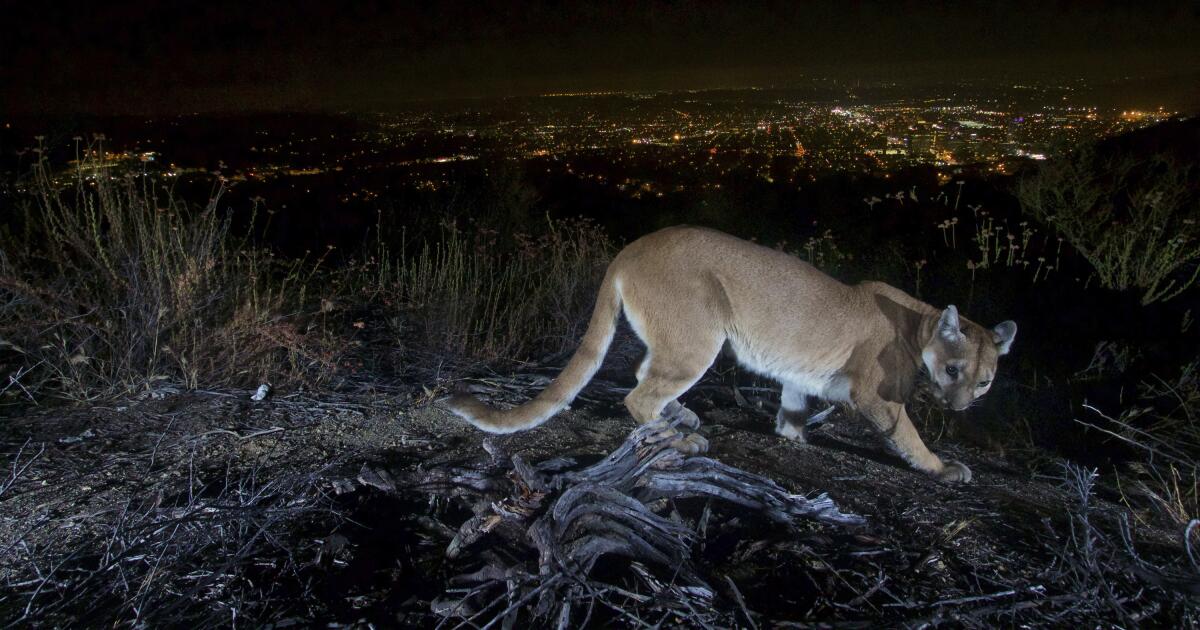
On the public front, Stanford highlights potential institutional improvements as well as bureaucratic roadblocks. In what is perhaps the book’s most compelling chapter, he writes about the man-made challenges to L.A.’s mountain lions. The gravest threat to these magnificent animals is our ubiquitous freeway system: Since 2015, more than 500 California cougars have become roadkill. Perhaps anyone could guess as much, but what a layman might never know without Stanford’s book is that our busy roads severely circumscribe the territory cougars can roam, leading to isolation and inbreeding.
A wildlife crossing is under construction over the 101 to allow cougars to traverse the freeway safely, expanding the territory they can access. But the cost of the project is high (about $90 million), as is competition for land that might otherwise serve as sanctuary for wildlife. Stanford, who usually comes across as optimistic, can wax cynical in the face of such frustrations.
His unexpected insights range from comical to shocking. He offers a snapshot of his cat having a field day with the finches in his backyard birdbath — and then explains the vicious cycle that creates invasive populations of feral cats that kill literally billions of birds across North America every year.
Stanford’s self-proclaimed ecological purism doesn’t mean he believes we should do away with nonnative species altogether, though. In fact, human interference has helped many species worth keeping around. Hummingbirds, for example, stay in L.A. year-round because our backyard feeders preclude any need for them to migrate in search of sugary plants. With that comes the responsibility to care for the wildlife we cultivate in this landscape that he acknowledges is “beautiful but largely nonfunctional.” It’s not clear whether he thinks we’re up to the task.
At his best, Stanford interweaves vivid prose, a reverence for nature and a seasoned Angeleno’s eye for what makes this city unique. At times, however, he fails to draw a connection between a species and the city, punctuating the book with vignettes laden with contextless taxonomy.
Regardless, the overall effect is a worthy and illuminating entry in the tradition of works exploring urbanization’s effect on the environment. (Stanford references Rachel Carson’s “Silent Spring,” and that author’s influence is felt throughout his book.) Moral questions abound, ranging from animal rights to humanity’s role in nature. Stanford’s fundamental message is clear and simple (and oft-repeated): To preserve a Los Angeles in which humans and nature benefit from one another, we must increase our understanding of our city’s fragile wildlife mosaic.
Stanford is heavy-handed only when he has to be, and his subtlety often hits harder. One chapter concerns a succulent so common in Los Angeles that I never knew its name: It’s called the live-forever (genus Dudleya), and, ironically, it’s at risk of extinction due to poaching. You can buy the plants at Home Depot, and yet they’re disappearing from our cliff faces and hiking paths. At the chapter’s close, Stanford articulates a profoundly upsetting truth: “Each generation grows up accustomed to the scope of Nature that surrounds it.”
Despite all he has to say about it, L.A.’s biodiversity is waning before our eyes. Fortunately, with Stanford’s help, we can acquire some of his vision for preserving our native species while effectively introducing exotic ones. Los Angeles is, after all, a city of transplants.
Daniel Vitale is a writer in Los Angeles and the author of the novel “Orphans of Canland.”