WASHINGTON — The United States unveiled plans Monday for new sanctions against Iran that Trump administration officials said are designed to sever Tehran from the global financial system as the nearly six-month conflict between the two countries drags on.
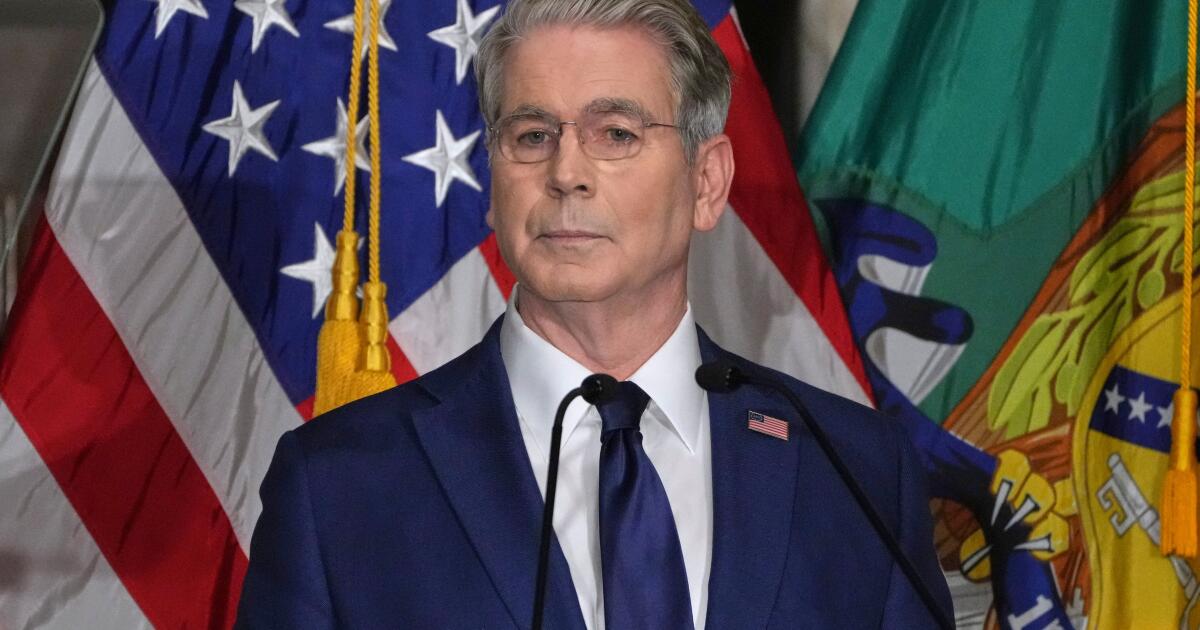
Treasury Secretary Scott Bessent, who previewed the announcement last week as “economic D-Day,” described the measures as the opening of an all-out financial assault on the Iranian government and its trade partners — a group that includes China, India, Turkey and the United Arab Emirates.
“To those who enable Tehran, do not discount the cost of testing Washington’s resolve,” Bessent said at a news conference. “No nation should expect to enjoy the rewards of our system while helping those who seek to destroy it.”
Bessent said it was time for world leaders to “make a decision” between “America and Iran,” adding that President Trump has already been calling foreign leaders to make specific requests ahead of the new sanctions.
But when asked whom the president had been talking to, Bessent said he would not “name names.” He also said the secondary measure would not take effect immediately, arguing that the administration is trying to give “everyone the opportunity to remedy bad behavior.”
“Why would I want to blow up the global financial system?” Bessent said when a reporter pressed him on why the sanctions weren’t immediate. “We believe that it is important to level set and give people a cure period, but they should know that that will move very quickly and that we are serious.”
The pressure campaign will build on a naval blockade and other sanctions the Trump administration has already imposed in its effort to force Tehran into a deal that ends the war on U.S. terms.
Trump’s latest economic push against Iran revives a familiar strategy from presidents of both parties, using financial leverage to pressure Tehran toward more serious negotiations over its nuclear program. Sanctions helped bring Iran to the table before a 2015 nuclear deal brokered by President Obama, but the agreement was widely criticized as weak by Republicans. After Trump withdrew from the agreement in his first term, a new “maximum pressure” campaign failed to secure a new deal.
Trump’s decision to return to a strategy of economic coercion has signaled to Iran that the fighting phase of the war is probably over, for now, with the U.S. administration choosing a path “neither of war nor of peace,” Masoud Pezeshkian, Iran’s president, said this week.
Iranian officials, who had been anticipating the move, pushed back on Washington’s strategy even before Bessent began speaking Monday.
Foreign Minister Abbas Araghchi told Iranian state media over the weekend that the sanctions amounted to a repackaged version of decades-old American pressure tactics that Tehran has already learned to withstand. Esmail Baghaei, Iran’s foreign ministry spokesman, warned of “grave consequences” for any countries cooperating with what he said was “illegal behavior” by the United States. And Mohsen Rezaei, the secretary of Iran’s Supreme Security Council, suggested that the economic pressure could shut down oil exports through the Strait of Hormuz, a threat that would ripple through global energy markets.
That defiance underscores the central gamble of Washington’s strategy. Rather than aiming sanctions at Iran alone, Bessent’s plan to potentially squeeze major economies like China and India over their ties to Tehran could pose a diplomatic risk to the U.S.
The fallout could also reach beyond foreign diplomacy as a hit to global markets also risks compounding Trump’s troubles at home ahead of the midterm elections, as Americans grow unhappy with the economy and their support for the conflict in the Middle East plummets. The Iran sanctions also land as the administration wages a separate trade fight with Canada, adding uncertainty to global and domestic markets.
Whether Washington will be able to apply pressure on Iran’s trade partners remains an open question.
China alone shares nearly $10 billion in bilateral trade with Iran, and paid roughly $31.2 billion for unreported Iranian crude oil imports in 2025, according to the U.S.-China Economic and Security Review Commission. That makes China the largest buyer of Iranian crude oil by a wide margin, accounting for more than 90% of Iran’s oil exports, according to the commission.
It is unclear whether Trump has spoken to China’s leader, Xi Jinping, about the sanctions. But the two leaders are set to meet in Washington next month, adding to the diplomatic dynamics of the moment.
Other trading partners have already made some moves.
The UAE said last week that it was suspending trade with Iran, a decision that followed accusations that Tehran had fired two ballistic missiles at the Emirates.
Afra Al Hameli, a spokesperson for the Emirati Ministry of Foreign Affairs, said in a post on Aug. 18 on X that all trade, commercial exchanges and financial transactions with Iran have been halted until further notice. She added that the Emirates was “firmly committed to safeguarding the integrity of the international financial system.”
Bessent said Monday that he expects other countries will “take similar actions as we continue our engagement.”
In an opinion article written for the Financial Times last week, Bessent has cast the new measures as the “single greatest financial offensive ever marshalled against an adversary.”
Bessent wrote that countries that “sever Iran’s remaining financial and commercial connectivity” will see their economies reinvigorated, and those who don’t will experience the end of their “lasting prosperity.”
“Any nation that serves as a financial artery of a withering regime should expect to share in its isolation,” he wrote. “To become a sanctuary for terror is to become, in the eyes of the United States, a global pariah.”
Ahead of the announcement Monday, Trump posted on Truth Social that Iran was “completely collapsing.”
Meanwhile, Iran’s central bank governor, Abdolnaser Hemmati, said the U.S. had already done all that it can against Iran and that the central bank had been shoring up its foreign currency reserves for months. Last week, he said Iran’s crude exports had “virtually stopped.”
“[The Americans] have done everything, so what else can they do?” he said in an interview with Tasnim News.
Despite his assurances that the central bank was working on preventing a devaluation of the Iranian rial, the currency has struggled to remain above a black market exchange rate of 2 million per dollar — a record low. The Central Bank rate stands at roughly 1.5 million rial to the dollar.
Though experts question the effectiveness of additional economic pressure on Tehran, Bessent’s threat to target Iran’s trading partners — especially the UAE, China and Turkey, who together comprise almost three-quarters of Iran’s foreign imports — will undoubtedly be painful for Iranians.
For example, Iran uses the UAE as a reexport hub and buffer, and receives vehicle spare parts from China, according to the Observatory for Economic Complexity. Iranian economic experts say both the agricultural and pharmaceutical sectors also rely on imports from countries such as Brazil and Turkey.
Ceballos reported from Washington and Bulos from Beirut.