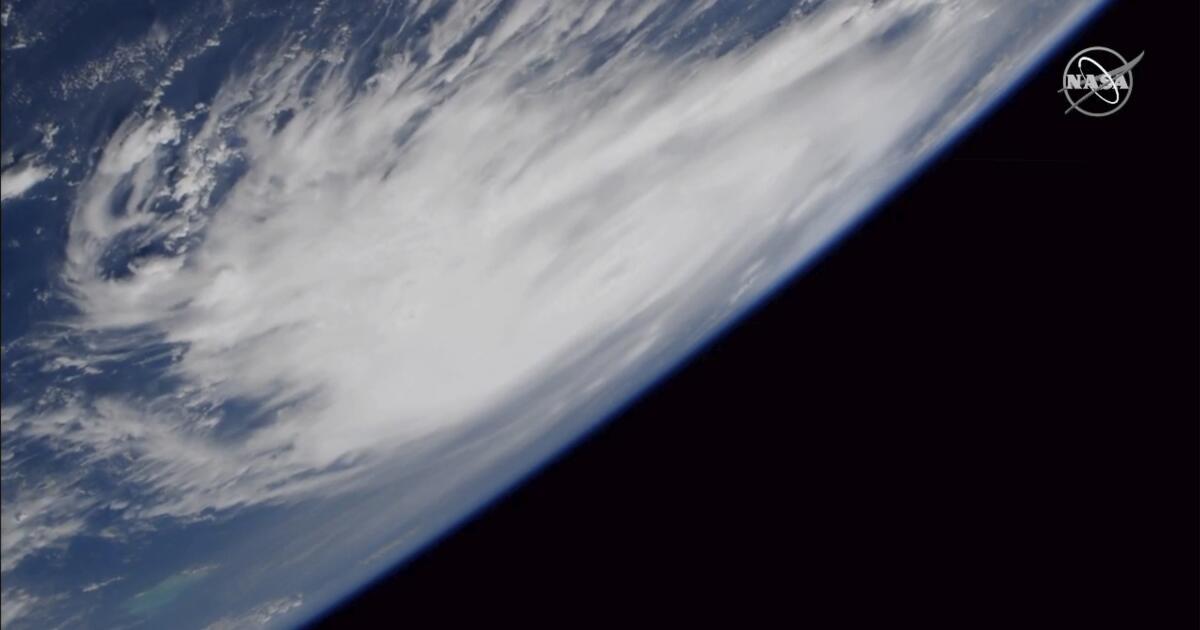
In 1973, the National Hurricane Center introduced the Saffir-Simpson scale, a five-category rating system that classified hurricanes by wind intensity.
At the bottom of the scale was Category 1, for storms with sustained winds of 74 to 95 mph. At the top was Category 5, for disasters with winds of 157 mph or more.
In the half-century since the scale’s debut, land and ocean temperatures have steadily risen as a result of greenhouse gas emissions. Hurricanes have become more intense, with stronger winds and heavier rainfall.
With catastrophic storms regularly blowing past the 157-mph threshold, some scientists argue, the Saffir-Simpson scale no longer adequately conveys the threat the biggest hurricanes present.
Earlier this year, two climate scientists published a paper that compared historical storm activity to a hypothetical version of the Saffir-Simpson scale that included a Category 6, for storms with sustained winds of 192 mph or more.
Of the 197 hurricanes classified as Category 5 from 1980 to 2021, five fit the description of a hypothetical Category 6 hurricane: Typhoon Haiyan in 2013, Hurricane Patricia in 2015, Typhoon Meranti in 2016, Typhoon Goni in 2020 and Typhoon Surigae in 2021.
Patricia, which made landfall near Jalisco, Mexico, in October 2015, is the most powerful tropical cyclone ever recorded in terms of maximum sustained winds. (While the paper looked at global storms, only storms in the Atlantic Ocean and the northern Pacific Ocean east of the International Date Line are officially ranked on the Saffir-Simpson scale. Other parts of the world use different classification systems.)
Though the storm had weakened to a Category 4 by the time it made landfall, its sustained winds over the Pacific Ocean hit 215 mph.
“That’s kind of incomprehensible,” said Michael F. Wehner, a senior scientist at the Lawrence Berkeley National Laboratory and co-author of the Category 6 paper. “That’s faster than a racing car in a straightaway. It’s a new and dangerous world.”
In their paper, which was published in the Proceedings of the National Academy of Sciences, Wehner and co-author James P. Kossin of the University of Wisconsin–Madison did not explicitly call for the adoption of a Category 6, primarily because the scale is quickly being supplanted by other measurement tools that more accurately gauge the hazard of a specific storm.
“The Saffir-Simpson scale is not all that good for warning the public of the impending danger of a storm,” Wehner said.
The category scale measures only sustained wind speeds, which is just one of the threats a major storm presents. Of the 455 direct fatalities in the U.S. due to hurricanes from 2013 to 2023 — a figure that excludes deaths from 2017’s Hurricane Maria — less than 15% were caused by wind, National Hurricane Center director Mike Brennan said during a recent public meeting. The rest were caused by storm surges, flooding and rip tides.
The Saffir-Simpson scale is a relic of an earlier age in forecasting, Brennan said.
“Thirty years ago, that’s basically all we could tell you about a hurricane, is how strong it was right now. We couldn’t really tell you much about where it was going to go, or how strong it was going to be, or what the hazards were going to look like,” Brennan said during the meeting, which was organized by the American Meteorological Society. “We can tell people a lot more than that now.”
He confirmed the National Hurricane Center has no plans to introduce a Category 6, primarily because it is already trying “to not emphasize the scale very much,” Brennan said. Other meteorologists said that’s the right call.
“I don’t see the value in it at this time,” said Mark Bourassa, a meteorologist at Florida State University’s Center for Ocean-Atmospheric Prediction Studies. “There are other issues that could be better addressed, like the spatial extent of the storm and storm surge, that would convey more useful information [and] help with emergency management as well as individual people’s decisions.”
Simplistic as they are, Herbert Saffir and Robert Simpson’s categories are the first thing many people think of when they try to grasp the scale of a storm. In that sense, the scale’s persistence over the years helps people understand how much the climate has changed since its introduction.
“What the Saffir-Simpson scale is good for is quantifying, showing, that the most intense storms are becoming more intense because of climate change,” Wehner said. “It’s not like it used to be.”
Newsletter
Toward a more sustainable California
Get Boiling Point, our newsletter exploring climate change, energy and the environment, and become part of the conversation — and the solution.
You may occasionally receive promotional content from the Los Angeles Times.